
Adopt Greyhound rescue dogs and puppies near you: A neutral guide to eligibility, care, and local options
People searching to adopt Greyhound rescue dogs and puppies near you generally need more than a list of names. Rescue records show substantial differences in age, temperament, prey drive, cat tolerance, training needs, health considerations, and household suitability. The following analysis explains how to interpret those differences and what prospective adopters can reasonably expect from regional rescue organizations.
What Greyhound rescue programs typically involve
The Greyhound Trust is described as a UK-wide charity with more than 50 volunteer-run branches supporting retired racing Greyhounds. Regional organizations, including Greyhound Rescue West of England, operate within defined areas, while Forever Hounds Trust focuses on Greyhounds and lurchers across the UK. These structures mean that local availability, assessment methods, and adoption procedures can vary by branch and region. 1
Many retired Greyhounds enter adoption after racing and may have limited experience of domestic life. Guidance supplied through the research material notes that household noises, appliances, stairs, leash routines, and indoor manners can require patient introduction. Post-adoption support is common among rescue organizations, reflecting the transition from kennel or racing environments to ordinary homes. 2
Examples of dogs and puppies in rescue records
Greyhound Pets, Inc. lists Alfie, a black male born in September 2019, weighing about 65 pounds and located in Woodinville, Washington. His record describes him as people-friendly and comfortable with Greyhounds, but unsuitable for small dogs because of vigorous prey drive. The organization identifies a quiet suburban or rural home with an enclosed yard as the preferred setting, illustrating why breed label alone does not determine suitability. 3
Some records involve younger dogs or mixes rather than typical retired racers. Minnesota Greyhound Rescue describes Tootsie as a Greyhound and Foxhound mix born in December 2023, still requiring house manners and basic obedience training. Danny and Stacey, both born in March 2024, are described as loving and intelligent but still puppy-like, with resource-guarding behaviors requiring experienced handling and restrictions involving young children. 4
Matching a dog to the household
Household compatibility should be assessed through the individual record rather than assumptions about Greyhounds as a breed. Kurt, a five-year-old male listed by Greyhound Rescue in Australia, is described as suitable with other dogs and children over five, but not cats. Penelope, a petite 50-pound female described by the Greyhound Adoption League of Texas, lived calmly with resident dogs and children, yet her prey drive made small animals inappropriate companions. 5
Other dogs require more restrictive arrangements. KC REGAP describes Tilly as an only-dog candidate for a home with older teenagers, despite her polite behavior around dogs during walks. Marlene, in foster care with Kent Greyhound Rescue, is described as affectionate and compatible with other dogs, but she has a heart murmur and needs protection from overexertion. These examples show why rescue assessments should be read in full. 6
Home preparation and everyday care
Greyhounds are widely characterized in the research as “45mph couch potatoes,” meaning their athletic history does not automatically translate into demanding daily exercise. Their short, smooth coats are generally considered low maintenance. Even so, adopters must account for safe outdoor access, controlled walks, quiet resting areas, and gradual exposure to household routines. An enclosed yard may be specifically required for an individual dog, as Alfie’s record indicates. 7
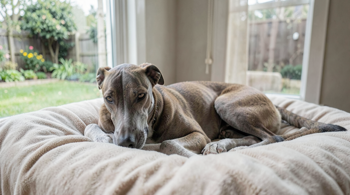
Newly rehomed dogs may need help understanding ordinary domestic signals, including televisions, vacuum cleaners, doors, stairs, and indoor schedules. Marlene’s foster information refers to gentle introductions and reassurance under a three-three-three settling principle, while Tilly’s history records that she initially had to learn stairs, leash walking, and toilet training. These cases demonstrate that calm behavior after adoption should not be presumed from kennel behavior alone. 8
Eligibility, screening, and welfare considerations
Prospective adopters in the UK are typically subject to a home check designed to assess whether the environment is safe and appropriate. Rescue organizations may also evaluate existing pets, children, fencing, lifestyle, and the adopter’s capacity to manage prey drive or behavioral concerns. The Greyhound Trust, Dogs Trust, Blue Cross, and RSPCA are identified in the research as sources of adoption or welfare guidance, but individual organizations retain their own procedures. 9
Health and behavior information can create practical constraints. Marlene’s heart murmur requires limits on exertion, while Danny and Stacey are associated with resource-guarding concerns and a recommendation for experienced ownership. Kurt is described as desexed, vaccinated, and microchipped, with an adoption fee of 395 Australian dollars. UK guidance places typical Greyhound adoption fees between 150 and 300 pounds, often covering veterinary preparation such as microchipping, neutering, and vaccinations. 10
Where local information is usually found
Local information may be distributed across national charities, regional rescue groups, foster networks, and specialist Greyhound organizations. The research identifies Battersea Dogs and Cats Home, the Kennel Club, Pets4Homes, Forever Hounds Trust, and Greyhound Rescue West of England as examples of organizations or resources connected with rehoming guidance. Their geographic coverage and intake patterns differ, so a nearby option may not have a dog at every point in time. 11
Individual pages also change status as dogs move into foster care, trial homes, or permanent adoption. Penelope’s record is marked “Home Forever,” and Biggy Pop’s Australian record is marked adopted, while Kurt is identified as being on trial. These statuses demonstrate why online records should be treated as time-specific information rather than a guaranteed inventory. The Greyhound Board of Great Britain provides welfare standards relevant to the racing-to-rescue transition. 12
Questions to resolve before adoption
Before making a decision, an adopter should establish whether the dog can live with cats, small dogs, children, or other Greyhounds; whether the home needs secure fencing; and whether the dog has lived indoors. Records may also identify shyness, separation behavior, resource guarding, medical monitoring, or a need for obedience training. Tootsie’s profile, for example, specifically recommends basic obedience education because she remains very much a puppy. 13
The central risk is an unsuitable match rather than a lack of affection. Greyhounds can be gentle and companionable, but prey drive, unfamiliarity with domestic settings, health limitations, and puppy energy can materially change daily care. A responsible process therefore weighs the dog’s documented needs against the household’s structure, experience, time, other animals, and ability to follow rescue guidance. This approach supports welfare for both the dog and adopter. 14
Sources
- Greyhound Trust, https://greyhoundtrust.org.uk
- Blue Cross, https://www.bluecross.org.uk
- Greyhound Pets, Inc., https://greyhoundpetsinc.org/available-dogs/
- Minnesota Greyhound Rescue, https://minnesotagreyhoundrescue.org/Project/tootsie/
- Greyhound Rescue Australia, https://greyhoundrescue.com.au/greyhound/kurt/
- KC REGAP, https://kcregap.org/greyhound-for-adoption/3792/
- Dogs Trust, https://www.dogstrust.org.uk
- Kent Greyhound Rescue, https://www.kentgreyhoundrescue.com/dogs/marlene-2/
- RSPCA, https://www.rspca.org.uk
- Greyhound Rescue Australia, https://greyhoundrescue.com.au/greyhound/kurt/
- Forever Hounds Trust, https://foreverhoundstrust.org
- Greyhound Board of Great Britain, https://www.gbgb.org.uk
- Minnesota Greyhound Rescue, https://minnesotagreyhoundrescue.org/Project/tootsie/
- Battersea Dogs and Cats Home, https://www.battersea.org.uk