3-day Edinburgh getaway with rail tickets and hotel stay 2026: An evidence-led planning report
A 3-day Edinburgh getaway with rail tickets and hotel stay in 2026 can combine a reserved-seat journey, two nights in the city, historic attractions, and either independent sightseeing or a guided excursion. The available research shows that dates, hotel location, rail-ticket conditions, and the choice between a city-focused itinerary and a Highlands tour materially affect the experience and total cost.
What a three-day Edinburgh package can include
Rail-based Edinburgh itineraries from London commonly use a return journey between London King’s Cross and Edinburgh Waverley, with reserved seating and approximately four and a half hours of travel each way. One published three-day itinerary includes two nights in a centrally located three-star hotel, breakfast, Edinburgh Castle admission, a hop-on hop-off sightseeing ticket, and a full-day Outlander filming-location tour. The listed adult figure is £899, although the page describes it as a starting amount rather than a fixed 2026 quotation. 1
Other rail-tour formats use Edinburgh as a base before allocating the second day to the Highlands. A published example combines two nights in a central hotel, castle entry, a 24-hour hop-on hop-off bus ticket, and a guided day covering Loch Ness, Inverness, Ben Nevis, and Glencoe. Its displayed starting figure is $1,235.45, and the research notes that the first and third days are largely self-guided. 2
Rail tickets and timetable considerations
LNER is identified as a principal operator for direct London King’s Cross to Edinburgh Waverley services, while ScotRail provides timetable and journey-planning information for rail routes within Scotland. Exact journey times, departure schedules, and fares depend on the selected date, so a comparison should be made for the intended 2026 travel dates rather than relying on a general estimate. 34
National Rail states that Advance tickets are sold in limited numbers and are normally valid only on the specific train printed on the ticket. This creates a trade-off: a dated reserved ticket may reduce the fare compared with more flexible options, but changing the departure can be difficult or subject to additional conditions. Railcard eligibility should also be checked, since National Rail lists Railcards as a potential source of fare reductions and the 16–25 Railcard applies only to qualifying travellers. 5
Choosing an Edinburgh hotel area
Edinburgh’s Old Town and New Town are the principal central areas identified for accommodation planning. Staying near these districts places major sights within walking distance, including Edinburgh Castle, the Royal Mile, Grassmarket, Princes Street, and the National Gallery. The research specifically advises examining the exact address rather than relying only on a star rating, because hill gradients, station access, and walking distances affect a short stay. 6
Accommodation pricing varies considerably by season and event demand. One Edinburgh guide gives indicative average hotel figures of £95 from January to March, £160 in May and June, £220 in July, and higher levels during August festival periods. It identifies May and June as comparatively mild months with medium crowds, while late August requires particularly early planning because availability can tighten substantially. 7
A city-focused three-day itinerary
Day one can centre on the Old Town: Edinburgh Castle in the late morning, a Royal Mile walk, St Giles’ Cathedral, Grassmarket, and either Real Mary King’s Close or an evening whisky-focused activity. A published itinerary prices the castle visit at approximately $28, a Royal Mile lunch at $22, an optional ghost tour at $26, and dinner with whisky tasting at $40. These figures are planning references, not guaranteed 2026 charges. 8
Day two can cover New Town, Princes Street Gardens, the Scott Monument, the National Museum or National Gallery, and the Leith waterfront. Day three can use Holyrood Park and Arthur’s Seat before continuing to Portobello Beach or North Berwick, followed by a sunset visit to Calton Hill. The route research assigns approximate daily totals of $75 to $85 for a basic sightseeing pattern and $180 to $200 for a mid-range pattern, excluding the main rail journey and accommodation. 8
Transport and attraction logistics
Central Edinburgh is walkable, but the terrain is uneven and includes steep streets. Lothian Buses provide city coverage and publish current fares, while Edinburgh Trams connect the airport with the city centre. A published local guide lists a Day Saver bus fare of £4.80, and airport-tram information should be checked against the current 2026 fare structure before arrival. 9
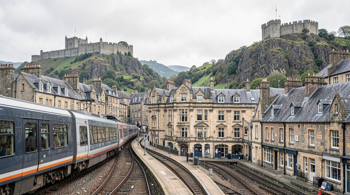
Edinburgh Castle is best treated as a timed anchor attraction because it occupies a prominent position on Castle Rock and contains several major historic features. The Palace of Holyroodhouse offers a contrasting royal site at the lower end of the Royal Mile, but opening arrangements can vary, making official visitor information important when assigning it to day two or day three. The official attraction pages provide the relevant ticket and visiting guidance. 10
Risks, trade-offs, and planning checks
The principal risk in a three-day rail itinerary is schedule rigidity. Advance rail tickets can be tied to one train, while a delayed departure, missed connection, or late attraction visit may disrupt the rest of the day. Guided Highlands or Outlander excursions also reduce flexibility because their routes cover multiple locations, including Midhope Castle, Doune Castle, Culross, Falkland, and Blackness Castle, within a fixed day. 111
A second risk is mismatch between the advertised structure and the traveller’s priorities. A city itinerary provides more control over museums, neighbourhoods, meals, and walking pace, whereas a Highlands day adds long-distance scenery and landmark stops but leaves less time in Edinburgh. Published research also notes that hotel quality can vary within a stated category and that package figures may change with dates, room type, availability, and traveller numbers. These conditions should be verified before any financial commitment. 212
Sources
- Travel Reference, “3 Days in Edinburgh: The Local Itinerary Beyond the Royal Mile”
- The England Guide, “Edinburgh, Loch Ness, The Highlands from London: 3 Day Rail Tour”
- LNER, “London to Edinburgh”
- ScotRail, “Timetables”
- National Rail, “Advance Tickets” and “Railcards”
- Forever Edinburgh, “Where to Stay”
- Travel Reference, seasonal Edinburgh planning data
- Hello Travel, “3 Days in Scotland: A Day-by-Day Itinerary”
- Lothian Buses and Edinburgh Trams, official transport information
- Historic Environment Scotland and Royal Collection Trust, official attraction information
- Backpacker Tours, “3 Day Edinburgh & Outlander Rail Tour from London”
- Goin2London, “Edinburgh, Loch Ness, The Highlands from London: 3 Day Rail Tour”