
Dental implant consultations for new patients near you in the UK: An evidence-based guide
For new patients looking for dental implant consultations near them in the UK, the first appointment is generally an assessment rather than a commitment to treatment. It may cover medical history, oral health, imaging, suitability, treatment stages, alternatives, risks and expected costs. Private consultations are widely available, while NHS implant treatment is usually limited to selected clinical circumstances rather than routine replacement of missing teeth. 1
What a first consultation normally involves
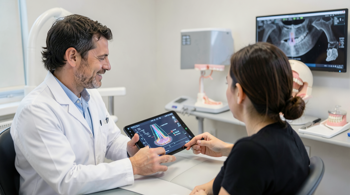
An implant consultation should begin with a discussion of missing teeth, general health, medicines, previous dental treatment and treatment objectives. The clinician may examine the teeth, gums, bite and jawbone, then explain whether a single implant, several implants, an implant-supported bridge, an implant-retained denture or a full-arch approach could be relevant. Assessment is necessary because implants are not suitable in every case. 6
Imaging can form part of the planning process. UK providers describe the use of digital scans, three-dimensional planning and, in some cases, CBCT imaging to assess anatomy and plan placement. The consultation should distinguish diagnostic work from surgery and explain whether scans, temporary teeth, laboratory work and follow-up appointments are included in the quoted treatment plan. 7
Finding providers in different parts of the UK
Patients in England can use the NHS dentist-finder service to identify nearby NHS practices, although a listed practice may not routinely provide implant treatment. Private providers commonly advertise implant consultations in local areas, including Sheffield, London districts such as Shoreditch, Edgware, Hanwell and Manor House, Lee in south-east London, Carlisle and Sudbury. These examples show geographic availability, not a quality ranking. 1 11 12
Online clinic directories can help identify practices by location and patient review information, but directory inclusion is not the same as clinical endorsement. A sensible comparison should establish who will place the implant, who will provide the crown or bridge, where imaging takes place, how referrals are handled and whether the consultation is conducted by the clinician responsible for treatment. 9
Eligibility, regulation and professional checks
Dental implants are elective in many situations, so suitability depends on the individual clinical assessment rather than age or a promotional headline. Factors discussed at consultation can include gum health, available bone, the condition of neighbouring teeth and relevant medical history. Where bone volume is insufficient, providers may discuss procedures such as bone grafting or a sinus lift, while alternatives should also be explained. 10 13
Patients can verify that a dentist is registered with the General Dental Council and check whether relevant specialist status appears on the GDC specialist lists. In England, the Care Quality Commission regulates and inspects dental services, so its registration and inspection information can provide an additional regulatory reference. These checks do not predict an individual outcome, but they support informed comparison. 3 4
Understanding consultation fees and treatment quotations
Published consultation and treatment charges vary substantially between practices and should not be treated as directly comparable. The total may depend on the number of implants, the type of crown or bridge, extractions, bone grafting, sedation, imaging, laboratory work and the complexity of restoration. UK dental information sources describe implant costs as dependent on the treatment required rather than a single national tariff. 8
Examples from provider information illustrate this variation. A Sheffield practice describes a consultation valued at £150 that includes a digital scan, while a North London practice lists a specialist consultation at £50. Other pages publish figures such as £1,995 for an Edgware implant case, £2,350 for a Hanwell single implant and crown, and a London package beginning at £1,580 for an implant and ceramic crown. These figures are provider-specific and may have conditions or exclusions. 11 13 14 16
Questions that expose differences between practices
A written plan should state the proposed implant system, the clinician responsible for placement, the restoration provider, the expected stages and the estimated timescale. It should also identify what happens if an extraction, temporary tooth, graft, additional scan or adjustment becomes necessary. Clear documentation helps patients distinguish a consultation assessment from the full cost of completing treatment. 6 7
- Ask whether the implant, abutment, crown, scan and laboratory charges are itemised.
- Ask who provides emergency care and routine reviews after placement.
- Ask what alternatives exist, including a bridge or denture where clinically appropriate.
- Ask how complications, implant failure or restoration repairs are managed.
- Ask whether finance information represents the full cost or only part of the treatment.
Provider descriptions show different service models. Some practices emphasise principal-dentist involvement, some describe specialist-led planning, and others highlight digital scans, same-day options for suitable cases or virtual consultations. Such features may affect convenience, but they do not remove the need to assess clinical suitability, maintenance requirements and long-term responsibility for the restoration. 15 17 18
Risks, maintenance and realistic expectations
Implants can restore function and appearance, but treatment involves surgery, healing and later restoration. The jawbone must integrate with the implant, and the final result depends on planning, oral hygiene, gum health, the restoration and ongoing professional care. A Carlisle provider describes digitally planned treatment and individual assessment, while a Sudbury practice presents single, multiple and full-arch treatment as separate clinical categories. 19 20
Maintenance does not end when the crown is fitted. Patients should clarify the recommended review schedule, cleaning technique, management of gum inflammation and arrangements for repairs or complications. NHS guidance indicates that implant treatment is not normally provided routinely, except in limited clinical circumstances, so patients considering private treatment should compare at least two suitably qualified providers, review the written quotation and allow time to consider alternatives before proceeding. 2 5
Sources
- NHS, How to find an NHS dentist
- NHS, Dental treatments
- General Dental Council, Specialist lists
- Care Quality Commission, Dentists
- National Institute for Health and Care Excellence, Guidance on dental implants for hypodontia
- Bupa Dental Care, Dental implants
- PortmanDentex, Dental implants
- Dentaly, Dental implants in the UK
- WhatClinic, UK dental implant clinics
- Oral Health Foundation, Dental implants
- Porterbrook Dental, Dental Implants in Sheffield
- The Modern Dentist, Dental Implant Treatments in Shoreditch
- Toothi, Dental Implants in Edgware
- Hanwell Smiles, Dental Implants in Hanwell
- New River Dental, Dental Implants in Enfield
- DentPlus Dental Clinic, Dental Implants in London
- Lee Dental and Implant Practice, Dental Implants in Lee
- Woodberry Down Dental, Dental Implants in North London
- Chiswick Street Dental Practice, Dental Implants in Carlisle
- Perfect Smile Clinic, Dental Implants in Sudbury