How to budget for full arch reconstruction and maintain long-term bone density preservation
Patients exploring how to budget for full arch reconstruction and maintain long-term bone density preservation frequently encounter a wide spectrum of price points and clinical recommendations that can be difficult to reconcile. Understanding both dimensions simultaneously, the financial and the biological, is essential because cost decisions made early in the planning phase directly affect which bone-preservation strategies remain viable throughout a patient's lifetime of care.
Understanding the True Cost Range of Full Arch Reconstruction
Full arch implant restoration costs between $20,000 and $50,000 per arch in the United States, with some complex zirconia restorations in major metropolitan areas reaching $65,000 per arch. 1 The variation is not arbitrary. It reflects the number of implants placed, prosthetic material selection, geographic practice location, and whether preparatory procedures such as bone grafting or sinus augmentation are required before surgery. A basic All-on-4 configuration using acrylic prosthetics in a suburban practice represents the lower end of this range, while a monolithic zirconia bridge requiring extensive pre-surgical bone work in a high-cost urban center sits at the upper boundary.
A 2024 study by the American Academy of Implant Dentistry found that 47% of patients seeking full mouth reconstruction were unaware of the true financial scope beyond the initial consultation fee, which frequently led to treatment delays or abandonment. 2 A complete treatment quote should itemize consultation, digital imaging, extractions if required, implant placement surgery, the provisional prosthesis, all follow-up visits, and the final custom restoration. Sedation fees, bone grafting, and gum disease treatment are additional line items that are often excluded from headline pricing.
Prosthetic Material Selection and Its Budget Implications
The choice of prosthetic material is the single largest cost variable within a full arch case. Acrylic prostheses sit at the lower end of the pricing spectrum, while zirconia restorations add $5,000 to $15,000 per arch compared to acrylic equivalents. 3 Clinical research published in BMC Oral Health, examining 250 edentulous patients over a mean follow-up of 3.6 years, found that prosthetic complications were significantly more frequent in the metal-acrylic group at 26.9% versus 8.9% in the zirconia group, a statistically significant difference. 4 This data point carries direct budgeting implications: a lower upfront material cost may translate into higher downstream repair and replacement expenditure over the life of the restoration.
Patients on bisphosphonate therapy for systemic bone conditions, such as osteoporosis, face an additional clinical layer. Research tracking 32 patients on alendronate therapy over three years reported an implant and prosthesis survival rate of 98.98% when treatment timing, minimally invasive technique, and strict hygiene protocols were carefully observed. 5 This demonstrates that systemic bone conditions do not automatically disqualify patients from full arch reconstruction, but they do introduce additional planning requirements that affect treatment timelines and costs.
Bone Density Preservation: The Biological Foundation of Long-Term Success
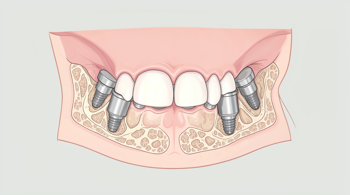
Alveolar bone resorption occurs at a rate of approximately 25% in the first year following tooth loss when no intervention takes place. 6 Implants address this by acting as artificial tooth roots that transmit occlusal forces into the jawbone during chewing, replicating the mechanical stimulation that natural teeth once provided. Traditional dentures, by contrast, rest on gum tissue and provide no such stimulation, which is why denture wearers experience progressive bone loss, facial structure changes, and increasingly poor prosthesis fit over time.
A finite element analysis study published in The Saudi Dental Journal in December 2025 identified that optimized All-on-4 implant configurations can reduce peak cortical bone stress by 32% compared to earlier design benchmarks, reaching a Von Mises stress value of 2.26 MPa. 7 Reduced cortical bone stress is directly associated with lower rates of marginal bone loss and improved long-term implant stability. A 12-year retrospective study from the University of Lisbon, tracking 111 patients treated with computer-guided All-on-4 protocols, recorded average marginal bone loss per implant of 1.19 mm at 10 years, with a 92.5% implant cumulative survival rate and a 96.2% prosthetic survival rate at 12 years. 8
Key Risk Factors That Accelerate Bone Loss and Undermine Budgets
Smoking is identified across multiple clinical sources as the single most modifiable risk factor for implant failure and accelerated bone loss. Smokers experience 3 to 5 times higher implant failure rates than non-smokers, and smoking has been documented to reduce osseointegration success by 15 to 20% while accelerating peri-implant bone resorption. 9 Patients who continue smoking after implant placement not only risk implant failure, requiring costly replacement procedures, but also undermine the bone-preservation mechanisms that justify the original investment in implant-based reconstruction over removable alternatives.
Bone quality at the surgical site is another variable with measurable cost and survival implications. A multicenter cohort study in BMC Oral Health found overall implant survival at 94.8% across bone types, but survival dropped significantly in Type 4 (lowest density) bone at 89.1% compared to 98.3% in Type 1 bone. 4 Patients with uncontrolled diabetes, classified as HbA1c above 8%, face significantly elevated implant failure risk and higher rates of peri-implantitis, an inflammatory condition that causes progressive bone destruction around implant fixtures. Pre-operative diabetes control is therefore a clinical prerequisite, not merely a recommendation, and its management may extend treatment timelines and add preparatory costs to the overall budget.
Financial Planning Frameworks and Maintenance Cost Projections
Financing structures available for full arch reconstruction include in-house payment plans, third-party healthcare lenders such as CareCredit, health savings accounts (HSAs), flexible spending accounts (FSAs), and buy-now-pay-later arrangements, many offering 0% promotional APR over 12 to 36 months. 10 Guided bone regeneration procedures, when required, add $2,000 to $5,000 to reconstruction costs but significantly improve long-term bone retention and implant success rates, making them a cost-effective addition when bone volume is marginal. 6
Long-term maintenance costs are a structural component of the total budget that patients frequently underestimate. Professional cleanings should occur every three to six months, and annual maintenance and monitoring costs for full arch reconstructions average between $500 and $1,500. 11 Over a decade, this represents $5,000 to $15,000 in maintenance expenditure that should be factored into total cost-of-ownership calculations. By comparison, conventional dentures require relining every one to two years at $300 to $600 per session, full replacement every five to eight years, and ongoing adhesive costs, with cumulative ten-year expenses potentially exceeding $10,000 while providing none of the bone-preservation benefits of implant-supported restorations. 12
Long-Term Maintenance Protocols for Bone Density Preservation
Peri-implantitis is the primary biological threat to bone density preservation after full arch reconstruction. It is an inflammatory condition affecting peri-implant tissues that, when unmanaged, causes progressive and irreversible crestal bone loss. Prevention relies on three interconnected protocols: daily home hygiene using interdental brushes, water flossers, and low-abrasive cleaning agents formulated for implant surfaces; professional maintenance appointments every three to six months that include subgingival debridement and prosthesis inspection; and periodic radiographic monitoring using panoramic X-rays or CBCT scans to detect early-stage bone changes before they become clinically significant. 13
Systemic support for bone mineral density is an often-overlooked dimension of long-term preservation strategy. Adequate dietary intake of calcium and Vitamin D is recommended to support systemic bone mineral density, which indirectly influences the health of the jawbone supporting implants. 14 For patients with established osteoporosis, bisphosphonate therapy and Vitamin D supplementation represent evidence-based pharmacological approaches to maintaining skeletal bone density during and after the reconstruction phase. Patients should inform both their dental team and their physician of all medications before treatment begins, as bisphosphonate therapy carries a documented, duration-dependent risk of osteonecrosis that requires careful management rather than blanket exclusion from implant candidacy.
Sources
- myspecialtydentist.com - Full Arch Implant Restoration Guide
- chairfull.org - Full Mouth Dental Implant Cost 2026 Guide
- myspecialtydentist.com - All-on-4 Cost per Arch in 2026
- link.springer.com - Medium-term clinical outcomes of the all-on-4 system in different bone types: a retrospective analysis, BMC Oral Health
- ohi-s.com - Study on 3-Year Clinical and Radiographic Outcomes of Implant-Supported Dental Prostheses in Patients on Alendronate
- Journal of Dental Research - Alveolar bone resorption rate following tooth loss
- link.springer.com - Enhanced implant longevity: Finite element optimization of all-on-four implant designs to minimize jawbone stresses, The Saudi Dental Journal
- researchportal.ulisboa.pt - Computer-Guided Flapless Immediate Function Dental Implants for Full-Arch Rehabilitations Using the All-on-4 Concept: A 12-Year Clinical and 10-Year Radiographic Retrospective Study
- dentalpedia.co - All-on-4 Full-Arch Implant Restoration: Evaluation to Long-Term Care
- vdentaltx.com - Cost Comparison: Dental Implants vs. Traditional Dentures
- British Academy of Restorative Dentistry - Annual maintenance and monitoring costs for full arch reconstructions
- myspecialtydentist.com - Dental Implant vs. Denture Cost Guide
- British Society of Periodontology and Implant Dentistry - Peri-implant diseases patient information
- National Institute for Health and Care Excellence (NICE) - Vitamin D and bisphosphonate therapy recommendations