How NHS dentistry affects implant prices: single tooth implants for seniors in 2026
Seniors across the UK investigating single tooth implants quickly encounter a defining reality: the NHS dental system, structured around banded charges and clinical necessity thresholds, does not routinely fund implant treatment. This structural gap between NHS provision and implant costs means that almost all older adults must navigate a private market where prices range from under £2,000 to over £4,000 per tooth, depending on region, clinical complexity, and what each quote actually includes. Understanding exactly how NHS policy creates that private pricing environment is essential for any senior planning implant treatment in 2026.
How the NHS Dental Band System Excludes Implants
NHS dentistry in England operates through three fixed band charges. As of April 2026, Band 1 covers examinations and preventive work at £27.90, Band 2 covers fillings, extractions, and root canals at £76.60, and Band 3 covers crowns, dentures, and bridges at £332.10. 1 These charges represent a per-course-of-treatment fee, not a per-item cost, and they are determined through NHS England commissioning arrangements and Units of Dental Activity contracts. 2 Dental implants fall entirely outside this banded structure because their component and laboratory costs alone typically reach £500 to £1,500, which cannot be absorbed within the NHS contract framework. 3
The consequence for seniors is direct. Over-60s in England must pay NHS band charges and do not receive free routine dental care unless they hold qualifying low-income benefit certificates. 1 More critically, because implants are classified as elective rather than clinically necessary for standard tooth loss, no NHS band charge covers them. Scotland provides free NHS dental examinations to all registered patients, but the exclusion of implants from NHS commissioning applies across all four UK nations as a baseline policy. 1
NHS Eligibility Criteria for Implant Funding in 2026
NHS England commissioning policy does fund implants in a narrow set of clinical scenarios, all managed through hospital oral and maxillofacial surgery budgets rather than high-street NHS dentistry. In 2026, the qualifying circumstances include oral or head and neck cancer reconstruction, severe facial trauma such as road traffic accident damage to the jaw, congenital absence of multiple teeth including hypodontia or cleft palate cases, severe atrophy of the lower jaw where conventional dentures cannot function, and failed conventional restorations in specific developmental conditions. 4 According to NHS Business Services Authority data, fewer than 5% of dental implant cases in the UK are NHS-funded. 3
For seniors, age alone creates no eligibility advantage or disadvantage. Hospital consultants assess bone quality, gum health, medical history, and whether conventional alternatives such as dentures or bridges are clinically adequate. If dentures or a bridge can restore function, NHS commissioning guidelines consider those options sufficient, regardless of a patient's preference for implants or the functional limitations they may experience with removable prosthetics. The referral pathway from GP or NHS dentist to hospital specialist and then to surgery is typically measured in 12 to 24 months, often longer. 5
Private Single Tooth Implant Prices for Seniors in 2026
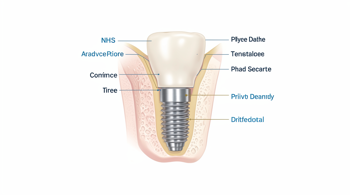
Because NHS funding is unavailable for routine tooth loss, senior patients face the full private cost structure. Based on data from 1,125 UK dental practices, the national median for a single dental implant is £2,500, with a range from £585 to £3,500 at the fifth and ninety-fifth percentile. 6 A more detailed component breakdown shows the titanium fixture at £800 to £1,500, the abutment connector at £200 to £500, and the porcelain or zirconia crown at £500 to £1,200. 7 Pre-surgical costs add further: an initial consultation and X-rays run £50 to £150, and a CBCT cone-beam scan costs £100 to £250. 3
| Component | Typical UK Cost (2026) |
|---|---|
| Initial consultation and X-rays | £50–£150 |
| CBCT scan (3D imaging) | £100–£250 |
| Implant fixture (titanium post) | £800–£1,500 |
| Abutment (connector) | £200–£500 |
| Crown (porcelain or zirconia) | £500–£1,200 |
| Bone graft (if required) | £400–£800 |
| All-in total without bone graft | £1,800–£3,500 |
Regional Price Variation Across the UK
Location is one of the most significant variables in private implant pricing, and this effect is particularly relevant for seniors who may have limited mobility or fixed travel budgets. Central London practices carry a median of £2,000 per implant, but Harley Street clinics commonly charge £3,000 to £6,000, roughly double the UK average, due to location costs and facility overhead. 8 The Midlands region shows a median of £2,545, and the North sits at a median of £2,500, both with ranges that reach £3,485 at the upper end. 6
| Region | Median Price | Range (P5–P95) |
|---|---|---|
| Central London | £2,000 | £595–£3,400 |
| Greater London | £2,400 | £520–£3,440 |
| South (excl. London) | £2,500 | £569–£3,500 |
| Midlands | £2,545 | £600–£3,500 |
| North | £2,500 | £612–£3,485 |
The price spread within Central London is the widest nationally, which reflects the high density of practices competing across different market segments. Very low-end quotes in any region, sometimes advertised below £1,000, almost universally reflect the fixture placement fee only, excluding the abutment, crown, scan, and post-operative care. 9 Seniors comparing quotes should confirm whether each figure represents a fully assembled single-tooth restoration or a component-only price.
Clinical Factors That Affect Implant Costs for Older Adults
Several clinical realities specific to older patients can push the final cost of a single tooth implant above standard market averages. Bone density loss is one of the most common. Without a tooth root stimulating the jawbone, measurable bone resorption begins within three to six months of tooth loss. 10 For seniors who have had a gap for several years, bone grafting may be required before implant placement. Bone graft procedures add £400 to £800 in typical cases, and if a sinus lift is also required, total additional costs can reach £1,500. 11
Medical history is assessed carefully for older implant candidates. Conditions including uncontrolled diabetes, severe osteoporosis, and certain cardiovascular medications can affect osseointegration, the process by which the titanium post bonds with the jawbone over three to six months. 12 Dentists typically require full health disclosure and may request correspondence with a patient's GP before proceeding. These additional clinical steps can extend the overall treatment timeline and may involve further consultation fees. Premium implant systems from brands such as Straumann and Nobel Biocare carry higher component costs than standard systems, potentially adding £500 to £1,000 per implant to the final figure. 13
Alternatives and Long-Term Cost Perspective
For seniors for whom implant treatment is not clinically viable or financially accessible, NHS-funded alternatives remain available. Dentures are provided under Band 3 at £332.10 in England and Wales, and dental bridges also fall within this band. 1 However, the functional and structural differences between these options and implants are clinically meaningful. Implants preserve jawbone by providing root-level stimulation, while dentures and bridges do not prevent ongoing bone resorption. Implants carry a reported 95 to 98% success rate over 10 years and a typical lifespan of 20 to 30 years, whereas dentures generally require replacement every 7 to 10 years and bridges every 10 to 15 years. 10
Private implant clinics commonly offer 0% APR finance plans spanning 24 to 60 months through Financial Conduct Authority-regulated lenders, bringing monthly payments into the £50 to £500 range depending on case complexity. 5 University dental schools, including those affiliated with Guy's, Manchester, Edinburgh, and Birmingham, sometimes offer implant placements at reduced rates supervised by qualified specialists, representing another route worth investigating. Patients should weigh total lifetime cost, not just upfront expenditure, when comparing implants against repeated denture or bridge replacement across a 20-year horizon.
Sources
- Dentist Cost UK – NHS Dental Costs Explained 2026: dentistcost.co.uk
- NHS England – NHS Dental Contract Information: england.nhs.uk
- MyDentalFly – Dental Implant Cost UK 2026: mydentalfly.com
- Dental Implant Quote – Dental Implants on the NHS in 2026: Who Actually Qualifies: dentalimplantquote.co.uk
- Dental Implant Quote – NHS vs Private Dental Implants UK: dentalimplantquote.co.uk
- TreatCompare – How Much Do Dental Implants Cost in the UK? 2026 Price Guide: treatcompare.com
- Pearlie Blog – How Much Do Dental Implants Cost in the UK? 2026 Price Guide: pearlie.org
- Dental Implant Quote – Dental Implants London: Harley Street and Beyond 2026: dentalimplantquote.co.uk
- Dental Implant Quote – How Much Do Dental Implants Really Cost in the UK in 2026: dentalimplantquote.co.uk
- Dentists Closeby – Missing Tooth Replacement Options UK Guide: dentistscloseby.com
- NHS Business Services Authority – NHS Dentistry: nhsbsa.nhs.uk
- Threadlifted – Dental Implants for Seniors in the UK: 2026 Costs and Options: threadlifted.com
- Smyleee – Low-Cost Dental Implants UK: NHS, Private and Tourism Tradeoffs 2026: smyleee.com