
Dental implant options after losing several teeth in the United Kingdom: A UK clinical and cost overview
Dental implant options after losing several teeth in the United Kingdom range from two-implant bridges to full-arch restorations supported by four to eight implants. The appropriate approach depends on the position and number of missing teeth, the health of the remaining teeth, jawbone volume, bite forces, medical history and personal priorities, rather than on the implant system name alone. 1
Implant-supported bridges for adjacent gaps
When several missing teeth are next to one another, an implant-supported bridge can replace the gap without placing one implant for every tooth. Two or three implants may support a bridge containing replacement teeth, including a middle pontic that rests between implanted supports. This can avoid preparing healthy neighbouring teeth for a conventional bridge, while providing a fixed restoration that is not removed for routine use. 2 3
| Situation | Possible arrangement | Planning issue |
|---|---|---|
| Two or three adjacent teeth missing | Two implants supporting a three-unit bridge | Implant spacing and bite forces |
| Four to six teeth missing in one area | Individual implants, an implant bridge or an implant-retained partial denture | Bone volume and remaining tooth health |
Individual implants and hybrid treatment
Individual implants may be considered where missing teeth are separated by healthy natural teeth or where each replacement needs independent cleaning and repair. An implant consists of a titanium fixture acting as an artificial root, an abutment and a visible crown. Where some natural teeth remain serviceable, a hybrid plan may preserve them and place implants only in the spaces that require replacement. 3 7
This approach can involve more surgical sites, crowns and appointments than a bridge, so the total treatment plan is influenced by tooth position, gum disease, bone condition and the desired restoration material. A clinical assessment should establish whether teeth with a poor prognosis should be retained, removed or treated before implants are planned. 2
Full-arch fixed implant restorations
For people who have lost all or most teeth in one jaw, a fixed full-arch bridge can be attached to a limited number of strategically positioned implants. All-on-4 uses four implants per arch, while All-on-6 uses six. All-on-8 uses eight and is described as an option where additional stability is required, including some cases involving a heavy bite or bruxism. The bridge is screwed into place and is not removable by the patient. 1
| System | Implants per arch | Indicative UK cost per arch |
|---|---|---|
| All-on-4 | 4 | £8,000 to £18,000 |
| All-on-6 | 6 | £10,000 to £22,000 |
| All-on-8 | 8 | £13,000 to £26,000 |
| Zygomatic implants | 2 to 4 in the upper jaw | £18,000 to £35,000 |
These figures are reported private-market ranges rather than quotations. Upper-jaw treatment can be more complex because of sinus proximity, varying bone anatomy and higher aesthetic demands. Severe upper-jaw bone loss may lead to discussion of zygomatic implants, but suitability requires specialist assessment and detailed imaging. 1
Removable implant-retained dentures
An implant-retained overdenture clips onto two to four implants per arch and remains removable for cleaning. It can offer more stability than a conventional denture while avoiding the permanently fixed design of a full-arch bridge. This distinction matters for hygiene, repairs, expectations about movement and the ability to remove the prosthesis at night or during professional maintenance. 4 6
| Restoration | Removable by patient | Indicative full-mouth private range |
|---|---|---|
| Implant-retained overdentures | Yes | £8,000 to £16,000 for both arches |
| Fixed All-on-4 bridges | No | £18,000 to £28,000 for both arches |
| Fixed All-on-6 bridges | No | £22,000 to £36,000 for both arches |
Assessment, bone requirements and treatment risks
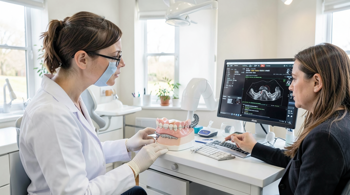
Planning normally includes an examination of the gums, remaining teeth, bite and general oral condition, together with dental X-rays and, for complex cases, a CBCT scan. Bone resorption can follow tooth loss, and insufficient volume may require bone grafting before implant placement. In the upper jaw, a sinus lift may also be discussed. Smoking, uncontrolled gum disease, poor cleaning and some medical conditions can affect eligibility or healing, so these issues should be documented before consent. 3 5
- Ask which teeth can realistically be retained and why.
- Check whether grafting, temporary teeth, sedation and follow-up are included in the written plan.
- Request a clear explanation of foreseeable surgical, mechanical and hygiene-related complications.
- Consider a second clinical opinion if only one treatment design is presented without reference to anatomy.
UK costs, NHS access and ongoing care
Private implant costs vary according to the number of implants, bridge or crown material, imaging, extractions, grafting, clinical complexity and practice location. Reported figures include approximately £1,800 to £4,500 for one implant and £15,000 to £50,000 for full-mouth treatment, while 20 to 28 individually placed implants may exceed £30,000. These are broad published ranges and should not be treated as fixed national tariffs. 4 7
Dental implants are primarily private treatment in the UK and are rarely available through the NHS except in exceptional clinical circumstances, such as particular cases involving trauma or cancer treatment. Patients should verify the dentist’s professional registration through the General Dental Council and consider information from professional bodies such as the British Dental Association or Association of Dental Implantology. Implants also require daily cleaning, professional reviews and maintenance of the bridge, denture components and surrounding gums. 8 9 10 12
Sources
- UK Dental Guide, “Full Arch Dental Implants UK 2026”
- Smile Dentist South Kensington, “Can You Get Dental Implants for Multiple Teeth?”
- Dental Implant Quote, “Single vs Multiple Dental Implants”
- Dental Implant Quote, “Dental Implants for Full Mouth”
- Dentists Closeby, “Missing Tooth Options UK”
- Dentists Closeby, “Dental Implants vs Dentures UK”
- Dentists Closeby, “Dental Implants Cost UK”
- NHS, “Dental treatments”
- General Dental Council, “Find a dentist”
- British Dental Association, patient resources
- Bupa Dental Care, dental implants guidance
- Association of Dental Implantology, patient information