
Home security installation: Comparing service packages: A consumer analysis
What service packages typically include
Home security packages generally combine a control hub, entry sensors, motion detection, an alarm, mobile-app access, and optional cameras. Starter kits commonly cover a hub, two door sensors, and one motion sensor, while larger packages add several sensors, a video doorbell, outdoor cameras, and smoke or carbon-monoxide detection. Equipment can be purchased as a fixed bundle or expanded with individual components as household needs change. 1
The main service distinction is monitoring. Self-monitoring usually sends app alerts to the homeowner, while professional monitoring routes alarm events to a response centre and may include escalation procedures. In the UK, monitored services commonly cost about £15 to £45 per month, with the upper end associated with broader response arrangements. Contracts for professionally installed systems commonly run from 12 to 36 months, and early termination charges may apply. 2
DIY installation and professional installation
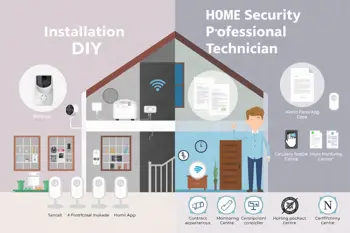
DIY systems are designed for homeowner installation, often using wireless sensors and adhesive mounts rather than permanent wiring. This reduces installation complexity and allows components to be repositioned or added later, but the homeowner remains responsible for sensor placement, network setup, battery replacement, and troubleshooting. Consumer guidance identifies DIY systems as a way to avoid installation charges and long-term commitments, although the level of technical support varies by provider. 3
Professional installation is more appropriate where a property needs hardwired equipment, extensive coverage, or a formal assessment of entry points. A site survey may identify ground-floor windows, back doors, garages, and other vulnerable areas before equipment is fitted. Professional-installation systems typically cost more than DIY alternatives and may require a contract, but the service can reduce configuration errors and transfer some maintenance responsibility to the installer. 4
Comparing package costs over time
Equipment price alone does not establish the financial difference between packages. A complete comparison includes hardware, installation, monitoring, cloud video storage, replacement batteries, and additional sensors over the expected service period. One buyer’s guide recommends comparing three-year total cost because recurring monitoring and storage charges can double or triple the initial hardware figure. 5
| Package element | Reported category range or structure | Comparison issue |
|---|---|---|
| Basic equipment | $100 to $200 | Usually limited sensor coverage |
| Mid-range equipment | $250 to $450 | May include several sensors and a doorbell camera |
| Comprehensive equipment | $400 to $800 | May include cameras and smoke or carbon-monoxide detection |
| Professional installation | $99 to $299 added labor estimate | Check whether wiring, surveys, and follow-up visits are included |
These published cost categories are market estimates rather than quotations for a particular property. Monitoring estimates range from $15 to $30 monthly for many DIY systems and $28 to $60 for some professionally installed services, while video storage can add $5 to $15 monthly. Regional pricing, equipment ownership, contract terms, and taxes can materially change the total. 6
Monitoring, connectivity, and response
Professional monitoring changes what happens after an alarm event. Self-monitoring depends on the homeowner receiving an alert, assessing it, and contacting emergency services where appropriate. A monitored service can follow an escalation process, but response is not identical across providers or jurisdictions. In the UK, police notification may require a Unique Reference Number and compliance with local alarm-response rules. 7
Connectivity is a central package difference. Some monitored plans include cellular backup so the alarm can continue communicating when broadband or home Wi-Fi fails. This does not eliminate every failure mode: power loss, poor cellular coverage, depleted batteries, damaged equipment, and incorrect contact details can still affect operation. Package comparisons should therefore identify the backup connection, battery duration, testing procedure, and escalation sequence rather than relying only on the phrase 24/7 monitoring. 8
Certification, insurance, and contractual limits
UK buyers may encounter NSI and SSAIB certification when comparing installers. These are the two primary certification bodies commonly referenced for security installation standards and insurance considerations. Insurers may treat certified alarm systems differently from unverified installations, but eligibility depends on the policy, the system specification, the installer’s status, and whether monitoring is maintained continuously. 9
Certification does not remove the need to inspect contractual terms. A package may require an approved installation, annual servicing, a maintained communications path, or particular alarm settings for insurance recognition. Professionally installed services can also include minimum contract periods and early termination fees. The relevant documents are the installation certificate, monitoring agreement, service schedule, equipment ownership terms, renewal provisions, and conditions that could invalidate an insurance requirement. 10
Smart-home features and maintenance realities
Many current systems connect security controls with lighting, locks, heating, thermostats, and voice-assistant platforms. This can centralise daily routines in one app, but compatibility should be checked at the device level rather than assumed from a general smart-home label. Integration may also depend on a subscription, a supported wireless standard, an internet connection, or continued compatibility after software updates. 11
Video storage is another recurring consideration. Some systems permit self-monitoring without a subscription, while recording history, advanced camera functions, or professional monitoring may require a paid plan. Data location, encryption, account security, camera access permissions, and the provider’s retention period affect privacy and resilience. A package with extensive cameras can therefore create more maintenance and data-management obligations than an alarm-only system, even when installation is straightforward. 12
Questions that distinguish similar packages
Package names often conceal meaningful differences in equipment, service boundaries, and long-term obligations. A structured comparison should record exactly what is installed, which components remain usable if monitoring is cancelled, and whether the customer or provider owns the equipment. It should also identify the cost of additional sensors, camera storage, replacement parts, servicing, relocation, and cancellation.
- Does the quoted installation include a site survey, drilling, wiring, testing, and user training?
- Does professional monitoring include cellular backup and defined escalation procedures?
- Are NSI or SSAIB credentials relevant to the intended insurance policy?
- What happens if broadband, power, batteries, or the provider’s cloud service fails?
- Are monitoring, storage, servicing, and contract charges fixed or subject to review?
- Can the system remain operational through self-monitoring after a contract ends?
The most suitable package depends on property layout, technical confidence, desired response arrangements, insurance conditions, and tolerance for recurring commitments. DIY installation prioritises control and expansion, while professional installation prioritises assessment and assisted setup. Neither model removes the need to verify coverage, connectivity, privacy controls, maintenance duties, and the full cost over the intended ownership period. 13
Sources
- Consumer Reports, “How to Pick a Home Security System”
- Expert Reviews, “Best Home Security System”
- PCMag, “The Best Smart Home Security Systems for 2026”
- The New York Times Wirecutter, “The 3 Best Home Security Systems of 2026”
- HomeGuard Review, “Home Security Buyer’s Guide 2026”
- CostPrism, “Home Security Cost Calculator 2026”
- Metropolitan Police Service, “How to Protect Your Home”
- MoneySuperMarket, “Alarm Systems and Home Insurance”
- Which?, “Best Home Security Systems”
- ADT UK, “Home Security”
- TechRadar, “Best Home Security Systems”
- Ring, “Security Systems”
- SimpliSafe UK, “How It Works”