NHS Hip Replacement Referral Criteria and Waiting Times 2026: A Data-Driven Patient Guide
Patients seeking NHS hip replacement surgery in 2026 face a pathway shaped by strict clinical eligibility thresholds, a national 18-week Referral to Treatment (RTT) standard that has not been consistently met since September 2015, and a regional patchwork of waiting times that can differ by more than 13 weeks depending on where a patient lives. 1 With England's overall elective waiting list standing at approximately 7.1 million treatment pathways representing around 6 million individual patients, orthopaedic procedures including hip replacement remain among the most heavily burdened specialties in the entire health service. 2
How the NHS Hip Replacement Referral Process Works
Access to NHS hip replacement begins with a GP assessment. When a GP and patient agree that specialist input is needed, the referral is processed through the NHS e-Referral Service (e-RS), which replaced the former Choose and Book programme. Patients have a legal right to choose where their first outpatient appointment takes place, and the NHS App or phone booking line can be used to select from a shortlist of eligible hospitals or clinics. 3 However, choosing a provider does not guarantee a shorter overall wait for surgery; it only governs where the initial consultation occurs.
To be considered for NHS hip replacement, patients must generally meet a set of clinical criteria. A confirmed diagnosis of hip osteoarthritis, hip fracture, or degenerative joint disease causing significant pain and functional limitation is required. Imaging evidence, typically X-rays or MRI confirming structural joint damage, is expected. Critically, candidates must also demonstrate that conservative treatments including physiotherapy, pain relief medication, corticosteroid injections, and lifestyle modification have been attempted and have not provided sufficient relief. NICE clinical guidelines establish that referral for surgical assessment is appropriate when conservative management fails and functional impairment materially affects daily activities. 4
The 18-Week RTT Standard and 2026 Performance Data
The NHS Constitution sets a standard that 92% of patients should begin consultant-led treatment within 18 weeks of referral. That benchmark has not been achieved nationally since September 2015. As of January 2026, only 61.6% of patients in England were beginning treatment within 18 weeks, far below the constitutional requirement. 5 In March 2026, performance improved marginally to 65.3%, described as the best result seen in several years, but still representing a 26.7 percentage point shortfall against the legal standard. The government has acknowledged the gap, pledging to restore the 92% standard by March 2029. 2
Monthly RTT waiting times data is published by NHS England and has been released continuously since March 2007, covering completed admitted pathways, completed non-admitted pathways, and incomplete RTT pathways where patients are still waiting at the end of the reporting period. The April 2026 release, published on 11 June 2026, provides the most current official dataset for monitoring elective care performance across all specialties including Trauma and Orthopaedics. 6
Current Hip Replacement Waiting Times by City and Region
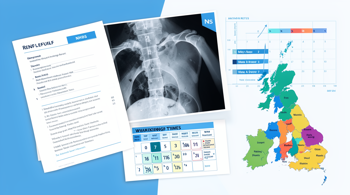
National median waiting time for NHS hip replacement surgery as of April 2026 stands at approximately 15 weeks, with the 92nd percentile wait reaching approximately 39 weeks, meaning one in twelve patients waits longer than nine months. 7 Regional variation is substantial. Analysis of NHS England RTT data by city reveals the following median waits across Trauma and Orthopaedics:
| City | NHS Median Wait | 92nd Percentile Wait | Patients Waiting | Seen Within 18 Weeks |
|---|---|---|---|---|
| Birmingham | 11 weeks | 38 weeks | 9,056 | 67% |
| Manchester | 14 weeks | 45 weeks | 25,874 | 57% |
| London | 13 weeks | 48 weeks | 48,252 | 56% |
| Leeds | 15 weeks | 46 weeks | 5,864 | 56% |
| Coventry | 16 weeks | 46 weeks | 5,780 | 56% |
| Leicester | 24 weeks | 50 weeks | 11,282 | 39% |
These figures reflect Trauma and Orthopaedics specialty-level data and are indicative of the trust catchment areas serving each city. Leicester, for instance, records a median wait 13 weeks longer than Birmingham, illustrating the postcode-level inequality embedded in current NHS performance. The total number of patients nationally waiting for hip replacement surgery is estimated at 237,020. 7 In Wales, conditions are more severe; Hywel Dda University Health Board recorded an average wait of 450 days (approximately 64 weeks) for elective hip replacement during the 2025/26 financial year, with 1,608 patients on the list as of May 2026. 8
BMI Referral Policies and the Postcode Lottery Controversy
A significant and contested dimension of NHS hip replacement referral criteria in 2026 concerns the use of Body Mass Index (BMI) thresholds. Analysis by Arthritis UK found that 31 out of 42 NHS Integrated Care Boards (ICBs) hold policies linking BMI to joint replacement access. Of these, eight ICBs, representing 19% of the total, are actively rationing procedures by setting defined BMI thresholds as a criterion for surgical referral. A further 23 ICBs have policies that encourage or mandate weight loss before a patient becomes eligible for surgery. 9
NICE explicitly advises against using BMI alone as a basis to exclude patients from referral for surgery, noting that available research only demonstrates significantly elevated operative risk at very high BMI levels. Arthritis UK has stated that these policies have been inappropriately applied to patients with BMIs as low as 35, affecting thousands of individuals who would otherwise qualify for surgery and benefit from meaningful reductions in pain and functional limitation. The charity's chief executive, Deborah Alsina, characterised the practice as unfair and inconsistent with the intent of national clinical guidelines. Only 11 of the 42 ICBs currently impose no restrictions on joint replacement access based on BMI. 9
Clinical Factors Considered During Surgical Assessment
Beyond the headline referral threshold, NHS orthopaedic assessment for hip replacement involves evaluating multiple factors. Pain severity, degree of functional limitation, documented failure of conservative management, radiological evidence of structural damage, and the patient's overall fitness for major surgery all inform the clinical decision. The NIHR-funded SCORE evidence synthesis, published in Health Technology Assessment in July 2026 and conducted across institutions including the Nuffield Department of Orthopaedics at Oxford, provides updated evidence on surgery for early structural osteoarthritis of the hip and knee, which is increasingly informing when earlier surgical intervention may be justified. 10
Clinically urgent cases, such as fractures or rapidly deteriorating conditions, follow different pathway classifications and are not subject to the same routine elective RTT timelines. For conditions such as femoro-acetabular impingement syndrome, specific ICB-level thresholds apply; for example, Norfolk and Suffolk ICB requires a confirmed FAI diagnosis with imaging, specialist assessment, at least six months of severe symptoms, and documented failure of conservative management including NSAIDs and physiotherapy before funding arthroscopic intervention. 11 These local variations reinforce the importance of understanding the specific policies of the ICB covering a patient's area of residence.
The Human and Clinical Cost of Prolonged Waiting
The WAIT-DATA study, a prospective multicentre audit of patients awaiting elective hip or knee arthroplasty across 14 UK hospitals, presented findings at the Scottish Committee for Orthopaedics and Trauma meeting in January 2026. Researchers found that prolonged waiting times for hip and knee arthroplasty are associated with deterioration in health-related quality of life, and that the lived experience of waiting remains poorly characterised in clinical literature. The study assessed patient satisfaction across nine domains of preoperative information and support and identified groups reporting the lowest levels of support during the waiting period. 12
NHS England reported that approximately 180,000 patients nationally were waiting longer than 52 weeks for elective treatment across all specialties as of 2026. 13 The orthopaedic backlog, which includes hip replacement, accounts for one of the single largest contributions to the overall elective waiting list. Regional trauma and orthopaedic waiting figures from February 2026 data show that the Midlands alone had approximately 173,000 patients waiting, followed by South East at 138,000 and North West at 118,000. 14 Greater Manchester ICB confirmed in a Freedom of Information response dated April 2026 that it commissions elective services in line with national RTT standards, with a minimum routine waiting period applied to Independent Sector Providers to support pathway management, while preserving allowances for clinically urgent cases. 15
Sources
- TreatCompare - Hip replacement surgery UK 2026: NHS Wait 15 Weeks vs Private (treatcompare.com)
- My Medical Gateway News - NHS Waiting Lists in 2026: What Patients Can Realistically Expect (news.mymedicalgateway.com)
- Orthopaedic Innovation - How to Get Ahead of the NHS Waiting List for Hip Replacement Surgery (orthopaedicinnovation.co.uk)
- NICE Clinical Guidelines CG176 / NHS.uk - Hip Replacement Referral Criteria (nice.org.uk / nhs.uk)
- Shifam Health - NHS Waiting Times for Hip and Knee Replacement in 2026 (shifamhealth.co.uk)
- GOV.UK / NHS England - Referral to Treatment Waiting Times Statistics for Consultant-Led Elective Care for April 2026 (gov.uk)
- TreatCompare - Hip replacement surgery UK 2026: NHS Wait and 92nd Percentile Data (treatcompare.com)
- Pembrokeshire Herald - Hywel Dda Patients Waited Average of 64 Weeks for Hip Surgery (pembrokeshire-herald.com)
- Yahoo News UK / The Sun - UK Patients Denied Joint Replacement Operations Because They Are Obese; Arthritis UK Analysis (uk.news.yahoo.com / thesun.co.uk)
- NIHR Journals Library - Surgery for Early Structural Osteoarthritis of the Hip and Knee: The SCORE Evidence Synthesis (journalslibrary.nihr.ac.uk)
- NHS Knowledge NoW - Hip Arthroscopy for Femoro-Acetabular Impingement Syndrome, Norfolk and Suffolk ICB (nwknowledgenow.nhs.uk)
- Bone and Joint - WAITING POORLY for Hip and Knee Arthroplasty: WAIT-DATA Study (boneandjoint.org.uk)
- Going Private UK - NHS vs Private: Hip Replacement Wait Times and Costs 2026 (goingprivateuk.co.uk)
- My Medical Gateway News - Cracking the NHS Waiting Times in Your Area, April 2026 (news.mymedicalgateway.com)
- Greater Manchester Integrated Care Partnership - FOI 2026/1705 Response on Referral Criteria and Minimum Waiting Periods (gmintegratedcare.org.uk)