
Tai chi wellness programs for older adults 2026: Evidence, formats, and safety considerations
Tai chi wellness programs for older adults in 2026 are being structured around balance, fall prevention, arthritis management, mobility, relaxation, and social participation. Documented examples include community classes, seated online sessions, and instructor-led courses based on established Tai Chi for Health models. 1
Documented 2026 program formats
University of Illinois Extension scheduled a 16-session Tai Chi for Arthritis and Fall Prevention series in Milan, Illinois, from August 3 through September 30, 2026. The one-hour classes were planned for Mondays and Wednesdays, with a full-series fee of $20, although registration was recorded as full. The stated objectives included improving balance, reducing pain, and supporting healthy aging. 1
Another Illinois Extension course in Murphysboro was scheduled from April 14 through June 4, with classes on Tuesdays and Thursdays. Participants were advised to attend at least 14 of 16 sessions because each lesson introduced additional forms. The program used Dr. Paul Lam's Tai Chi for Arthritis and Fall Prevention model, recognized by the CDC as evidence-based. 2
Fall prevention and functional movement
Connecticut Community Care describes Tai Ji Quan: Moving for Better Balance as a 24-week program meeting twice weekly for one hour. Its movements are designed to develop stability, strength, coordination, mobility, confidence, and everyday functioning while reducing fall risk. The organization reported opportunities during 2026 and 2027 for eligible organizations to receive training and authorization to implement the licensed model. 3
Healthy Aging NC listed a Conover, North Carolina, course running from April 6 through June 1, 2026, with Monday and Wednesday sessions. The program uses Sun-style tai chi because of its emphasis on relaxation, balance, and ease of use for older adults and people with arthritis. Teaching movements to both sides, with forward and backward turns, addresses weight transfer, strength, and mobility. 10
Arthritis, strength, and flexibility
Tai Chi for Arthritis programs are designed to use gentle, flowing movements that may help address arthritis-related pain and stiffness while developing flexibility, strength, stamina, and balance. Illinois Extension participant feedback cited improved stability, less pain, greater stamina, reduced fear of falling, better concentration, and increased social connection, but these reports were participant observations rather than controlled outcome measurements. 1
The Arthritis Foundation characterizes tai chi as a low-impact activity that can be adapted for people with arthritis. The relevant program design issue is progression: movements should be introduced gradually, performed with comfortable footwear and surroundings, and adjusted for individual range of motion. Tai chi should complement, rather than replace, clinical care, strength training, aerobic activity, or specialized falls-prevention services. 16
Seated, hybrid, and accessible delivery
Lifespan scheduled a Tai Chi for Health series in Montour Falls, New York, from April 7 through May 28, 2026. The 45-minute Tuesday and Thursday classes were described as suitable for all abilities and could be performed seated, standing, or through a combination of both. The stated aims included balance, flexibility, strength, heart and lung function, stress reduction, and mood support. 4
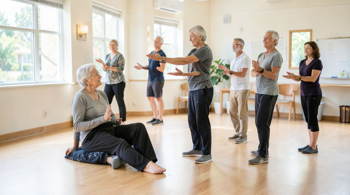
Lifespan also documented a seated Zoom course running Mondays from April 6 through May 18, with 30-minute sessions. The evidence-based program was adapted for people who needed or preferred seated participation and identified flexibility, range of motion, strength, sleep, mood, and physical, mental, and emotional wellbeing as relevant outcomes. Accessibility and interpretation services were available by advance request. 8
Community participation and program reach
Community delivery models in 2026 included senior centers, recreation facilities, county offices for aging, caregiver organizations, and online platforms. Lifespan listed an in-person Southport Recreation Center course in Pine City, New York, from April 1 through May 27, with 45-minute Wednesday sessions. The program welcomed different ability levels and incorporated standing or seated participation. 7
Georgia Health Matters described an eight-week, twice-weekly course beginning September 14, 2026, for members of a Cobb County Senior Wellness Center. It required no previous tai chi experience and used certified Tai Chi for Health instructors. Healthy Acadia reported a separate autumn schedule across Downeast Maine, using both in-person and online classes, with weekly one-hour sessions over eight weeks. 5 9
Safety, eligibility, and evaluation
NHS guidance states that older adults should remain active each day and perform activities supporting strength, balance, and flexibility on at least two days each week. Tai chi can contribute particularly to balance and flexibility, but program planners should assess whether participants also need aerobic or progressive strength exercise. People with significant mobility limitations, cardiovascular conditions, or high falls risk should seek professional advice before participation. 11
Providers should document attendance, adherence, falls, functional mobility, and participant-reported wellbeing when assessing a 2026 program. Safety procedures should include an initial assessment, gradual progression, seated or supported alternatives, stable footwear, clear floors, and referral pathways for complex health needs. National guidance supports individually tailored strength and balance work, while falls resources such as CDC STEADI can inform partnerships between healthcare and community services. 19 22
What participants can reasonably expect
Class structures vary from 30-minute seated online sessions to 45-minute community classes and 60-minute courses meeting once or twice weekly. Some programs require continuity because new forms are introduced progressively, while others emphasize adaptable movements for mixed abilities. Comfortable clothing and secure footwear are common practical requirements, and sandals or slides may be excluded where balance safety is a concern. 2 6
The National Center for Complementary and Integrative Health describes tai chi as a mind-and-body practice combining slow movements, gentle exercise, and focused breathing. The Tai Chi for Health Institute provides established instructor-led models, including arthritis and fall-prevention courses. In the United Kingdom, local delivery may involve leisure centers, voluntary organizations, care settings, primary-care referrals, or specialist older-adult exercise providers. 15 21 17
Sources
- University of Illinois Extension, Tai Chi for Arthritis and Fall Prevention, Milan
- University of Illinois Extension, Tai Chi for Arthritis and Fall Prevention, Murphysboro
- Connecticut Community Care, Tai Ji Quan: Moving for Better Balance
- Lifespan, Tai Chi for Health, Montour Falls
- Georgia Health Matters, Tai Chi for Arthritis and Fall Prevention
- Lifespan, Tai Chi for Health, Seneca County
- Lifespan, Tai Chi for Health, Southport Recreation Center
- Lifespan, Zoom Seated Tai Chi
- Healthy Acadia, Autumn Tai Chi for Health Schedule
- Healthy Aging NC, Conover Tai Chi for Arthritis and Fall Prevention
- NHS, Physical Activity Guidelines for Older Adults
- UK Government, UK Chief Medical Officers' Physical Activity Guidelines
- Cochrane, Exercise for Preventing Falls in Older People
- PubMed, Systematic Review of Tai Chi and Fall Prevention
- National Center for Complementary and Integrative Health, Tai Chi and Qi Gong
- Arthritis Foundation, Tai Chi for Arthritis
- Age UK, Tai Chi
- British Heart Foundation, Tai Chi
- British Geriatrics Society, Frailty in Older People
- British T'ai Chi Ch'uan Association
- Tai Chi for Health Institute
- CDC, STEADI Falls Prevention Initiative