
Dance fitness classes for active seniors 2026: A factual guide to formats, schedules, and safety
Dance fitness classes for active seniors in 2026 include low-impact choreography, modified Zumba, chair Zumba, line dancing, mindful movement, and creative dance. Published schedules show that these classes commonly emphasize balance, coordination, flexibility, social connection, and movement at an adaptable intensity. The documented examples span community centers, recreation facilities, senior centers, and online formats in the United States and Canada.
Documented class formats for older adults
Modified Zumba is one of the clearest recurring formats. San Diego’s Dance-Zumba class, scheduled from September 10 through December 17, 2026, is designed for active older adults and uses lower-intensity versions of familiar Zumba movements. Its stated focus includes balance, range of motion, and coordination, with Thursday sessions at Stockton Recreation Center for participants aged 18 to 99. 1
Other documented formats use different movement goals. Kettering Health describes Zumba Gold as lower-intensity dance exercise centered on cardio, coordination, and enjoyment, while a Barstow Senior Center listing presents Chair Zumba as a seated format involving simple dance movements, stretching, clapping, and swaying. These examples illustrate that “dance fitness” may mean standing, seated, or mixed movement rather than one standardized class type. 2 3
Examples of 2026 schedules and locations
Published 2026 listings show substantial variation in timetable structure. A San Diego senior dance and fitness class runs Sundays from June 7 through August 16 at Balboa Park Activity Center and is described for ages 55 to 99. Culver City’s Let’s Get Fit program runs Tuesdays, Thursdays, and Saturdays from September 1 through November 24, combining low-impact cardio with optional chair conditioning, bands, and light hand weights. 4 5
Several programs extend beyond a short seasonal course. The Dance Centre lists Creative Movement for Seniors on Mondays from September 14 through December 7 and on Wednesdays from September 16 through December 2, with separate in-person and hybrid arrangements. Indianapolis Municipal Gardens lists Sassy Seniors line dancing from September through December, using step-by-step instruction and group participation. Timetables, locations, and registration conditions should therefore be verified directly with each organizer because recurring event pages can contain exceptions or changed dates. 6 7 8
What active seniors may encounter in class
Class content ranges from choreographed aerobic movement to creative exploration. The San Diego senior class describes easy-to-follow routines set to upbeat music, with modifications intended to support different comfort levels and abilities. The Agoura Hills Jazzercise Lite listing describes a one-hour sequence involving gentle warm-ups, low-impact aerobics, muscle toning, stretching, and a cool-down, with participation available in person or through Zoom for people holding the stated senior membership. 4 9
Creative and mindful programs may place less emphasis on conventional cardio. West Harlem Arts Alliance describes Mindful Movement for adults aged 60 and older, combining gentle dance, music, mindfulness, and creative expression, with movement possible from a chair or while standing. The Dance Centre describes gentle stretching, contemporary and creative dance, coordination, rhythm, and a final stretch. No dance experience is required in either description, but individual class expectations still differ. 7 8
Accessibility, eligibility, and participation conditions
Eligibility is not uniform across the documented classes. The Balboa Park activity specifies ages 55 to 99, West Harlem Arts Alliance specifies adults aged 60 and older, and Indianapolis Municipal Gardens lists ages 62 to 69. Other listings use broad adult ranges. This means the word “senior” does not establish a universal age threshold. Venue access, seating, room layout, footwear requirements, and the ability to modify standing movements are important practical questions before participation. 4 7 10
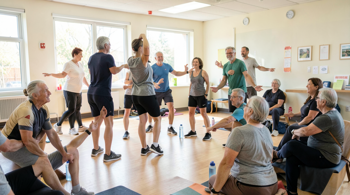
Registration and equipment requirements can also create participation barriers. Kettering Health states that its September Zumba Gold series requires registration and does not accept walk-ins. Culver City’s program mentions walking or running shoes, water, and optional one-to-three-pound hand weights, while the San Diego listings request a water bottle. These details indicate that accessibility involves more than choreography and should include transport, hydration, equipment, and communication arrangements. 2 5 4
Health guidance and potential risks
Public-health guidance for adults aged 65 and over recommends regular activity, reduction of prolonged sedentary time, and inclusion of aerobic, strengthening, balance, and flexibility activities. NHS guidance also advises older adults to build activity gradually and choose movement that reflects current fitness, mobility, and health conditions. Dance may contribute to several of these categories when the instructor adapts intensity and movement demands, but a dance class should not automatically be treated as a complete exercise plan. 11 12
Potential risks include falls, overexertion, unsuitable footwear, crowded spaces, and movements that aggravate an existing condition. Older adults beginning exercise after illness, injury, a fall, or prolonged inactivity are advised to consult a healthcare professional or qualified instructor. Questions about emergency procedures, chair options, balance support, and disability accommodations can identify risks before attendance. Dance to Health is specifically described as a structured dance-based falls-prevention program, which differs from a general recreational dance class. 13 14 15
How to assess a 2026 class objectively
Comparison should focus on documented suitability rather than marketing language. Relevant criteria include the class’s age range, intensity, seated and standing options, instructor qualifications, falls-prevention content, venue accessibility, timetable, registration process, equipment, and trial-session policy. Move It or Lose It describes seated, standing, and mixed exercise formats, while Later Life Training provides specialist education and resources for professionals working with older adults on strength, balance, mobility, and falls prevention. 16 17
- Check whether movements can be performed seated, standing, or with support.
- Confirm the venue, transportation access, restroom arrangements, and class duration.
- Ask how instructors adapt routines for balance, mobility, pain, or disability.
- Distinguish a general dance class from a structured falls-prevention program.
- Review registration, equipment, attendance, and cancellation conditions.
Oomph! describes music and movement programs for older people in care and community settings, while One Dance UK provides sector information relevant to dance participation and provision. These organizations represent different parts of the field, so their existence does not establish that every local class has the same training or safeguards. Local organizers remain responsible for accurate schedules, instructor information, accessibility details, and any applicable operating requirements. 18 19
Sources
- Active, Dance-Zumba, San Diego
- Kettering Health, Zumba Gold, Centerville
- Barstow Senior Center, Chair Zumba
- Active, Senior Dance and Fitness Class, San Diego
- Active, Let’s Get Fit, Culver City
- Access Alliance, Seniors’ Gentle Fitness
- West Harlem Arts Alliance, Mindful Movement
- The Dance Centre, Creative Movement for Seniors
- Active, Jazzercise Lite, Agoura Hills
- Active, Sassy Seniors Line Dancing, Indianapolis
- NHS, Physical activity guidelines for older adults
- GOV.UK, UK Chief Medical Officers’ physical activity guidelines
- Age UK, Exercise and staying active
- Dance to Health
- Move It or Lose It
- Later Life Training
- Oomph! Wellbeing
- One Dance UK