
8 day river cruise from Vienna to Bucharest: Route, Timing, and Practical Realities
An 8 day river cruise from Vienna to Bucharest is generally presented as a Danube passage through several countries, although published itineraries vary in length, port order, and the location used for embarkation or disembarkation. Comparable journeys include Budapest, Belgrade, Vidin, the Iron Gates, and a land transfer associated with Bucharest. 1 2
Route structure and duration
The phrase “8 day” can describe either eight nights or a programme combining hotel accommodation with a shorter cruise. One Celebrity itinerary, for example, is described as seven cruise nights plus one hotel night in Bucharest, with the ship departing from Oltenita rather than central Bucharest. 6 Other Vienna to Bucharest listings are longer, including a nine-night Amadeus Mira itinerary and a 13-night extension, showing that the same geographic corridor is sold in several formats. 1 5
The river route follows the Danube downstream from Austria toward Hungary, Serbia, Bulgaria, and Romania. A cruise-search overview lists a sequence including Vienna, Bratislava, Budapest, Mohacs, Vukovar, Novi Sad, Belgrade, Golubac, Vidin, Ruse, Constanta, and Bucharest, while other itineraries use fewer calls or substitute nearby ports. 4 Consequently, an eight-day schedule normally prioritizes major highlights rather than providing extended time in every destination.
Typical day-by-day pattern
Vienna commonly occupies the beginning of the programme, sometimes with an overnight stay before sailing. Published descriptions emphasize the city’s museums, concert venues, historic coffeehouses, wine bars, Ringstrasse, and classical cultural identity. Bratislava may follow as a guided capital-city visit, with references to the National Theater, St. Martin’s Cathedral, Michael’s Gate, and the city’s castle district. 2 This opening segment combines urban sightseeing with the transition from Austria into Slovakia.
Downstream schedules often place Budapest, Vukovar, Belgrade, and Bulgarian ports such as Vidin or Ruse at the centre of the voyage. TourRadar’s Danube Serenade itinerary identifies guided Bratislava sightseeing and later calls including Belgrade, while Celebrity lists Ruse, Vidin, Donji Milanovac, Golubac, Belgrade, Vukovar, and Mohacs before Budapest in the reverse direction. 2 6 The exact daily sequence depends on sailing direction, water levels, and the operator’s port plan.
Principal cultural and scenic highlights
Belgrade provides a historical focus through sites such as Belgrade Fortress and the Nikola Tesla Museum, with the Skadarlija neighbourhood identified as a cultural area associated with traditional kafanas. 1 Budapest contributes a major capital-city stop, while Bratislava offers a smaller-scale historic centre described through castles, clock towers, cathedral architecture, and Michael’s Gate. 2 These stops are generally experienced through organised walking or panoramic tours rather than independent multi-day stays.
The Iron Gates is the principal scenic passage associated with the Lower Danube. The gorge forms a dramatic river corridor between Serbia and Romania, and itineraries may combine scenic sailing with a shore visit at Donji Milanovac or Golubac. Celebrity specifically identifies the Iron Gates as a scenic segment, while Amadeus describes the route as passing through the gorge during its longer Danube programme. 6 5 Romania’s Bucharest is frequently connected to the river port by road transfer.
Ships, cabins, and onboard experience
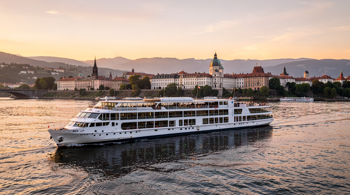
Published vessel information varies substantially by operator. The Filovent programme describes a river boat with 90 cabins, capacity for 180 travellers, and 33 crew members. Its cabin categories include upper, middle, and main decks, with panoramic sliding windows on some upper-deck rooms and high windows on lower decks. 3 These distinctions matter because “river-view cabin” does not necessarily mean the same window size, deck position, or degree of visibility across different ships.
Amadeus positions its fleet as an established Austrian-owned operation with more than 30 years of history, while Scenic describes its river vessels as luxury ships offering panorama lounges, terraces, spas, spacious cabins, and private butlers. 1 5 Such descriptions indicate a broad range of onboard models, from conventional guided group cruises to higher-service formats. Cabin accessibility also requires separate checking, since one published vessel specification identifies a dedicated reduced-mobility category. 3
Meals, excursions, and language arrangements
Organised excursions are a central feature of the itineraries in the research material. TourRadar describes a fully guided, low-intensity group programme conducted in English, with German and Spanish available on request. Its Vienna and Bratislava days include meals and guided city activities, while the itinerary also records a welcome cocktail and a panoramic Vienna tour. 2 This structure suits travellers seeking scheduled sightseeing, but it leaves less flexibility than an independently planned land journey.
Meal arrangements differ by programme and day. The published Danube Serenade schedule records dinner on arrival and breakfast, lunch, and dinner on subsequent sailing days. 2 Celebrity’s itinerary includes one hotel night in Bucharest and a shore excursion, while Amadeus describes hotel accommodation, airport collection, welcome dining, and transfers in its longer 11-day version. 6 5 Travellers should therefore distinguish cruise inclusions from optional excursions, transfers, and pre- or post-cruise accommodation.
Transfers, scheduling risks, and suitability
Bucharest is not consistently the vessel’s physical endpoint. Published programmes refer to Oltenita, Fetesti, Turnu Magurele, or another river access point, followed by road transportation to the Romanian capital. 1 2 6 This creates a practical distinction between the advertised city and the actual port. Flight timing, hotel location, luggage handling, and transfer duration should be checked as separate elements rather than assumed from the headline route.
Water conditions and operational changes are material considerations on any long river itinerary, particularly when a short eight-day schedule has limited recovery time. Port calls can also be abbreviated, and a listed destination may involve a coach excursion from a nearby berth. The research shows considerable variation between eight-night, nine-night, 11-day, 13-night, 16-night, and 17-night programmes. 1 4 5 The route is therefore most suitable for travellers who value a structured overview of the Lower Danube and accept itinerary variation.
Sources
- World of Cruising, “Vienna to Bucharest, 9 nights, on board AMADEUS Mira”
- TourRadar, “Danube Serenade: Romantic Journey from Vienna to Turnu Magurele (Bucharest), MS Fidelio”
- Filovent, “From the Blue Danube to the Black Sea, from Vienna to Bucharest”
- Cruise Critic, “Best Cruises from Vienna to Bucharest 2026-2028”
- Amadeus River Cruises, “1.200 Miles on the Beautiful Blue Danube”
- Celebrity Cruises, “Danube, One Night Included Hotel Bucharest to Budapest”