
Tennis elbow recovery: physiotherapist-recommended exercises and support | Clinical evidence and practical guidance
Tennis elbow recovery commonly involves physiotherapist-recommended exercises and support for pain during gripping, lifting or wrist movement. The condition is usually a load-related problem affecting the wrist extensor tendons on the outside of the elbow, and rehabilitation typically combines activity adjustment with gradual strengthening rather than complete rest.
What tennis elbow means
Tennis elbow, more precisely called lateral elbow tendinopathy or lateral epicondylalgia, affects the tendons connecting the forearm extensor muscles to the outer elbow. The extensor carpi radialis brevis, or ECRB, is frequently involved because it helps stabilise the wrist during gripping and lifting. Despite its name, the condition is not limited to tennis players and can follow repeated work, household, typing or gym activities. 1
Symptoms commonly include tenderness over the bony prominence on the outside of the elbow, aching into the forearm and reduced grip tolerance. Turning a doorknob, shaking hands, lifting a cup or extending the wrist can reproduce discomfort. Modern clinical descriptions generally treat the problem as tendinopathy rather than a simple inflammatory injury, so anti-inflammatory strategies alone do not restore the tendon’s capacity for load. 2
How physiotherapy approaches recovery
Physiotherapy usually begins with an assessment of the painful movement, grip strength, work or sport demands and recent changes in activity. The plan may temporarily reduce the most aggravating tasks while preserving tolerable movement. Education is important because prolonged passive rest can leave the tendon less prepared for normal demands, whereas carefully graded loading is intended to rebuild strength and confidence. 3
A therapist may also examine the neck, shoulder, nerves and elbow joint when symptoms are unusual or fail to follow the expected pattern. Manual techniques can provide short-term symptom relief for some people, but exercise remains central to longer-term rehabilitation. A practical progression often moves from low-load contractions to resisted wrist and forearm work, followed by task-specific return to work, recreation or sport. 4
Exercises commonly used in rehabilitation
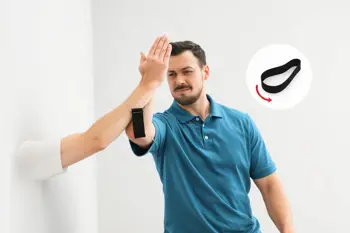
Wrist-extensor strengthening is a common foundation. With the forearm supported and the wrist near the edge of a surface, the person may lift the hand through extension using the unaffected hand for assistance, then lower slowly under control. As tolerance improves, resistance can be added with a light weight, resistance band or specialised flexible bar. Eccentric and concentric loading may both be used, depending on assessment findings and symptom response. 5
Exercise dosage should be individualised rather than copied rigidly. A clinical exercise guide describes strengthening sets in the range of two sets of 12 to 15 repetitions, while other rehabilitation plans begin with isometric contractions or fewer repetitions when pain is more irritable. The important principle is gradual progression without a substantial or lasting flare-up. Sharp worsening, increasing weakness or pain that remains elevated after exercise indicates that the load may need adjustment. 6
Pain monitoring and activity modification
Temporary modification does not necessarily mean stopping every activity. Common adjustments include reducing forceful gripping, avoiding prolonged wrist extension, changing tool or racquet technique, taking breaks from repetitive work and distributing loads between both arms where practical. The NHS approach also emphasises reducing provoking activities and using simple symptom measures while recovery develops. 7
Pain during rehabilitation should be interpreted alongside function and the following day’s response. A mild, manageable discomfort may be acceptable in a graded programme, but exercises should not be used to push through marked pain. Returning suddenly to heavy lifting, repeated backhand strokes or high-volume manual work can exceed current tendon capacity. A slower increase in duration, resistance and frequency allows the rehabilitation plan to reflect actual tolerance. 8
Supports, heat and other symptom measures
A counterforce elbow strap or wrist splint may reduce strain during selected activities for some people. These devices are supportive tools rather than a replacement for strengthening, and their suitability depends on comfort, task demands and whether wrist movement is being unnecessarily restricted. A brace that causes numbness, swelling or increased pain should not be continued without professional review. 9
Ice or heat can offer short-term comfort, but neither method is expected to rebuild tendon capacity. Massage and other hands-on treatments may also help symptoms temporarily, yet passive care alone is less likely to address the underlying tolerance problem. Corticosteroid injections require particular caution: evidence indicates that they can provide short-term relief but may produce less favourable longer-term outcomes than physiotherapy or observation. 10
Recovery times, risks and when to seek assessment
Improvement is often gradual and may take weeks to months, depending on symptom severity, workload and the tendon’s ability to tolerate progressive exercise. Many cases improve without surgery, but recurrence is possible when activity increases faster than strength and endurance. Persistent symptoms after a structured six-to-eight-week exercise period, worsening pain or uncertainty about the diagnosis are reasons to arrange assessment by a physiotherapist or doctor. 1
Prompt medical assessment is appropriate after significant trauma or when pain is accompanied by marked swelling, redness, fever, loss of movement, numbness or clear weakness. These features may indicate a condition other than typical lateral elbow tendinopathy. Clinical guidance also supports further evaluation when symptoms spread, remain atypical or fail to respond to conservative care. Imaging, specialist review or other interventions may then be considered according to the examination findings. 2
Sources
- CK Physio, “Tennis Elbow Physiotherapy: Evidence-Based Exercises & Treatment Guide,” https://ckphysio.co.uk/blog/5-physiotherapy-exercises-tennis-elbow-rehabilitation
- NHS, “Tennis elbow,” https://www.nhs.uk/conditions/tennis-elbow/
- Chartered Society of Physiotherapy, “Tennis elbow,” https://www.csp.org.uk/conditions/tennis-elbow
- ChoosePT, “Physical Therapy Guide to Tennis Elbow,” https://www.choosept.com/guide/physical-therapy-guide-tennis-elbow
- Quincy Physical Therapy, “Managing Tennis Elbow,” https://quincypt.com/managing-tennis-elbow-lateral-epicondylitis/
- Cleveland Clinic, “8 Tennis Elbow Exercises and Stretches,” https://health.clevelandclinic.org/tennis-elbow-exercises
- NHS, “Tennis elbow,” https://www.nhs.uk/conditions/tennis-elbow/
- The BMJ, “Tennis elbow,” https://www.bmj.com/content/341/bmj.c6767
- Versus Arthritis, “Tennis elbow,” https://www.versusarthritis.org/about-arthritis/conditions/tennis-elbow/
- Cochrane Library and JAMA Network, corticosteroid injection evidence, https://www.cochranelibrary.com/cdsr/doi/10.1002/14651858.CD003524.pub2/full