
65+ Dental Implant Planning: What the Timeline Usually Looks Like and Options in 2026
Many adults over 65 approach implant consultations believing their age is the primary barrier to treatment. Clinical evidence from 2024 to 2026 consistently shows otherwise: success rates for patients aged 65 to 85 remain between 94% and 98%, which is virtually identical to outcomes in younger adults. 1 A 2025 systematic review of nearly 4,000 implants confirmed a five-year survival rate of 96.8% among patients aged 75 and older, while those aged 65 to 75 recorded a 92.1% five-year survival rate. 2 What clinicians actually assess is bone density, gum condition, systemic disease management, and medication profile, not a birthdate.
Why Age Is Not the Deciding Factor
The FDA does not set an upper age limit for dental implants, and no peer-reviewed clinical threshold exists beyond which age alone disqualifies a patient. 1 Research published in the International Journal of Oral and Maxillofacial Implants confirms that well-selected older adults achieve implant success rates comparable to patients decades younger. What does introduce complexity for the 65-plus population is the higher statistical likelihood of certain co-occurring conditions: reduced jawbone volume from prior tooth loss, uncontrolled diabetes, bisphosphonate or blood-thinner use, osteoporosis, and reduced manual dexterity for home care. 3
Critically, most of these conditions are manageable rather than absolute contraindications. Well-controlled diabetes with an HbA1c under 8%, managed hypertension, and even osteoporosis do not disqualify a patient; the operative word is controlled. 1 Smoking, by contrast, dramatically reduces success rates and requires honest discussion at the planning stage. An active, healthy 80-year-old may present a stronger clinical profile than a 55-year-old with uncontrolled metabolic disease and significant bone loss. 3
The Evaluation Phase: What a Senior Assessment Actually Involves
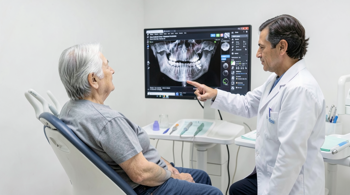
The first clinical appointment for a 65-plus candidate goes beyond a routine dental examination. CBCT (cone beam computed tomography) scanning is now standard, producing a three-dimensional map of jawbone height, width, cortical thickness, and trabecular density at the intended implant site. 4 This imaging determines whether sufficient bone exists for primary implant stability and flags the proximity of nerves and sinuses that would affect surgical planning. Digital treatment planning software then allows the clinician to simulate implant positioning before any surgical step begins. 5
Alongside imaging, a thorough medical and medication review is completed. Bisphosphonates, widely prescribed for osteoporosis in older adults, can impair bone healing and require specific protocols or physician consultation before surgery. 3 Blood thinners affect surgical management. Renal or liver disease influences bone metabolism. This pre-treatment mapping phase typically takes one to two appointments and is the foundation on which the entire subsequent timeline is built. AI-assisted analysis of CBCT data, which flags bone volume concerns and optimizes implant positioning automatically, is becoming a standard planning tool in 2026. 6
The Standard Timeline for 65+ Patients: Phase by Phase
For a senior patient with adequate bone density and no tooth requiring extraction, the overall timeline from initial consultation to final crown placement typically runs four to seven months. 7 Osseointegration, the phase during which the titanium post fuses with the jawbone, accounts for the longest single period: three to six months. 8 This phase cannot be shortened without risking implant failure, and for patients aged 70 to 79, clinicians generally anticipate the upper end of that range, approximately six to seven months total healing. 9
| Age Group | Typical Success Rate | Expected Healing Duration | Key Planning Considerations |
|---|---|---|---|
| 65 to 69 | 95 to 97% | 5 to 6 months | Good bone likely; more medications to review |
| 70 to 79 | 93 to 96% | 6 to 7 months | Slower healing; more advanced bone loss possible |
| 80 and older | 90 to 95% | 7 to 8+ months | Careful candidate selection; multiple medications common |
When bone grafting is required, the timeline extends substantially. A graft must fully consolidate before the implant post can be placed, adding three to six months to the process. 8 Combined with post-placement osseointegration, a patient requiring grafting should anticipate a total treatment arc of seven to fourteen months. Sinus lift procedures, used when the upper jaw has insufficient vertical bone height, carry similar timeline implications. 5
Implant Options Available to Seniors in 2026
The implant landscape for older adults in 2026 is broader than it was even five years ago. For a single missing tooth, a standard endosteal implant with a ceramic or zirconia crown remains the most common approach. For patients missing most or all of their teeth, All-on-4 and All-on-6 full-arch techniques use four to six strategically placed implants to support a complete fixed arch, reducing both the number of surgical sites and the overall treatment duration compared to restoring each tooth individually. 10 Full-arch treatment, including healing, typically completes in six to nine months. 11
Immediate-load implants, sometimes referred to as same-day teeth, are available for carefully selected seniors who have sufficient primary bone stability. A temporary restoration is fitted on the same day as post placement, avoiding the gap-in-smile period during osseointegration. 12 Mini implants represent a narrower-diameter alternative that may be appropriate for patients with moderate bone volume who are not candidates for conventional-width posts. Implant-supported dentures, which clip onto two to four implants for stability while remaining removable, occupy a middle ground: they eliminate denture slippage and stimulate bone preservation without requiring the bone volume needed for a fully fixed arch. 10
Risks, Complications, and Ongoing Maintenance Realities
Peri-implantitis, an inflammatory condition affecting the tissue and bone around an implant, is the most significant long-term risk factor for all implant patients and is more consequential in seniors because bone resorption is already a concern. Quarterly professional cleanings, rather than the standard biannual schedule, are frequently recommended for older adults with implants to reduce this risk. 3 Reduced manual dexterity or mobility challenges can make effective home care more difficult and should be addressed in the planning conversation, including the possible recommendation of powered interdental tools or water flossers.
Implant failure, when it does occur, is most strongly associated with poor oral hygiene, uncontrolled diabetes, and active smoking, not chronological age. 1 A study comparing patients over 65 with younger cohorts found only a 2% failure rate across both groups over a ten-year period. 13 Longer-term data shows implants achieving a 97% success rate at ten years and 75% at twenty years, making them more durable than bridges or dentures when maintenance is sustained. 13 However, patients should have realistic expectations: the post-surgical recovery period, including dietary restrictions and reduced activity, typically runs two weeks for visible healing, with complete bone integration taking months. 14
Coverage, Costs, and Financial Planning Context
Original Medicare in the United States does not cover dental implants in 2026, leaving seniors to fund treatment through Medicare Advantage dental riders, private dental insurance, or out-of-pocket payment. 2 In the United Kingdom, NHS treatment does not routinely include implants; private costs generally range from approximately £2,000 to £3,500 per single implant tooth, while full-arch solutions run from £15,000 to £30,000 depending on complexity. 15 In the United States, single-tooth implant costs range from roughly $3,100 to $6,000 per tooth, with implant-supported full-arch solutions spanning $8,000 to $25,000 per arch. 16
Bone grafting, sinus lifts, extractions, sedation, and temporary restorations all add to the baseline implant cost and should be itemized in any written treatment estimate before a decision is made. 17 Dental school clinics, community health centers, and structured payment plans through implant-focused practices represent pathways that some fixed-income seniors use to manage the financial dimension of treatment. The key planning step for any 65-plus patient is obtaining a fully itemized written quote that includes all preparatory procedures, not only the implant post and crown, so that the complete financial scope is understood before treatment begins.
Sources
- dentistdecoded.com - Dental Implants After 65: Are You Too Old? [2026 Evidence Review]
- xhaowen.com - Dental Implants for Seniors: Medicare, Bone Density and Costs (2026)
- outcomesmhcd.com - Are You Too Old for Dental Implants? What Age Really Matters
- pubmed.ncbi.nlm.nih.gov - National Library of Medicine: CBCT Digital Treatment Planning
- bda.org - British Dental Association: Bone Grafting and Sinus Lift Procedures
- imaginedentalarts.com - Are Dental Implants Worth It After Age 70?
- myspecialtydentist.com - Dental Implant Timeline Start to Finish
- northwestoralsurgeons.com - Implant Healing in Older Adults: Factors That Affect Recovery Time
- dentistdecoded.com - Dental Implants After 60: Age-Specific Success Rates
- thenuvodental.com - Dental Implants for Over 60s: A Complete 2026 Guide
- bspd.org - British Society of Prosthodontists: All-on-4 and Full-Arch Timeline
- dentalcountry.com - Dental Implants 2026: Costs, Procedure and Patient Guide
- allinthefamilydental.com - Dental Implants for Seniors: Benefits, Costs, Risks and What to Expect
- northwestoralsurgeons.com - Dental Implant Recovery Timeline: Week-by-Week Healing Guide
- which.co.uk - Dental Implants Cost UK
- willowfamilydds.com - Tooth Replacement Options for Elderly: Implants, Dentures, Bridges
- brisbanedentalimplant.com.au - Dental Implant Guide 2026: Costs, Timeline and Risks