Blepharoplasty through the NHS: how the procedure evaluation works | A UK eligibility and waiting-time guide
Key facts
- NHS eyelid surgery is governed by local criteria-based access policies rather than a single national funding rule.1
- Functional blepharoplasty may be considered when excess upper-eyelid tissue causes measurable obstruction of the visual field.
- Leeds Teaching Hospitals describes blepharoplasty as removal of excess eyelid skin, muscle or fat for functional or cosmetic reasons.2
- A 2026 London clinic guide places private cosmetic blepharoplasty at approximately £2,000 to £5,000 per procedure.3
Blepharoplasty through the NHS is not a routine cosmetic service. The procedure evaluation works by distinguishing surgery intended to address impaired function from surgery intended mainly to alter appearance, then applying the funding policy used by the relevant NHS area. A qualified GP, ophthalmologist or oculoplastic surgeon should assess eligibility, risks and alternatives.
What blepharoplasty involves
Blepharoplasty is an operation on the eyelids. It can involve removing or repositioning excess skin, muscle or fat from the upper eyelids, lower eyelids, or both. Leeds Teaching Hospitals explains that upper-eyelid incisions are generally placed in the natural crease, while lower-eyelid surgery may use an incision beneath the lashes or, in some cases, through the inside of the lower lid.2
The same hospital describes surgery lasting approximately one to three hours, depending on whether two or four eyelids are treated, with day-case care commonly used.2 Lower-eyelid procedures can involve fat removal or repositioning, and additional support may be considered where the lower lid needs tightening. These details are decided during specialist assessment rather than at the GP referral stage.
Functional and cosmetic treatment are assessed differently
Functional surgery is considered when eyelid or brow changes interfere with sight or another aspect of physical function. A typical concern in local NHS policies is excess upper-eyelid tissue that obstructs the upper or peripheral visual field. The assessment focuses on demonstrable impairment, not simply on the presence of loose skin or an appearance that causes dissatisfaction.
Cosmetic blepharoplasty is intended primarily to change the appearance of the eyelids and is generally outside NHS funding. Local policies can differ, however. Central East Integrated Care Board describes eyelid and brow surgery as a criteria-based service, meaning that funding depends on specified medical circumstances and the policy applying to the patient’s registered GP area.1 This distinction means that a private provider’s clinical view does not automatically establish NHS eligibility.
How the NHS evaluation usually proceeds
The process normally begins with a GP appointment. The GP records the functional concern, relevant medical history, medicines, previous eye treatment and any effect on everyday activities. Where clinical justification appears possible, referral may be made to an ophthalmologist, oculoplastic surgeon or another specialist service. The receiving service then decides whether the referral meets its local criteria and whether further evidence is needed.
Specialist assessment can include visual-acuity checks, examination of eyelid position and skin excess, photographs, eyelid measurements and visual-field testing. Perimetry can help document whether drooping tissue affects peripheral sight. The clinician also considers alternative explanations, such as true eyelid muscle drooping, brow descent, lower-lid malposition or another eye disorder, because these may require a different operation.
Why the postcode and local policy matter
There is no single practical checklist that applies identically throughout the UK. NHS commissioners publish policies for their areas, and those policies can set different evidence requirements for dermatochalasis, ptosis, brow descent and related eyelid conditions. The Central East policy states that its rules apply to adults registered with a GP in that area and are designed to allocate NHS treatment according to clinical benefit and evidence.1
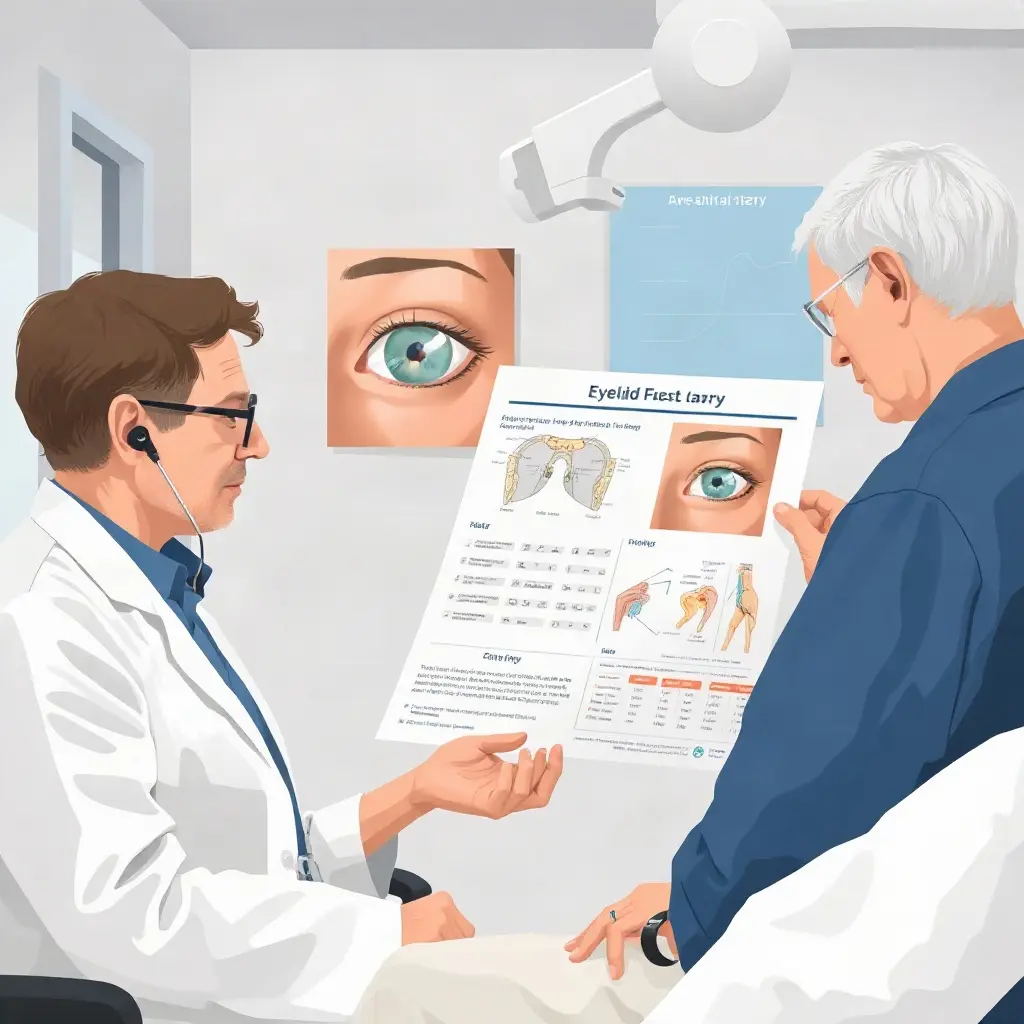
NHS Thames Valley publishes separate policy documents covering eyelid surgery for ptosis and dermatochalasis, as well as other eyelid conditions such as ectropion and entropion.4 A referral may therefore be assessed under a policy for a specific condition rather than under a broad label of “eyelid surgery”. The final decision rests with the responsible NHS service and its qualified clinicians, not with a general internet description of the operation.
Waiting times and what the published figures mean
Waiting time has two stages: the interval before specialist assessment and, if surgery is approved, the interval before the operation. Both depend on referral urgency, local capacity, clinical prioritisation and whether additional tests are required. NHS England publishes consultant-led referral-to-treatment statistics to monitor the period from referral through elective treatment, but these figures are generally reported by service or specialty rather than for blepharoplasty alone.5
As a broad 2026 indicator, an NHS waiting-time summary reported a median wait of 10.4 weeks for ophthalmology and 14.0 weeks for plastic surgery among pathways still waiting in August 2026.6 These figures are not a prediction for eyelid surgery and do not separately measure the first consultation or the procedure. The hospital can provide the most relevant local estimate after acceptance of the referral.
Risks, side effects and recovery considerations
Common short-term effects include swelling, bruising and blurred vision. Leeds Teaching Hospitals lists bleeding, delayed healing, scarring and infection among possible complications, in addition to the usual post-operative discomfort and temporary visual disturbance.2 Incisions, stitches and recovery differ between upper- and lower-eyelid procedures, and stitches may be removed after approximately five to seven days when non-dissolving sutures are used.2
Other possible concerns include asymmetry, altered eyelid position, dry or irritated eyes and the need for further clinical review. The balance of benefit and risk depends on the anatomy, the operation proposed, general health and the surgeon’s findings. A qualified ophthalmic or plastic-surgery professional should explain consent, alternatives, expected recovery and warning signs before any decision is made.
What happens when NHS criteria are not met
If the specialist concludes that the operation is cosmetic or does not meet the applicable medical-necessity threshold, NHS-funded surgery is normally not authorised. The referral may be closed, returned for further information or redirected if another eye condition requires attention. A GP can explain the decision and whether a review or second clinical opinion is appropriate under local procedures.
Private treatment is the main alternative for cosmetic cases, although prices vary by surgeon, location, anaesthesia, facility fees, follow-up and whether upper or lower lids are treated. A 2026 London clinic guide reports a typical private range of £2,000 to £5,000 per procedure, while noting that functional cases and cosmetic cases follow different pathways.3 That figure is market context, not a quotation or guarantee, and a regulated specialist should provide a written breakdown of all expected costs and risks.
Sources
- Blepharoplasty, Ptosis and Brow Lift Policy - Central East ICB: https://www.centraleast.icb.nhs.uk/documents/blepharoplasty-and-brow-lift-eyelid-and-brow-surgery/
- Blepharoplasty - Leeds Teaching Hospitals NHS Trust: https://www.leedsth.nhs.uk/patients/resources/blepharoplasty/
- Functional vs Cosmetic Eyelid Surgery: Is Your Concern Medical or Aesthetic? | The SEE Clinic, London | The SEE Clinic: https://eyesandeyelids.co.uk/insights/functional-vs-cosmetic-eyelid-surgery
- NHS Thames Valley - Aesthetics Cosmetics: https://thamesvalley.icb.nhs.uk/policies-and-documents/clinical-commissioning-policy-statements/aesthetics-cosmetics
- Referral to treatment waiting times statistics for consultant-led elective care for August 2026 - Accredited official statistics announcement - GOV.UK: https://www.gov.uk/government/statistics/announcements/referral-to-treatment-waiting-times-statistics-for-consultant-led-elective-care-for-august-2026
- NHS waiting times by specialty (August 2026) | NHSQueue: https://www.nhsqueue.co.uk/waiting-times