
Dental implants for lower jaw: procedure and costs: A clinical and pricing overview
Dental implants for lower jaw: procedure and costs are determined by the number of missing teeth, available bone, surgical complexity, and the type of restoration selected. Lower-jaw implants often benefit from denser bone, but planning must account for the mandibular nerve and the possibility of additional treatment. 1
What lower-jaw implants are
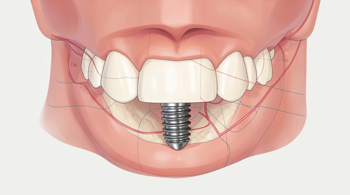
A dental implant is a threaded titanium post placed surgically into the jawbone to replace a missing tooth root. The completed treatment generally has three parts: the implant post, an abutment that connects the post to the visible tooth, and a restoration such as a crown, bridge, or denture. 1
For a single missing lower tooth, one implant can support one crown without relying on neighboring teeth. Several implants can support a bridge, while a full lower arch may use four to six strategically positioned implants to hold a fixed bridge or denture. 24
Assessment and treatment planning
Assessment begins with an examination of the teeth, gums, general health, and jawbone. CBCT three-dimensional imaging can map bone dimensions, tooth positions, and the mandibular nerve, helping the clinician choose an implant size and angle and determine whether guided or robotic assistance is appropriate. 2
Eligibility depends on sufficient bone volume, healthy gums, and medical conditions that are adequately controlled. Smoking, uncontrolled diabetes, severe bone loss, and other unmanaged health problems can make treatment less predictable or require preparatory care before placement. 210
Procedure and healing stages
Implant surgery places the post into the prepared bone, sometimes after removing a failing tooth or completing bone preparation. The gum is then allowed to heal while the implant integrates with the surrounding bone, a process called osseointegration. 14
Osseointegration commonly takes about three to six months. After healing is confirmed, the abutment and final crown, bridge, or denture are attached. Some treatment plans use a temporary restoration during healing, while selected full-arch cases may provide a functional provisional restoration sooner, depending on clinical conditions. 4
Lower jaw considerations, risks, and recovery
The mandible commonly provides strong support because its bone is often denser than bone in the upper jaw. However, the lower jaw contains the mandibular nerve, so detailed imaging and careful implant positioning are particularly important because nerve injury is a recognized concern. 2
Bone grafting may be needed when resorption or other bone loss leaves insufficient support. Sinus lifts, which are associated mainly with some upper-jaw cases, are rarely needed for lower implants. Recovery includes follow-up examinations and ongoing monitoring of healing, gum health, and the fit of the restoration. 214
What the costs may include
A quoted implant price may represent several separate components rather than one procedure. Typical cost elements include consultation, imaging, implant placement, the implant post, abutment, crown or bridge, temporary teeth, anesthesia, follow-up visits, and any extraction or grafting required. Comparing quotations requires checking whether these elements are bundled or itemized. 56
| Treatment scope | Reported market context | Important qualification |
|---|---|---|
| One implant and crown in the United States | About $3,000 to $5,000 in one 2026 guide | Location, clinician, materials, imaging, and preparatory treatment affect the total |
| Complete implant in a 2025 United States practice survey | National median of $4,000 | Specialist median was $3,400 and general dentist median was $4,800 |
| One lower arch using All-on-4 | About $20,000 to $30,000 in one 2026 guide | Restoration design and the number of implants change the fee |
| Private single implant in the United Kingdom | Typically about £2,000 to £3,500 | Clinic location and case complexity influence the range |
The United States figures illustrate why a single national number can be misleading. A 2025 survey of 278 practices across six metropolitan areas reported Minneapolis as the highest median market at $5,505, while provider type also produced a substantial difference in median fees. 3
Full lower-arch treatment
Full lower-arch treatment is different from replacing one tooth. Four to six implants may support a fixed prosthesis, which means the quote covers multiple surgical sites and a larger restoration rather than a simple implant-and-crown unit. The evaluation must consider remaining teeth, bone distribution, bite, gum condition, and the desired degree of removability. 4
Reported United States ranges for extensive treatment vary considerably. One source places All-on-4 treatment for one arch at approximately $20,000 to $30,000, while another states that full-mouth implant treatment can exceed $60,000. These figures are broad market references, not individualized estimates, and may not include every preparatory procedure. 56
Maintenance, coverage, and oversight
Implants are intended to function like replacement tooth roots, but the surrounding gums and bone still require professional monitoring and daily oral hygiene. Follow-up visits assess the implant, restoration, bite, and neighboring teeth. With proper care, implants may last a lifetime, although the visible restoration can require maintenance or replacement. 14
In the United Kingdom, implants are generally private treatment and are rarely available through the NHS except in specific clinical circumstances, such as certain trauma or cancer-surgery cases. Insurance contributions vary by plan, and financing arrangements differ between practices. Professional standards for clinicians are overseen by the General Dental Council, making credentials, regulated practice, and a clear written treatment plan relevant safeguards. 712
Questions to resolve before treatment
A useful consultation should identify the exact number of implants, the restoration type, imaging charges, temporary teeth, anesthesia, extractions, grafting, follow-up care, and the circumstances that could change the estimate. It should also explain the relationship between the planned implant position and the mandibular nerve. 25
- Whether the quoted amount includes the post, abutment, and final restoration.
- Whether bone grafting or other preparation is clinically necessary.
- How long the expected healing and restoration stages will take.
- What maintenance, repair, and review arrangements apply after completion.
- Which risks are specific to the patient’s health, bone anatomy, and smoking status.
These questions help distinguish a complete treatment estimate from a headline figure that covers only implant placement. A clinical examination and three-dimensional imaging remain necessary before eligibility, timing, and total cost can be determined for an individual lower-jaw case. 210
Sources
- Cleveland Clinic, “Dental Implants: Types, Purpose & Benefits”
- Aarohi Dental, “Implants For Bottom Teeth: Everything You Need To Know”
- Dental Economics, “A comparative analysis of dental implant costs across major US markets”
- Dental Country, “Dental Implants: Complete Patient Guide to Tooth Replacement”
- dental.me, “How Much Do Dental Implants Cost? A Complete 2026 Price Guide”
- MetLife, “How Much Do Dental Implants Cost?”
- NHS, “Dental treatments”
- Bupa UK, “Dental implants”
- Oral Health Foundation, “Dental implants”
- Mayo Clinic, “Dental implant surgery”
- American Dental Association, “Implants”
- General Dental Council
- Healthline, “Dental implant procedure”
- WebMD, “Dental Implants”