Natural recovery methods for heel pain and plantar fasciitis in active adults: Evidence, limitations, and practical guidance
Natural recovery methods for heel pain and plantar fasciitis in active adults commonly begin with reducing aggravating activity, stretching, icing, and changing exercise rather than surgery or invasive treatment. Most people recover within a few months with simple conservative care, although the course varies and persistent symptoms require reassessment. 1
Recognizing plantar fasciitis and heel pain
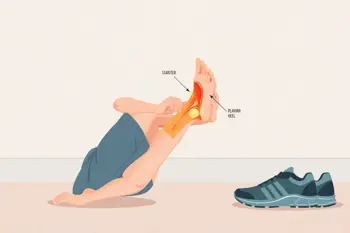
Plantar fasciitis typically causes sharp pain near the heel, often most noticeable during the first steps after waking or after sitting. Repetitive strain can affect the plantar fascia, the tissue supporting the foot’s arch, and active adults may notice symptoms after running, jumping, prolonged standing, or abrupt increases in training. Tight calf or Achilles tissues, unsupportive footwear, altered foot mechanics, and higher body weight can increase mechanical stress. 4
A clinical diagnosis usually relies on medical history and physical examination, including identification of tender areas. Imaging is not routinely needed, but an X-ray or MRI may be used to rule out problems such as a stress fracture. A visible heel spur does not necessarily explain the pain, and removing one is typically unnecessary. 1
Modify training without abandoning fitness
Activity modification is a central recovery method for active adults. Running, jumping, long walks, and prolonged standing should be reduced when they clearly increase pain, while lower-impact activities such as cycling or swimming can help maintain general fitness with less repetitive heel loading. The NHS also advises resting from activities that cause pain and avoiding barefoot walking on hard surfaces when that aggravates symptoms. 5
Returning to impact exercise is best treated as a gradual progression rather than a rapid resumption of the previous workload. Sudden increases in training volume can prolong symptoms, so pain response during and after activity should guide progression. This approach addresses load management, but it does not mean complete inactivity is required for every person. 10
Stretching and mobility approaches
Plantar-fascia-specific stretching and gastrocnemius-soleus stretching are established components of conservative rehabilitation. A physical therapist may teach stretches for the plantar fascia and Achilles tendon, along with lower-leg strengthening and techniques such as athletic taping. Stretching is generally most useful when performed consistently over several weeks rather than as an occasional response to pain. 1
Morning stiffness deserves particular attention because the first steps after rest can be painful. Stretching the calf and plantar tissues before or around periods of activity may reduce tension placed on the heel. Exercises should be controlled and should not produce sharply worsening pain. Evidence reviews caution that treatment effects vary, so stretching should be considered part of an individualized programme rather than a guaranteed stand-alone cure. 7
Strengthening the foot and lower leg
Strengthening can improve the ability of the calf, ankle, and intrinsic foot muscles to support movement. Common rehabilitation programmes include calf raises, foot exercises, and gradual loading of the plantar structures. A 2026 randomized trial involving 48 adults aged 40 to 60 compared conventional rehabilitation with a multimodal programme that added low-dye taping, short-foot exercises, and unilateral heel raises. Both groups trained three times weekly for eight weeks. 2
Another study of 33 adults with plantar fasciopathy examined eight weeks of home exercises, including massage-ball release, toes-elevated calf raises, and calf and foot stretches. One group also progressively wore minimalist shoes, but the research was focused on intrinsic foot-muscle strength and does not establish that minimalist footwear is suitable during active symptoms. Any strengthening or footwear transition should therefore be gradual and individually assessed. 8
Footwear, taping, and supportive aids
Supportive shoes with cushioning and arch support may reduce stress on the heel, especially during walking or standing. Store-bought or custom orthotics can distribute pressure more evenly, but orthoses generally work best as one element of a broader rehabilitation plan. Taping may provide short-term support and pain relief, potentially helping an active adult tolerate daily movement while stretching and strengthening progress. 6
Night splints keep the foot in a stretched position during sleep and may be considered when morning pain is prominent or when symptoms continue despite initial measures. Comfort and adherence can limit their usefulness. A walking boot, cane, or crutches may occasionally be recommended for a short period to reduce pressure, but these options require professional guidance because prolonged unloading can affect normal movement and conditioning. 1
Ice, recovery habits, and safety limits
Icing the heel can help ease symptoms, particularly after an activity that has irritated the area. Rest, supportive footwear, consistent stretching, and avoiding painful activity are commonly recommended conservative measures. Weight management may reduce mechanical loading for people who are overweight, but recovery should not be reduced to body weight alone because training errors, foot mechanics, calf tightness, and footwear can also contribute. 4
Home care has important limits. Severe, persistent, or atypical pain should be assessed by a GP, podiatrist, or physiotherapist because stress fractures, nerve problems, tendon disorders, and inflammatory conditions can resemble plantar fasciitis. Professional assessment is also appropriate when symptoms do not improve with conservative care, when walking becomes substantially limited, or when a return to sport repeatedly causes relapse. 9
What recovery evidence suggests
Clinical guidance supports combining education, load modification, plantar-fascia and calf stretching, strengthening, appropriate footwear, manual therapy, and taping where indicated. The American Physical Therapy Association guideline specifically supports plantar-fascia-specific and gastrocnemius-soleus stretching, manual therapy, taping, and therapeutic exercise for plantar heel pain. 8
Research does not show that one natural method works for everyone. A Cochrane review found that evidence for many plantar-heel-pain interventions is limited or mixed, supporting an individualized approach. Active adults should therefore track morning pain, walking tolerance, and exercise response over time, maintain the routines that are tolerable, and seek reassessment when progress stalls instead of repeatedly increasing painful training loads. 7
Sources
- 1. Mayo Clinic, Plantar fasciitis: Diagnosis and treatment, https://www.mayoclinic.org/diseases-conditions/plantar-fasciitis/diagnosis-treatment/drc-20354851
- 2. BMC Musculoskeletal Disorders, The effect of multimodal rehabilitation program on pain, functional outcomes, and plantar fascia thickness in patients with plantar fasciitis, https://link.springer.com/article/10.1186/s12891-026-09562-x
- 4. Health Service Executive, Plantar fasciitis, https://www2.hse.ie/conditions/plantar-fasciitis/
- 5. NHS, Plantar fasciitis, https://www.nhs.uk/conditions/plantar-fasciitis/
- 6. American Academy of Orthopaedic Surgeons, Plantar fasciitis and bone spurs, https://orthoinfo.aaos.org/en/diseases--conditions/plantar-fasciitis-and-bone-spurs/
- 7. Cochrane, Effectiveness and safety of interventions for treating plantar heel pain, https://www.cochrane.org/CD010515/MUSKINJ_effectiveness-and-safety-of-interventions-for-treating-plantar-heel-pain
- 8. Journal of Orthopaedic & Sports Physical Therapy, Clinical practice guideline for plantar heel pain, https://www.jospt.org/doi/10.2519/jospt.2023.0303
- 9. American Family Physician, Plantar fasciitis, https://www.aafp.org/pubs/afp/issues/2019/0615/p744.html
- 10. Australian Journal of General Practice, Plantar heel pain, https://www1.racgp.org.au/ajgp/2023/july/plantar-heel-pain