
A 14-day expedition cruise through the New Zealand fjords: What Travelers Need to Know
The Scale and Geography of Fiordland Expedition Cruising
Fiordland National Park occupies the southwestern corner of New Zealand's South Island and contains one of the most concentrated collections of glacially carved fjords on Earth. The park is a UNESCO World Heritage Site managed by the New Zealand Department of Conservation, which regulates vessel access and visitor numbers across all major waterways. 1 New Zealand's coastline measures approximately 15,000 kilometres, and the Fiordland portion alone contains 14 named fjords, ranging from the internationally recognized Milford Sound to the rarely visited Preservation Inlet and George Sound. 2
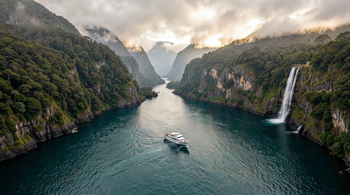
A 14-day expedition cruise typically covers far more of this geography than shorter day-trip or overnight offerings. While standard tourist itineraries concentrate almost exclusively on Milford Sound, a two-week voyage commonly includes Dusky Sound, Doubtful Sound, Breaksea Sound, Chalky Inlet, and the Marlborough Sounds in the north. Milford Sound itself features the iconic Mitre Peak, steep rainforest cliffs, and cascading waterfalls accessed from the Milford Deep Water Basin. 3 Doubtful Sound is New Zealand's largest fjord and requires a scenic coach transfer from Te Anau followed by a boat crossing, typically consuming a full expedition day. 4
Vessel Types and Passenger Capacity
Expedition vessels operating in the New Zealand fjords are specifically selected for their ability to navigate narrow waterways and anchor in remote coves inaccessible to large ocean liners. Operators including Heritage Expeditions, Coral Expeditions, and Swan Hellenic deploy small ships with passenger capacities ranging from as few as 18 guests on intimate yacht-style vessels up to approximately 140 passengers on larger expedition ships such as the Heritage Adventurer. 5 The smaller the vessel, the greater the flexibility for unscheduled landings and Zodiac deployments into sheltered inlets.
Many 14-day itineraries operate on vessels purpose-built for expedition-style access. The Heritage Explorer, for example, is a New Zealand-built small ship expedition yacht equipped with onboard kayaks, fishing equipment, and a commercial kitchen. 6 The Coral Adventurer, deployed on South Island fiordland routes, offers 10-night and longer itineraries departing from Bluff with limited passenger numbers per departure, emphasizing immersive shore time over transit speed. 7 Onboard amenities across operators typically include lecture programs by naturalists, observation lounges, and expedition briefing spaces.
Typical 14-Day Itinerary Structure
A full 14-day expedition cruise through the New Zealand fjords generally follows one of two structural patterns: a Fiordland-focused route running between Te Anau or Bluff and covering all major southern sounds, or a coastal odyssey traversing both the North and South Islands. The coastal format, such as those operated by Heritage Expeditions aboard the Heritage Adventurer, connects destinations including Auckland, Tauranga, Wellington, Marlborough Sounds, Dunedin, Stewart Island, Doubtful Sound, Dusky Sound, and Milford Sound. 8 Stewart Island, known as Rakiura, and nearby predator-free Ulva Island are frequently included for their endemic birdlife.
Fiordland-only expeditions concentrate entirely on the sounds and inlets of the southwest, arriving by helicopter into rarely visited entry points such as Preservation Inlet before working northward through Chalky Inlet, Dusky Sound, Doubtful Sound, and ultimately Milford Sound. 9 Daily activities on these itineraries include Zodiac excursions into sheltered coves, guided kayaking along forested shorelines, naturalist-led walks, and evening lectures covering glacial geology, conservation history, and Maori cultural context.
Wildlife and Ecological Significance
The biological diversity accessible on a multi-day fjord expedition is considerably greater than what day visitors observe. Fiordland's fjords support populations of bottlenose dolphins, New Zealand fur seals, Fiordland crested penguins, and numerous seabird species. 10 Predator-free island sanctuaries within Fiordland and Stewart Island protect some of New Zealand's most endangered species, including the kakapo and the little spotted kiwi, and expedition operators with conservation permits can arrange landings on these protected sites. 11
The ecological significance of longer voyages lies in the compounding observation time. Weather in the South Island fjords is highly unpredictable, and itineraries are routinely adjusted in real time to accommodate changing conditions. 12 Expedition naturalists, geologists, and marine biologists embedded on most vessels conduct structured lectures and guided excursions that contextualize wildlife sightings within broader ecological and geological frameworks. Historic sites such as Cuttle Cove, the location of New Zealand's first operational whaling station, and Pigeon Island, set aside by New Zealand's first conservationist Richard Henry, add a human history dimension to the wilderness experience. 13
Cost Ranges, Seasonality, and Practical Eligibility
Published pricing for New Zealand fjord expedition cruises varies significantly by vessel class, cabin type, and itinerary length. Shorter 10-night fiordland-only expeditions aboard vessels like the Heritage Explorer are listed from approximately AU$9,135 per person in twin share configuration. 14 The 12-day Heritage Adventurer coastal odyssey lists from AU$10,799 per person for a superior deck cabin. 15 Broader market estimates for 14-day expeditions range from NZD $4,000 to over NZD $9,000 for smaller vessel itineraries, while ultra-luxury options can exceed NZD $25,000 per person depending on suite category and inclusions. 16
The prime travel season runs from November through April, corresponding to the Austral summer when weather conditions are most favorable and wildlife activity peaks. 17 Winter departures in July, August, and September are available from some operators but carry greater risk of heavy rainfall, reduced visibility, and itinerary disruption. Travelers should assess their physical mobility requirements carefully, as Zodiac transfers and kayaking activities involve boarding from vessel swim platforms in variable sea conditions. Most operators maintain moderate activity levels but recommend participants consult medical advisors regarding prolonged sea travel in remote areas without hospital access.
Risks, Limitations, and Conservation Considerations
Expedition cruising in Fiordland carries inherent risks that prospective travelers must understand. The region's remoteness means medical evacuation is a complex undertaking, and travel insurance covering emergency helicopter extraction is strongly recommended by all operators. Itinerary changes due to weather are not exceptional events but routine occurrences; any fjord expedition should be booked with the expectation that specific locations may be substituted for safety reasons. 12 Vessel departures with limited capacity, some as low as 18 passengers on intimate yachts, mean that bookings can close well in advance of departure dates, and cancellation policies vary considerably between operators. 5
The New Zealand Department of Conservation enforces strict visitor management protocols within Fiordland National Park, including limits on where vessels may anchor and where passengers may go ashore. 1 These regulations exist to protect fragile ecosystems and are non-negotiable regardless of operator or passenger preferences. Carbon footprint considerations are also increasingly relevant; expedition vessels in this category consume significant fuel over 14-day itineraries, and travelers concerned about environmental impact should review individual operator sustainability policies before making commitments. Responsible expedition operators integrate Leave No Trace principles and support conservation monitoring programs as part of their operating agreements with the Department of Conservation.
Sources
- Department of Conservation NZ - doc.govt.nz
- Global Journeys - globaljourneys.com
- Department of Conservation New Zealand - doc.govt.nz (Milford Sound)
- Department of Conservation New Zealand - doc.govt.nz (Doubtful Sound)
- ANZCRO - anzcro.com.au (12 Day New Zealand Coastal Odyssey)
- ANZCRO - anzcro.com.au (10 Day Ultimate Fiordland Experience)
- Bluesun Cruises - bluesuncruises.com.au
- Global Journeys - globaljourneys.com (Heritage Expeditions Coastal Odyssey)
- Leisure Time Tours - leisuretimetours.co.nz
- Fiordland National Park Authority - doc.govt.nz
- Steppes Travel - steppestravel.com
- Tourism New Zealand - newzealand.com
- Leisure Time Tours - leisuretimetours.co.nz (Preservation Inlet)
- ANZCRO - anzcro.com.au (Heritage Explorer pricing)
- ANZCRO - anzcro.com.au (Heritage Adventurer pricing)
- Tourism New Zealand - newzealand.com (cost ranges)
- Tourism New Zealand - newzealand.com (seasonality)