
Botox injection: eligibility criteria and private costs 2026: reporting on coverage rules, unit requirements, and 2026 out-of-pocket pricing patterns
“Botox injection: eligibility criteria and private costs 2026” is a combined inquiry that compares who can qualify for medical coverage with what private-pay pricing patterns tend to look like across regions and service models. This report consolidates 2026 eligibility rules and documentation requirements used in Medicare policy, then places them next to 2026 private-sector pricing data points and cost drivers described in accessible medical and research summaries. Cosmetic use remains excluded from Medicare coverage in the provided policy summaries, so the “private costs” portion of the question largely refers to out-of-pocket payment.
1) Medicare and clinical eligibility in 2026: medical necessity versus cosmetic exclusion
For 2026 Medicare, the eligibility framing is not based on preference for aesthetics but on medically necessary, documented indications. A 2026 Medicare coverage summary emphasizes that Medicare coverage is limited to medical necessity and that cosmetic purposes such as wrinkle reduction are not covered. In that same framing, medically eligible indications include chronic migraine, overactive bladder, severe axillary hyperhidrosis, strabismus, dystonia, and spasticity management when conditions are documented and meet policy requirements. 1
Documentation and policy alignment are treated as central requirements in 2026 local coverage determinations. A Noridian Medicare LCD entry titled “Botulinum Toxin Injections” shows a finalized LCD with effective date February 22, 2026, and identifies that the LCD was created to be consistent with evidence for FDA-approved and off-label uses in the Medicare population. The LCD entry also indicates the MAC contractor structure by listing multiple contractor numbers and assigns an MCD number (L35172). 3
2) Chronic migraine as a documented gate: how criteria are recorded and why prior trials matter
Chronic migraine criteria in the provided 2026 policy summary are explicit and checklist-like, making eligibility dependent on recorded frequency and duration. The American Headache Society clinical resource states that chronic migraine documentation requires 15 or more headache days per month, 8 or more migraine days per month, each migraine lasting 4 or more hours a day, persistence for at least 3 months, and prior trials of preventive medication classes at target doses for at least 2 months. Intolerances, side effects, and contraindications must be documented for each medication if needed. 4
That same resource also ties coverage continuity to the diagnosis gate even when CGRP therapy is part of the clinical picture. It states that when patients are on a CGRP, they still must fulfill the chronic migraine diagnosis thresholds to qualify for onabotulinum toxin A coverage, as opposed to using CGRP status alone. The clinical framing here is that eligibility is condition-based and documentation-based rather than dependent on a patient’s treatment preference. 4
- 15+ headache days per month and 8+ migraine days per month, with each migraine lasting 4+ hours, sustained for at least 3 months 4
- Two-month trial of one agent in specified preventive medication classes, with target dose and documented intolerance or contraindications as applicable 4
- Even with CGRP, the chronic migraine thresholds remain required 4
3) Treatment frequency and medical policy mechanics in 2026: 12-week limits and dosing alignment
Beyond diagnosis thresholds, 2026 policy also includes interval limits tied to medical necessity review. A UnitedHealthcare commercial medical benefit drug policy effective January 1, 2026 includes a general requirement that botulinum toxin administration must not be more frequent than every 12 weeks regardless of diagnosis. The same policy also states that coverage for Botox, Dysport, Xeomin, and Myobloc is contingent on general and diagnosis-specific criteria, and it highlights that Daxxify is typically excluded from coverage with potential review only if required by law. 7
Separate guidance aimed at Medicare administrative contractors also reflects how dosing alignment affects payment. An American Academy of Ophthalmology update explains that when prescribed botulinum toxin treatment or dosage does not align with MAC policy guidelines, MACs pay up to a maximum recommended dose defined in the LCD or the FDA label if updated after the current LCD version. It further notes that any amount over that dose would require appeal support with peer-reviewed literature and reasonable and necessary progress notes. If a service is not reasonable and necessary, an advanced beneficiary notice (ABN) is required with specific claim submission handling. 11
| 2026 policy element | What it governs | Documented impact on eligibility |
|---|---|---|
| 12-week interval rule | How often injections can be administered | Administration must not be more frequent than every 12 weeks regardless of diagnosis in the provided policy summary 7 |
| MAC maximum dose alignment | Dosing within LCD or FDA label limits | Amounts above maximum require appeal support and documentation 11 |
| Diagnosis documentation gates | Condition thresholds and prior trials | Chronic migraine thresholds and preventive trial documentation are required for coverage 4 |
4) Coding and billing friction points: why unit accounting and administration coding can affect outcomes
Eligibility is not only clinical. In practice, Medicare reimbursement can be sensitive to unit accounting and the correct pairing of drug and administration codes. A 2026 billing-focused summary describes that a complete Botox chronic migraine claim has two major components: J0585 for onabotulinumtoxinA billed per unit, and a separate administration code (for chronic migraine, CPT 64615). The summary states chronic migraine standard protocol commonly calls for 155 units across 31 injection sites under PREEMPT, and it emphasizes that J-code unit billing errors and missing documentation are denial-prone failure modes. 9
For unit reporting, the same billing-related guidance stresses Medicare’s waste modifiers and exact-unit billing practices. A coding guide for 2026 notes that the drug code J0585 is billed per unit of Botox actually administered and that Medicare uses waste modifiers, specifically JW for wastage on a separate line and JZ when no waste occurred. It also reiterates that cosmetic use is not covered and that frequency limits generally follow a 12-week pattern, consistent with other 2026 policy summaries. 10
- Drug billed per unit administered using J0585 9 10
- Administration reported separately with CPT 64615 for chronic migraine in the provided guide 9 10
- Medicare waste accounting includes JW and JZ modifiers in the provided coding guide 10
5) Private costs in 2026: regional variation signals and how “per unit” versus “per area” changes totals
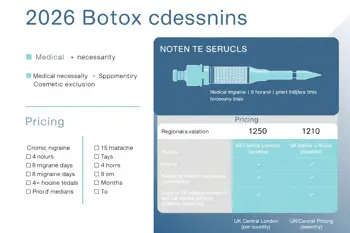
Private costs in 2026 vary widely because clinics may price by single area, multiple areas, or unit-based dosing, and because regional factors can shape price levels. A 2026 UK research report analyzing 990 clinics finds that anti-wrinkle injection pricing varies substantially by region, reporting a median UK price of £170 for a single-area treatment and £270 for three areas. The same analysis reports that Central London has the highest median three-area price at £310, compared with the North of England at £230, described as about 35% higher in Central London in the report’s summary. 2
Pricing model structure also changes how consumers perceive cost. A 2026 Japan-focused pricing breakdown describes per-unit pricing ranges of ¥5,500 to ¥1,800 per unit and per-area pricing ranges such as forehead at ¥8,000 to ¥30,000, crow’s feet at ¥8,000 to ¥25,000, and jaw at ¥25,000 to ¥80,000. It also explains that advertised prices may exclude consultation, tax, or touch-ups and that brands can alter cost, with a claimed 2 to 3 times price difference between Allergan Botox Vista and Korean alternatives for identical units in that article’s structure. 14
| 2026 private-market signal | Geography | What the pricing data shows |
|---|---|---|
| Median anti-wrinkle injection cost for three areas | UK | Central London median £310 versus North median £230, with national median three-area £270 2 |
| Common private pricing structure | Japan | Per-unit or per-area models change total; additional fees and unit-brand differences affect final totals 14 |
6) What patients should verify to avoid misfit expectations: eligibility mismatches, contraindications, and oversight gaps
Eligibility mismatch is a predictable friction point because policy exclusions are explicit and because private-market advertising may blur the difference between cosmetic and medical indications. The 2026 Medicare coverage summary emphasizes that cosmetic Botox for wrinkle reduction remains out of pocket and does not qualify for Medicare reimbursement, while medically necessary conditions can be eligible when documentation and policy requirements are met. A separate Botox savings program terms document further states that its offer is not valid for patients enrolled in Medicare and other government-reimbursed healthcare programs, reinforcing that Medicare beneficiaries generally do not access the same patient savings pathways described for commercially insured patients. 1 5
Safety and contraindication screening can also limit eligibility. The provided general research information states that individuals who are pregnant or breastfeeding or have active skin infections at the injection site are ineligible for Botox treatments, and that patients with documented allergies to botulinum toxin or human albumin are medically contraindicated. While this section does not substitute for clinician assessment, it frames that eligibility in real-world settings depends on medical status and injection-site conditions, not just the intended cosmetic or therapeutic goal. 15
- Pregnancy or breastfeeding and active injection-site skin infections can be exclusion factors in the provided research summary 15
- Documented allergies to botulinum toxin or human albumin can be contraindications in the provided research summary 15
- Medicare beneficiaries are excluded from the provided Botox savings program terms in the provided document 5
Sources
- https://getmedicaresolutions.com/medicare-botox-coverage-2026/
- https://www.treatcompare.com/research/anti-wrinkle-injection-prices-uk-2026
- https://med.noridianmedicare.com/web/jfa/article-detail/-/view/10529/botulinum-toxin-injections-final-lcd-effective-february-22-2026
- https://americanheadachesociety.org/resources/clinicians/clinical-practice-resources/updated-botulinum-toxin-a-local-coverage-determination-policy
- https://www.botox.com/completeterms
- https://www.drugs.com/medical-answers/botox-cost-3567878/
- https://www.uhcprovider.com/content/dam/provider/docs/public/policies/comm-medical-drug/botulinum-toxins-a-and-b.pdf
- https://www.aafp.org/afp/2026/0500/botulinum-toxin-procedures
- https://ams-solutions.com/botox-migraine-treatment-billing/
- https://www.codingahead.com/botox-injection-cpt-codes/
- https://www.aao.org/practice-management/news-detail/botulinum-toxin-mac-policy-updates
- https://legalclarity.org/how-to-fill-out-the-botox-patient-assistance-program-application-form/
- https://www.medicare.org/articles/does-medicare-cover-botox/
- https://www.clinicjapan.net/botox-japan-cost/
- General research information gathered from LLM (provided in payload)