Water aerobics classes for seniors with no equipment needed
Water aerobics classes for seniors with no equipment needed have grown steadily in popularity across community centers, YMCAs, and municipal pools because they eliminate two of the most common barriers to senior fitness: joint pain and the intimidation of complex gear. The water itself functions as the resistance tool, meaning participants can achieve meaningful cardiovascular and strength training outcomes simply by moving through it. Understanding how these classes are structured, what the research shows, and where realistic access points exist helps older adults make informed decisions about integrating aquatic exercise into their routines.
The Physics Behind Equipment-Free Aquatic Exercise
Water provides twelve times the resistance of air during movement, meaning even simple gestures like walking or swinging the arms deliver genuine muscular challenge without requiring foam dumbbells, resistance bands, or any external load. 1 At the same time, buoyancy reduces effective body weight proportional to submersion depth. At chest-depth water, a 180-pound individual exerts approximately 18 pounds of compressive force on weight-bearing joints, representing a 90% reduction in stress compared to land-based movement. 2 This physical reality is why no-equipment sessions remain legitimate workouts rather than passive recovery activities.
A third property, hydrostatic pressure, further distinguishes pool exercise from land alternatives. As the body moves through water, the surrounding pressure helps push blood back toward the heart, which can reduce swelling in the legs and feet. 3 This gentle circulatory support also provides sensory feedback that improves balance and body awareness, both critical functional capacities for older adults managing fall risk. Most water aerobics classes use pools heated between 83 and 88 degrees Fahrenheit, warm enough to keep muscles relaxed but cool enough to prevent overheating. 3
Documented Health Benefits for Older Adults
A 2021 study published in the International Journal of Environmental Research and Public Health found significant improvements in muscle mass and cognitive function among seniors participating in regular aqua aerobics sessions. 4 Research has also found that water exercises can improve quality of life, mood, depression, anxiety, and tension, and help prevent falls in older populations. 5 Only 24.2% of American adults currently meet the CDC's recommended guidelines of 150 minutes of aerobic exercise and two strength training sessions weekly, a gap that water-based programs are well positioned to address because of their accessibility. 6
For seniors managing osteoarthritis, chronic joint pain, balance disorders, obesity, or cardiovascular deconditioning, water aerobics delivers training intensities comparable to land-based exercise at a fraction of the musculoskeletal stress. 7 Harvard Health has noted that water-based exercise is especially effective for people managing joint discomfort because buoyancy offsets most body weight during movement. 8 Participants commonly report gains in cardiovascular fitness, muscular strength, and flexibility that are sustained across weeks, particularly when sessions occur at least three times per week. 9
What No-Equipment Classes Actually Look Like
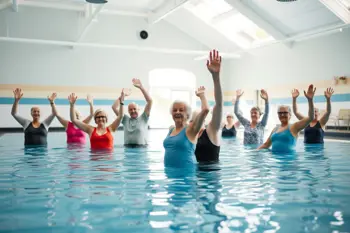
Most water aerobics sessions run 45 to 60 minutes and combine cardiovascular training, strength building, and flexibility work, all performed against the natural resistance of the water. 10 A typical session begins with water walking or marching in place as a warm-up, then progresses into main exercises like leg lifts, jogging in place, leg swings, walking backwards, and arm movements. Walking backwards in water, for example, increases activity in the back muscles, the front of the thigh, and the lower leg compared to walking forward, making it a surprisingly comprehensive lower-body drill. 11 Jogging in place requires the body to organize itself over the standing leg each time one foot lifts, functioning as both a leg exercise and balance training simultaneously. 11
Classes are generally held in waist-to-chest deep water with feet on or hovering above the pool floor. Participants do not need to know how to swim, as the head remains above water throughout. 10 For seniors above 70 years, high-intensity water exercises are advised only with the consent of a physiotherapist, while water walking remains appropriate as a starting point for most age groups. 12 Instructors typically set movements to music and pace the session to accommodate varying fitness levels within the same group.
Program Examples Across Community Settings
Silver Sneakers Splash, offered at Kansas City Parks and Recreation facilities including the Southeast Community Center and Mary Williams-Neal Community Center, is a shallow-water class that uses the pool's natural resistance to increase movement options. It is described as suitable for all skill levels, safe for non-swimmers, and open to adults aged 50 and older at a drop-in rate of $3 per session. 13 Senior Solutions in Springfield, Vermont, runs a program called Slow Aqua at the Edgar May Health and Recreation Center, a beginners' aquatic fitness class focused on improving balance, strength, and mobility in 45-minute sessions. 14 The City of Linden, New Jersey, partners with the Rahway YMCA to provide senior citizen water aerobics led by a certified instructor for local residents on Tuesday mornings at a low fee structure. 15
The Granite YMCA in New Hampshire offers multiple formats under its water exercise program, ranging from classic aquatic conditioning sessions to deep-water core-focused classes, with instructors specifically noted for creating welcoming environments for seniors. 16 The All Seniors Foundation in Los Angeles County provides free aquatic therapy for qualifying seniors aged 60 and older, supervised by licensed physical therapists, with transportation assistance and bilingual support available. 17 Ken Caryl Ranch in Colorado operates daily water aerobics sessions from late May through mid-August, with Silver Sneakers, Renew Active, and Silver and Fit members receiving access as part of their existing coverage. 18
Insurance Coverage, Cost Structures, and Access Pathways
Several major fitness benefit programs embedded in Medicare Advantage and Medigap plans cover water aerobics participation at no additional out-of-pocket cost. SilverSneakers, Renew Active, and Silver and Fit are the three most commonly cited programs, and eligibility can typically be verified directly at a participating facility's front desk during normal business hours. 18 Where these programs apply, drop-in fees that would otherwise range from $3 at municipal park facilities to $19 for non-residents at private community centers are waived entirely. 13
For those without plan-linked fitness benefits, municipal pool programs tend to carry the lowest access costs, with many city parks and recreation departments offering senior-specific rates. Community YMCAs across the United States and New Zealand operate aquatic fitness programs oriented toward older adults, with some locations providing sliding-scale membership structures. 19 Auckland Council, Wellington City Council, and Christchurch City Council each operate leisure facilities that include senior-focused aquatic fitness programming at their respective pool networks. 20 Identifying local options generally involves contacting the nearest public pool, municipal recreation department, or YMCA branch directly.
Safety Considerations and Realistic Limitations
While water aerobics carries significantly lower injury risk than most land-based exercise formats, it is not without precautions. Seniors managing active infections, open wounds, or uncontrolled cardiovascular conditions should consult a physician before beginning any pool-based program. Instructors should hold recognized aquatic fitness certifications, and participants are advised to confirm this before enrolling in a new class. 5 Water temperature matters: pools outside the 83 to 88 degree Fahrenheit range may cause muscle cramping in cooler water or cardiovascular stress in warmer water. 3
Outdoor pool programs carry additional weather-dependent constraints. Ken Caryl Ranch, for example, requires an air temperature of at least 60 degrees Fahrenheit at the time a class begins for the session to proceed. 18 Non-swimmers should confirm that the class operates in shallow water before attending, as some advanced formats use deep-water environments with flotation belts. Balance improvements from water aerobics are well documented, but they do not automatically transfer to land-based stability without supplementary practice. Seniors should also monitor their physical exertion in water carefully, as the cooling effect of the pool can mask perceived effort and lead to overexertion during high-intensity intervals. 7
Sources
- swim2000.com - Water Aerobics Workout Guide for Seniors and Beginners
- seniorssecrets.com - Water Aerobics for Seniors 2026: Clinical Benefits, Exercises and Medicare Coverage
- seniorfitness.org - Water Aerobics for Seniors: Pool Exercise Benefits
- wellnessvoice.com - Aqua Aerobics Workout Plan for Seniors to Lose Weight
- care.com - Water Aerobics for Seniors: Expert Recommended Water Exercises
- oakstreethealth.com - Water Aerobics for Seniors: Health Benefits and 7 Exercises to Try
- seniorssecrets.com - Water Aerobics for Seniors 2026: Clinical Benefits and Exercises
- lindell-living.com - Water Aerobics for Seniors: The Workout Worth Trying
- diabeteshealth.co.in - Water Aerobics for Older Adults
- watervolleyball.com - Water Aerobics for Beginners: Exercises, Benefits, and What to Expect
- blog.h2owear.com - Water Aerobics for Seniors: 5 Pool Exercises That Build Strength, Balance, and Confidence
- diabeteshealth.co.in - Water Aerobics for Older Adults (physiotherapist guidance)
- kcparks.org - Silver Sneakers Splash, Kansas City Parks and Recreation
- seniorsolutionsvt.org - Slow Aqua, Senior Solutions Vermont
- linden-nj.gov - Senior Citizen Water Aerobics, City of Linden
- graniteymca.org - Water Exercise and Aqua Fitness Classes, Granite YMCA
- allseniors.org - Senior Aquatic Therapy, All Seniors Foundation
- ken-carylranch.org - Water Aerobics, Ken Caryl Ranch
- ymca.org.nz - YMCA New Zealand Aquatic Fitness Programs
- aucklandcouncil.govt.nz - Auckland Council Regional Pools and Aqua Fitness