
Sleep apnea devices covered by Medicare alternatives: A policy and coverage analysis
How Medicare frames sleep apnea treatment
Sleep apnea devices covered by Medicare alternatives generally begin with a confirmed diagnosis and an individualized treatment assessment. Original Medicare commonly handles covered equipment through Part B, while sleep studies and other outpatient services follow separate billing rules. A qualifying in-lab or home sleep test is important because treatment suitability depends on apnea severity, symptoms, oxygen levels, related medical conditions, anatomy, and the ability to use positive airway pressure therapy. 1 5
Medicare Advantage plans must cover services included by Original Medicare, but they may apply different networks, copayments, deductibles, supplier arrangements, and prior-authorization procedures. Regional Medicare Administrative Contractors can also apply local coverage policies, particularly for respiratory-assist devices, custom oral appliances, and surgery. A device that is clinically appropriate is not automatically reimbursable, so the diagnosis, physician order, billing code, supplier eligibility, and supporting records all matter. 2 10
CPAP remains the reference point
Continuous positive airway pressure is usually the reference treatment against which alternatives are evaluated. Medicare Part B covers CPAP machines and related accessories for beneficiaries with obstructive sleep apnea when medical-necessity requirements are met. Coverage commonly begins with a rental and an initial trial period rather than immediate ownership. Continued coverage requires documented use and clinical benefit, making adherence records a central part of the reimbursement process. 1
The initial Medicare trial is generally described as a three-month period, with continued coverage dependent on usage requirements and evidence that the therapy helps the beneficiary. Masks, tubing, filters, and other replacement supplies are subject to Medicare replacement schedules, and equipment is normally obtained through a Medicare-enrolled durable medical equipment supplier. Failure to meet compliance requirements, incomplete documentation, or use of a nonparticipating supplier can create coverage problems. 1 2
Bilevel and respiratory-assist devices
BiPAP, also called bilevel positive airway pressure, provides different pressure levels during inhalation and exhalation. Medicare may cover a bilevel device as a respiratory-assist device when standard CPAP does not adequately treat obstructive sleep apnea, is ineffective, or is not tolerated and the beneficiary meets the applicable medical-necessity criteria. The clinical record must explain why a different device type is required rather than simply document a preference for another machine. 2
Coverage rules for bilevel equipment are more specific than general CPAP coverage. Medicare policy addresses transitions from a standard CPAP device to a bilevel device and distinguishes the documentation needed at different points in treatment. A treating clinician may need to record testing results, therapy response, intolerance, and the medical reason for changing equipment. The regional contractor policy and the exact device classification should be confirmed before delivery or billing. 2
Custom oral appliances
Custom mandibular advancement devices are a non-PAP alternative for selected adults with obstructive sleep apnea, particularly when CPAP is not tolerated or an alternative is clinically appropriate. Medicare covers a narrow category of custom-fabricated oral appliance under Part B durable medical equipment rules. The device must be ordered by a treating physician, supported by a qualifying diagnosis and sleep study, and furnished and billed through an eligible dental professional or supplier. 11 5
The Medicare-recognized E0486 category requires a uniquely fabricated appliance made from a full-arch dental impression. Policy requirements include a fixed mechanical hinge, incremental jaw advancement of one millimeter or less, retention of settings after removal, and stable positioning during sleep. Generic mouthguards, noncustom products, devices that do not meet the technical definition, and appliances billed under an incorrect code may be excluded. Documentation gaps are a frequent source of claim friction. 11 6
Inspire and hypoglossal nerve stimulation
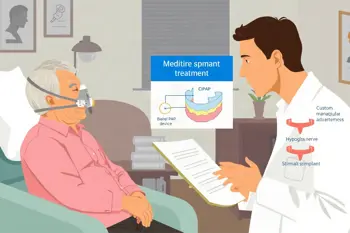
Hypoglossal nerve stimulation, including the Inspire system, is an implanted alternative for selected adults with moderate-to-severe obstructive sleep apnea. The system stimulates the nerve controlling tongue movement in response to breathing, helping keep the upper airway open without delivering continuous air pressure. The FDA describes the treatment as appropriate only for patients who meet defined clinical conditions and cannot adequately use or tolerate CPAP therapy. 3
Medicare Part B can cover implantation and related care when national and local requirements are satisfied, but coverage is not automatic. Records generally need to establish the obstructive diagnosis, the relevant severity, inadequate PAP use or intolerance, and clinical suitability for implantation. Surgical evaluation, facility participation, prior authorization, and plan-specific cost sharing can affect the final decision. Published consumer guidance identifies possible out-of-pocket responsibility after Medicare coverage, but actual amounts depend on the plan and care setting. 10 3
Surgery and non-device approaches
Medicare may cover certain obstructive sleep apnea surgeries when medical necessity and local policy requirements are met. Covered procedures can include uvulopalatopharyngoplasty, jaw advancement procedures, tracheostomy, and hypoglossal nerve stimulation. Surgical policies may require a diagnosis from a certified sleep disorders laboratory, an RDI of at least 15, documentation that CPAP failed or could not be tolerated, and counseling by a physician trained in sleep disorders. 12
Other approaches may be medically useful but are not automatically covered by Original Medicare as sleep-apnea equipment. Positional therapy, weight management, nasal-expiratory devices, and related interventions depend on the specific benefit category, diagnosis, and plan policy. Clinical guidance lists oral appliances, surgery, positional measures, and weight management among possible treatments, but treatment selection should account for severity, comorbidities, patient preference, and the ability to follow the prescribed therapy. 4 7
Costs, maintenance, and coverage barriers
For covered Part B equipment under Original Medicare, beneficiaries typically pay 20% of the Medicare-approved amount after meeting the annual Part B deductible. CPAP equipment commonly uses a rental-to-ownership structure, while oral appliances, implanted systems, and surgery involve different professional, facility, equipment, and follow-up charges. Medicare Advantage plans may use copayments or other cost-sharing arrangements, so the same clinical treatment can produce different financial responsibilities. 1 10
Maintenance is part of the coverage decision, not an afterthought. PAP users must meet adherence standards, obtain supplies according to replacement schedules, and retain clinical records. Oral-appliance users need dental fitting and monitoring, while implanted-device patients require surgical follow-up and device management. Before treatment, the relevant billing code, supplier enrollment, documentation requirements, network status, and prior-authorization rules should be identified. If a claim is denied, the beneficiary can review the written reason and use Medicare's formal appeals process. 1 2 6
Sources
- Medicare.gov, Continuous Positive Airway Pressure Devices
- Centers for Medicare & Medicaid Services, Positive Airway Pressure Devices LCD L33718
- U.S. Food and Drug Administration, Inspire Upper Airway Stimulation System
- National Heart, Lung, and Blood Institute, Sleep Apnea Treatment
- American Academy of Sleep Medicine and American Academy of Dental Sleep Medicine guideline
- American Academy of Dental Sleep Medicine, Oral Appliance Therapy
- Mayo Clinic, Sleep Apnea Diagnosis and Treatment
- Cleveland Clinic, Sleep Apnea Treatment
- Johns Hopkins Medicine, Oral Appliances for Sleep Apnea
- Inspire Sleep, Medicare Coverage Information
- LegalClarity, Medicare Coverage for Oral Appliances and HCPCS E0486
- LegalClarity, Medicare Coverage for Sleep Apnea Surgery