
itinerary travel to Portugal: A Reported Planning Framework for First-Time Visitors
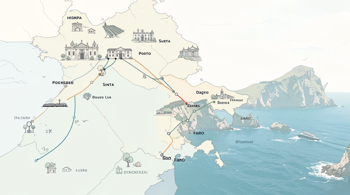
Itinerary travel to Portugal commonly follows a north-south route linking Lisbon, Sintra, Porto, the Douro Valley, and the Algarve. A seven-day trip can focus on Lisbon, Sintra, and Porto, while a ten-day plan allows time for Lagos, Sagres, or additional wine-country exploration. The main planning issue is balancing regional variety against long transfer days. 1
How Portugal Routes Are Commonly Structured
A standard ten-day itinerary connects Lisbon, Porto, and Lagos, with Sintra, the Douro Valley, and Sagres treated as day trips. The sequence begins in Lisbon, continues north to Porto, and finishes in the Algarve, where Lagos provides access to beaches, cliffs, coastal walks, and the western departure point of Faro Airport. This arrangement reduces backtracking when flights can be scheduled into Lisbon and out of Faro. 2
Seven days requires a narrower decision. One researched route divides the week into three days in Lisbon, two in Porto, and two in the Algarve, while another advises choosing either Porto and the Douro Valley or the Algarve rather than combining every region. The reason is logistical rather than geographic: Lisbon to Porto takes roughly three hours by train, while Porto to Lagos can require four to five hours overland. 3
Lisbon as the Arrival and Orientation Base
Lisbon is the principal international gateway in the supplied itinerary research, with Humberto Delgado Airport serving as the usual arrival point. The metro reaches the central area in approximately 20 minutes, with a reported fare of about EUR 1.80 using a Viva Viagem card and an additional EUR 0.50 for the card. A taxi or ride-hailing journey to Baixa is reported at approximately EUR 15 to EUR 20. 4
Three Lisbon districts repeatedly appear as practical bases. Baixa and Chiado provide central walking access and transport connections; Alfama offers narrow historic streets, viewpoints, and traditional character; and Príncipe Real combines restaurants, boutique accommodation, and a somewhat quieter setting. Core sightseeing includes Praça do Comércio, Rua Augusta, Rossio, the Alfama lanes, Castelo de São Jorge, Belém, Jerónimos Monastery, and the Tagus waterfront. Lisbon's hills and cobblestones make supportive walking shoes a practical consideration. 1
Sintra and the Lisbon Surroundings
Sintra is generally positioned as a full day trip from Lisbon rather than a separate overnight base. The commuter train from Rossio Station takes approximately 40 minutes, and the destination's principal planning challenge is managing visitor volume at Pena Palace and Quinta da Regaleira. Research sources consistently advise arranging timed attractions and winery or tour activities ahead of the travel date, particularly during peak months and weekends. 5
A Sintra day requires realistic pacing because palace visits involve hills, transfers, and substantial walking. The itinerary logic places Sintra on the second or third day in Lisbon, allowing travelers to recover from international arrival before tackling the excursion. In a seven-day route, Sintra remains one of the clearest additions because it provides a contrasting landscape and architectural experience without requiring a hotel change. 6
Porto and the Douro Valley
Lisbon and Porto are connected by Alfa Pendular high-speed rail in approximately two hours and 50 minutes, making the train the central transport option between the two largest cities. Porto itineraries commonly include the Ribeira waterfront, port-wine cellars in Vila Nova de Gaia, historic streets, viewpoints, and regional food. Ribeira is identified as an atmospheric base, while other central areas can offer easier access to restaurants and transport. 7
The Douro Valley can be visited as a day trip from Porto or used as a longer closing section. One ten-day plan assigns three nights to the valley, describing the Porto to Pinhão train journey as approximately two hours and 30 minutes along the river. The region is associated with terraced vineyards, port production, river scenery, and quinta tastings. Rail travel reduces driving requirements, although organized tastings and popular valley experiences require advance planning. 8
Choosing the Algarve and Southern Stops
The Algarve changes the rhythm of the itinerary from urban sightseeing to coastal activities. Lagos is repeatedly used as the base because it combines an old town, marina, beaches, cliff scenery, and coastal walks. Sagres is presented as a day trip from Lagos, while Faro functions as a useful departure airport. A route ending in Lagos is therefore most coherent when the return flight leaves from Faro rather than Lisbon. 1
The Algarve should not be added automatically to a short cultural itinerary. Research comparing seven-day routes concludes that Lisbon plus Porto is stronger for food, wine, culture, and rail logistics, while Lisbon plus the Algarve is more appropriate for a beach-focused trip, particularly from late spring through early autumn. Adding all three regions in one week creates a faster, transfer-heavy schedule with less time for deeper exploration. 9
Transport, Timing, and Practical Friction
Portugal's principal cities are well suited to public transportation, especially the Lisbon to Porto rail corridor. Rural areas such as the Alentejo may be more practical by rental car, according to the supplied general research, while the Lagos to Porto connection deserves particular attention because the journey is long by land. A route should count intercity travel as part of the sightseeing day rather than treating every transfer as separate unused time. 10
Several recurring friction points affect itinerary quality. Lisbon and Porto are steep, Sintra requires advance coordination, and Douro tastings can fill during busy periods. Restaurant couvert, consisting of items such as bread, cheese, and olives, is charged when consumed, so travelers should clarify whether they want it kept. Portugal is in the Schengen Area, and United States citizens generally have tourist entry permission for stays of up to 90 days, subject to current official requirements. 4
Route Selection by Trip Length
For seven days, the most coherent structures are Lisbon, Sintra, and Porto, or Lisbon, Sintra, and the Algarve. The first emphasizes historic cities, dining, port wine, and rail simplicity. The second emphasizes Lisbon's monuments and southern beaches. For ten days, the country supports a broader circuit including Lisbon, Sintra, Porto, the Douro Valley, and Lagos, although every added region introduces another transfer and reduces unstructured time. 3
Longer itineraries can distribute movement more comfortably. A twelve-day plan places three days in Lisbon, three in Lagos, and six in Porto, including day trips to Peso da Régua and Guimarães. Other planning material identifies Coimbra and Óbidos as possible additions when time extends beyond the core route. These alternatives illustrate the central trade-off: a trip can add destinations, but the quality of the schedule depends on protecting sufficient nights at each base. 2
Sources
- My Trip Blueprint, “10 Days in Portugal: Day-by-Day Itinerary + Map”
- The Portugal Guides, “One Week in Portugal: The Classic First-Visit Itinerary”
- Portugal Wander, “Portugal Itinerary 7 Days: Lisbon, Porto & Algarve in a Week”
- The Portugal Guides, Lisbon arrival and day-planning information
- My Trip Blueprint, booking and Sintra planning guidance
- Destination.com, “10 Days in Portugal: Lisbon, Porto, and the Douro Valley”
- CP Trains and supplied Portugal rail research
- Destination.com, Douro Valley route information
- Travel-Luck, “Portugal Itinerary 7 Days: A Realistic One-Week Route”
- Supplied general Portugal transportation and entry research