
Pilates Courses for Seniors: An Evidence-Based Guide to Formats, Safety, and Access
Pilates courses for seniors are commonly presented as low-impact programs centered on balance, mobility, posture, core strength, and controlled movement. The available examples range from five-class beginner foundations and six-class active-ageing series to small-group sessions, chair-based exercise, and dedicated reformer classes for adults over 60. 1
What senior Pilates courses typically teach
Introductory courses generally establish breath, alignment, core engagement, flexibility, balance, and movement control before progressing to more demanding exercises. Pilatesology’s Pilates Foundations program uses five classes and a slow tempo for people new to Pilates, while InstructorLive describes a six-class, six-week active-ageing program with 20-minute workouts. Research indexed by the National Library of Medicine reports that Pilates training can improve dynamic balance and physical performance in older adults. 1 2 3
- Common learning goals include posture, stability, flexibility, and body awareness.
- Beginner formats emphasize controlled technique rather than speed.
- Some programs provide written transcripts or weekly exercise video clips for review. 1 4
Mat, reformer, chair, and supported formats
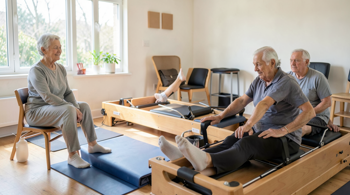
Course design depends heavily on the participant’s mobility and the equipment available. Mat classes may include floor work and props such as balls, bands, and light weights. Reformer sessions use springs for assistance and may not require floor transfers. Chair Pilates keeps the participant seated, while supported classes combine a chair with gentle strengthening and flexibility exercises. InstructorLive specifically identifies seated exercise for older adults, chair-bound people, and those with limited mobility. 2 5 6
- Mat format: may suit participants comfortable moving to and from the floor.
- Reformer format: can provide spring assistance and stability.
- Chair format: supports people who have difficulty getting up from the floor.
- Supported group format: may use chairs, walls, or resistance bands for modification. 4 6
Course structure and class size
Senior Pilates courses differ in length, class size, and instructional intensity. A Sale, Cheshire, program for adults aged 60 and over specifies a maximum of six participants so exercises can be observed and modified. Its functional approach connects the movements with daily activity, mobility, holidays, and hobbies. Pam’s Pilates describes a seated and supported class with a maximum of 12 people. Other examples include a 50-minute class for adults aged 50 and over in Columbia, Maryland, and a 55-minute senior session in Singapore. 4 6 7 8
- Small groups may allow more individual correction and adaptation.
- Shorter seated sessions can be practical for limited stamina.
- Longer mat sessions may include gentle floor work and props.
- Course schedules, locations, fees, and enrollment status require verification because listings change; one supplied event page is marked as passed. 7 9
Potential benefits and limits of the evidence
The supplied research links Pilates with improvements in balance, functional mobility, flexibility, physical performance, and quality of life for some older or clinically affected populations. A Journal of Bodywork and Movement Therapies source reports significant improvements in flexibility and functional mobility among healthy older adults participating in community Pilates. Mayo Clinic describes Pilates as a therapeutic exercise approach for quality-of-life improvement in people with chronic lower back pain. These findings support potential benefits, but they do not make every exercise appropriate for every participant. 3 10 11
- Results depend on consistency, starting ability, instruction, and exercise modification.
- Pilates should not be treated as a substitute for diagnosis or medical rehabilitation.
- Claims about bone density, pain, or fall prevention should be discussed in the context of individual health conditions.
Safety screening and modification
Course providers identify several situations requiring caution or professional clearance. The Atlanta senior reformer guidance advises consultation with a surgeon after knee or hip replacement, careful modification for severe osteoporosis, and private instruction as a possible starting point for balance problems. It also identifies active rehabilitation without provider clearance, acute spinal compression fracture, bed rest, and strict activity restrictions as reasons to hold off. Chair-based and supported formats can reduce floor-transfer demands, but they still require appropriate screening. 9 6
- Ask whether exercises can be performed seated, standing, or with support.
- Report osteoporosis, arthritis, surgery, injury, balance limitations, and pain before class.
- Stop an exercise that causes sharp pain, unusual symptoms, or instability.
- Confirm whether a physician, surgeon, or rehabilitation professional should provide clearance.
How to assess a course objectively
Useful evaluation criteria include instructor training, class size, equipment requirements, accessibility, stated age range, and modification policy. The Pilates Method Alliance is identified as a directory resource for certified instructors, while Balanced Body provides continuing education related to senior fitness. Community organizations such as YMCA centers and SilverSneakers are described as sources of low-impact movement classes for older adults. A suitable course description should explain who the class is for, whether floor work is required, how progression is handled, and what happens when an exercise must be adapted. 12 13 14 15
- Check certification and experience with age-related movement changes.
- Compare seated, supported, mat, and reformer requirements.
- Review cancellation, transfer, equipment, and attendance policies before payment.
- Prefer clear safety information over broad promises about pain relief, independence, or bone health.
Sources
- Pilatesology, Pilates Foundations
- InstructorLive, Active Ageing Pilates
- National Library of Medicine, Pilates and balance in older adults
- Senior Fit Solutions, Pilates Beginners Course 60+
- The Studio Pilates, Pilates for Seniors Atlanta
- Pam’s Pilates, Seated and Supported Class
- Active.com, Move with Ease Pilates for Seniors
- Space For Pilates, Seniors Pilates Singapore
- Mayo Clinic, Pilates for beginners and chronic low back pain
- Journal of Bodywork and Movement Therapies, Pilates in older adults
- Verywell Fit, Chair Pilates exercises
- Pilates Method Alliance
- Balanced Body, Senior Fitness Education
- YMCA, Fitness and Wellness
- SilverSneakers, Fitness Class Resources