
7-Day Japan Package with Flights and Hotel Included: A Neutral Travel Planning Analysis
A 7-day Japan package with flights and hotel included generally refers to a structured fly, stay, and guided tour covering several major destinations in one trip. Current examples describe international flights, multiple hotel nights, sightseeing, daily breakfast, and intercity rail travel, but the precise inclusions, departure points, dates, room categories, and taxes vary by provider. 1
What a Seven-Day Package Commonly Contains
The clearest documented seven-day example includes international flights arriving in Osaka and returning from Tokyo, six hotel nights, breakfast each day, private deluxe coach transportation, a high-speed bullet train journey, an expert guide, and sightseeing admissions listed in the itinerary. Hotels are described as 3.5 to 4-star properties in convenient locations. 1 The number of nights therefore deserves careful checking because “seven-day” may include travel time while providing six hotel nights.
Other published package descriptions use seven nights rather than six. One itinerary includes round-trip international airfare from Los Angeles or San Francisco, four-star hotels, a Shinkansen journey from Kyoto to Nagoya, a Lake Kawaguchi cruise, English-speaking guides, and eight meals. 2 A separate seven-night arrangement lists three nights in Tokyo, two in Kyoto, and two in Osaka, with breakfast and guided walking tours. 4 These differences show why baggage, transfers, meals, and airport taxes should be verified in writing.
How the Main Routes Are Organized
Japan’s principal seven-day routes usually connect Tokyo, Kyoto, and Osaka, either in a Tokyo-to-Osaka direction or the reverse. One documented plan places travelers in Tokyo for three nights, Kyoto for two, and Osaka for two, with bullet train tickets between the cities. 4 Another itinerary travels from Osaka to Tokyo and highlights Osaka Castle, Kyoto’s Kinkakuji, Mount Fuji, Lake Kawaguchi, Meiji Shrine, and Tokyo exploration. 2
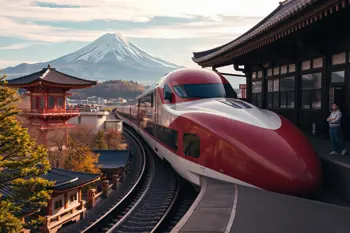
Some seven-day guided programs add Nara and allow a choice among Mount Fuji, Nikko, or Kamakura. The stated design balances guided sightseeing with free time and uses the Shinkansen for movement between cities, including a possible view of Mount Fuji during the journey. 3 A seven-day small-group route also runs from Tokyo to Osaka, is guided in English, accommodates groups of one to 16, and identifies Shibuya as a starting area. 5 This structure is efficient but leaves limited time for remote regions or extensive seasonal activities.
Flights, Airports, and Arrival Logistics
Flight arrangements are not uniform across packages. The documented Osaka-to-Tokyo plan uses an open-jaw structure, arriving in Osaka and departing from Tokyo, while another example describes round-trip flights into Tokyo and returning from Osaka. 1 Travelers should compare the arrival and departure airports, airline routing, connection requirements, baggage allowance, seat selection rules, and whether airport taxes are included. A package price cannot be evaluated accurately from airfare alone.
Narita International Airport publishes access information for rail and bus connections to Tokyo and nearby areas. 6 Kansai International Airport provides transport information for Osaka, Kyoto, Kobe, and other cities in western Japan. 7 Airport transfers may remain the traveler’s responsibility. One independently arranged Japan tour specifically states that the transfer from Tokyo airport to the hotel is not included, although an optional transfer service is described. 6 That possibility makes arrival instructions and transfer coverage important parts of the package documentation.
Hotels, Meals, and Guided Services
Accommodation standards range from three-star hotels to 3.5 and 4-star properties. A seven-day budget-oriented small-group itinerary lists possible three-star and four-star Tokyo hotels, while another published route identifies the Mitsui Garden Hotel Shiodome Italia-Gai or similar in Tokyo, Miyako Hotel Kyoto Hachijo or similar in Kyoto, and Sheraton Miyako Hotel or similar in Osaka. 4 “Similar” indicates that the named property may not be the final assignment.
Meal coverage also varies substantially. Daily breakfast is included in several documented arrangements, while one flight, hotel, and tour package specifies eight meals. 2 Guided components can include Tokyo’s Shibuya district, Kyoto’s Gion and geisha district, Osaka Castle, temples, markets, and observation sites. 2 A guided program may reduce navigation demands, but scheduled sightseeing can involve walking, fixed meeting times, coach transfers, and group pacing. Travelers should confirm accessibility, luggage handling, room occupancy, and whether admission fees are included.
Cost Information and Comparison Limits
Published figures show a wide range because the products differ in duration, departure market, accommodation, guidance, and included transport. One seven-night flight, hotel, and tour vacation is presented from $3,998 for two people, with airfare from Los Angeles or San Francisco and four-star hotels. 2 Another seven-night Tokyo, Kyoto, and Osaka arrangement is listed from $4,598 for two. 4 These figures are reference points from published pages, not universal market prices.
Land-only guided tours can display lower headline figures because international airfare is absent or because the service level differs. ENJYU JAPAN lists a seven-day route at approximately USD 1,300 per person and provides group-size pricing examples, while TourRadar pages show figures of US $2,548 and US $948 per person for different seven-day itineraries. 3 5 8 Expedia describes Japan vacation packages as allowing flights and hotels to be combined, with possible package savings of up to $2,000, but the final amount depends on selected travel components. 9
Entry Requirements and Practical Risks
U.S. passport holders visiting Japan for tourism can generally enter for short stays of up to 90 days under Japan’s visa-exemption conditions, subject to current eligibility and entry rules. 10 The U.S. Department of State provides current information on passport matters, local laws, health considerations, safety, and security conditions. 10 Entry policies can change, so package descriptions should not be treated as a substitute for official government guidance.
Japan’s Digital Agency describes Visit Japan Web, which supports online completion of immigration, customs, and tax-free shopping procedures before arrival. 10 Japan Customs separately publishes passenger information on customs declarations. 10 Rail planning also requires judgment: the Japan Rail Pass covers specified rail travel for eligible users and has defined validity periods, while Tokyo Metro publishes separate ticket and fare information for local subway travel. 10 Kyoto and Osaka maintain official transportation guidance, and those sources should be consulted when a package leaves local travel unstructured. 10
Sources
- My Cruises, 7 Day Golden Highlights of Japan Tour
- DealNews, 7-Night Japan Flight, Hotel, and Tour Vacation
- ENJYU JAPAN, 7-Day Golden Route Tour
- DealNews, 7-Night Tokyo, Kyoto and Osaka Flight, Hotel, and Tour Vacation
- TourRadar, 7 Day Japan Golden Route by UME Travel Co. Ltd
- Narita International Airport, Access Information
- Kansai International Airport, Access Information
- TourRadar, 7 Day Japan on a Budget Small Group Tour
- Expedia, Japan Vacation Packages
- U.S. Department of State, Ministry of Foreign Affairs of Japan, Digital Agency of Japan, Japan Customs, Japan Rail Pass, Tokyo Metro, Kyoto City Official Travel Guide, and Osaka Convention and Tourism Bureau