
Train tours across the Swiss Alps: A comprehensive guide to panoramic rail travel
Exploring Switzerland through its extensive rail network offers a specialized perspective on the country’s alpine topography, characterized by high-altitude engineering and panoramic vistas. Train tours across the Swiss Alps leverage a highly integrated system that connects urban centers with remote mountain resorts, glaciers, and UNESCO World Heritage sites 8. This analytical overview focuses on the primary rail routes, the mechanics of travel, and the operational structure required to experience these high-altitude landscapes effectively.
Iconic Panoramic Rail Routes and Engineering Feats
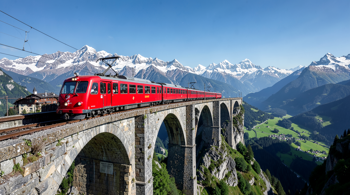
The Swiss alpine rail experience is defined by several legendary routes that utilize custom-built panoramic carriages to maximize visibility. The Glacier Express, often cited as the world’s slowest express train, connects St. Moritz and Zermatt in an approximately eight-hour journey 1. This route requires traversing 291 bridges and navigating 91 tunnels, showcasing advanced civil engineering through rugged alpine terrain 1. Similarly, the Bernina Express offers a unique passage between Chur, Switzerland, and Tirano, Italy, climbing through the Albula and Bernina passes 3. This particular line is recognized as a UNESCO World Heritage property for its integration into the alpine landscape 3.
- Glacier Express: Zermatt to St. Moritz, featuring the Oberalp Pass 1.
- Bernina Express: Chur to Tirano, notable for its UNESCO status 3.
- GoldenPass Express: A direct link connecting Montreux and Interlaken 4.
- Gotthard Panorama Express: Integrates Lake Lucerne boat travel with rail transit toward Ticino 5.
High-Altitude Excursions and Mountain Railways
Beyond the main transit lines, specialized cogwheel and mountain railways provide access to peaks that define the Swiss skyline. The Jungfrau Railway reaches the Jungfraujoch station, situated at 3,454 meters, serving as one of the highest railway altitudes in Europe 6. Another prominent ascent is the Gornergrat Railway, which climbs from Zermatt to a summit at approximately 3,089 meters, providing direct views of the Matterhorn 7. These excursions often operate as extensions to the primary rail network, requiring careful scheduling as they depend on favorable weather conditions for optimal viewing.
| Railway Route | Primary Destinations | Notable Feature |
|---|---|---|
| Jungfrau Railway | Jungfraujoch | High-altitude access at 3,454m |
| Gornergrat Bahn | Zermatt to Gornergrat | Matterhorn vantage point |
| Rigi Railways | Vitznau, Goldau, Mount Rigi | Historic mountain transport |
Logistical Infrastructure and Travel Coordination
Coordinating travel across these diverse routes is facilitated by the Swiss Federal Railways (SBB), which manages the national timetable and essential transit connectivity 8. Unlike standard intercity trains, panoramic routes frequently necessitate specific seat reservations and supplemental fees, even for passengers holding broader travel passes 9. Managing luggage is a significant consideration; many travelers utilize rail-based luggage transfer services to ensure ease of movement between destinations. Because these tours often involve multi-day itineraries, organizing accommodation in hubs like St. Moritz, Zermatt, and Lucerne is typically addressed as a pre-trip requirement 2.
Operational Realities and Service Standards
Most organized rail journeys in the region are structured as multi-day packages, ranging from 8 to 15 days, which aim to consolidate logistics such as hotel bookings and seat reservations 4, 5. Packages often include tourist cards that cover local public transportation in cities like Montreux or Lucerne, reducing daily friction for visitors 2. Travelers should note that seasonal changes significantly affect route availability, particularly for high-altitude passes during winter months, and availability of premium seating on routes like the Glacier Express can be limited during peak tourism periods 8.
Regulatory and Entry Requirements
International visitors must consider the regulatory framework for entry into Switzerland. For U.S. citizens, tourism stays of up to 90 days within any 180-day period generally do not require a Schengen visa, although adherence to current passport and documentation requirements remains mandatory 11, 12. It is advised that all travelers verify their status via the Swiss State Secretariat for Migration. Additionally, health and travel insurance are typically recommended as they are not universally included in standard rail packages, creating a potential financial risk for travelers who do not secure private coverage 2.
Market Trends and Sustainable Transit
The rise of rail-based tourism in Switzerland reflects a broader trend toward sustainable alpine exploration. By utilizing electric rail infrastructure, these tours provide a low-impact alternative to mountain road travel. Current market offerings range from semi-guided experiences to fully managed group tours, with price points fluctuating based on the complexity of the itinerary, the class of service, and the duration of stay 2, 8. The emphasis remains on the integration of engineering excellence with natural preservation, allowing for consistent access to diverse geological zones without the need for private vehicle transport 8.
Sources
- Glacier Express, https://www.glacierexpress.ch/en/travel-planning/
- Exotik Journeys, Grand Train Tour of Switzerland
- Rhaetian Railway, https://www.rhb.ch/en/personal/railway-experiences/bernina-express
- Montreux Oberland Bernois Railway, https://www.mob.ch/en/pages/goldenpass-express
- Switzerland Tourism, https://www.myswitzerland.com/en-us/experiences/route/gotthard-panorama-express/
- Jungfrau Railways, https://www.jungfrau.ch/en-gb/jungfraujoch-top-of-europe/
- Gornergrat Bahn, https://www.gornergrat.ch/en/
- Swiss Federal Railways, https://www.sbb.ch/en
- Swiss Travel System, https://www.swisstravelsystem.com/en/tickets/swiss-travel-pass/
- Rigi Railways, https://www.rigi.ch/en
- State Secretariat for Migration, https://www.sem.admin.ch/sem/en/home/themen/einreise.html
- U.S. Department of State, https://travel.state.gov/content/travel/en/international-travel/International-Travel-Country-Information-Pages/Switzerland.html