
10 Easy Hairstyles for Busy Mornings: A Practical Styling Guide
Running late, with hair that looks like it fought a pillow and lost, is a familiar five-minute morning problem. Quick hairstyles can provide a polished appearance without a blow dryer, advanced technique, or lengthy routine. The most reliable approaches work with existing texture, use clear parting and clean edges, and rely on simple tools such as elastics, bobby pins, claw clips, or scrunchies. 1
1. Sleek Low Bun
A sleek low bun gathers hair at the nape and turns it into a compact, professional style in roughly two to three minutes. Brush or finger-comb the hair into position, twist the length, and secure it with an elastic, satin scrunchie, claw clip, or pins. A small amount of smoothing product can control flyaways, while two loose strands create a softer outline. The style works particularly well for medium to long hair, including second-day hair and mornings affected by humidity. 2
2. Messy High Bun
The messy high bun is designed to look relaxed rather than perfectly arranged. Gather hair at the crown, twist it loosely, wrap it into a bun, and secure it with an elastic or a few pins. Pulling out selected pieces around the face prevents the result from appearing overly tight. This option suits medium and long hair, especially when natural texture or overnight movement already provides volume. Dry shampoo can add grip and fullness when the roots appear flat. 3
3. Sleek Low Ponytail
A sleek low ponytail is a structured alternative to a bun and can be completed by brushing hair toward the nape and securing it with an elastic. A neat center or side part makes the result look deliberate, while smoothing cream, hair oil, or light gel can reduce visible flyaways. For a refined finish, wrap a small section of hair around the elastic and pin it underneath. The style is adaptable to office settings, errands, and casual clothing. 4
4. Half-Up Top Knot
The half-up, half-down top knot removes hair from the face while leaving the rest of the length visible. Separate the hair from the temples upward, gather that section at the crown, twist it into a small bun, and secure it with an elastic or pins. The arrangement is useful for hiding less-fresh roots without committing to a full updo. It works across straight, wavy, and lightly curly textures, although the size of the bun depends on the amount of hair gathered. 1
5. Claw-Clip Twist
A claw-clip twist provides an updo with fewer steps than a pinned bun. Gather the hair at the back, twist it upward, fold the ends toward the crown, and place a suitable clip across the twist. The clip should hold the gathered weight without forcing the hair into a painful position. This method is especially practical for medium to long hair and can retain a deliberately loose appearance. A larger clip generally accommodates thicker or longer hair, while a smaller clip suits lighter sections. 5
6. Low-Twist Ponytail
The low-twist ponytail adds visual detail to a basic tied-back style. Gather hair at the nape, divide it into two sections, twist each section, cross the twists over one another, and secure the ends. Gently loosening the edges can make the result appear fuller. This technique is useful for second-day or wavy hair because existing texture helps the twists look less rigid. Layered hair may need the ends tucked under and held with bobby pins to keep shorter pieces controlled. 6
7. Quick Side Braid
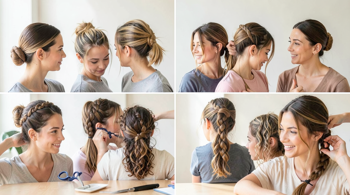
A small side braid is a practical way to control bangs, shorter layers, or hair that repeatedly falls across the face. Part the front section, braid it toward one ear, and secure the end behind or beside the ear with a small elastic or pin. The remaining hair can stay down, join a ponytail, or be gathered into a bun. The technique requires less coordination than a full-head braid and can add structure to otherwise unstyled hair. 1
8. Low Braided Bun
A low braided bun combines the stability of a bun with the visual order of a braid. Make a low ponytail, braid the length, wrap the braid around its base, and secure it with pins or an elastic. The braid helps contain long hair and can create a polished appearance suitable for professional environments. It may also transition from an early workout or commute into the working day. Keeping the braid slightly loose reduces a stiff finish and accommodates natural movement. 5
9. Curly Puff
A curly puff gathers textured hair high on the head while preserving its natural volume. Use a wide, gentle tool or the fingers to collect the hair, then secure it with a soft band that does not compress the curls excessively. The approach avoids forcing every strand into a smooth shape and can be adjusted according to the desired height. It is most effective when the existing curl pattern is refreshed lightly rather than repeatedly brushed, which can disturb definition. 3
10. Overnight-Braid Waves
Overnight braids shift part of the styling process to the evening before. Divide slightly damp or dry hair into one or more loose braids, secure the ends, and undo them in the morning for heatless waves. Texturizing or sea salt spray can help create a beachy, intentional pattern, while finger separation prevents the waves from becoming overly uniform. The method is most predictable when the hair is fully dry before the braids are removed, and it can be followed by a simple half-up style or ponytail. 4
Choosing Tools and Managing Wear
Tool selection affects both appearance and comfort. Satin or silk scrunchies can reduce creasing and are useful when a style must later be undone, while claw clips offer a quick alternative to repeated tight tying. Dry shampoo is commonly used between washes to add texture and volume, particularly before buns or other updos. A rat-tail comb can create a sharper part, although a fingertip can establish a workable part when speed matters. 2
Quick styling still has maintenance limits. Repeatedly wearing very tight ponytails or buns may create tension, so varying the height and placement of styles is a practical precaution. Clips and elastics should feel secure without causing discomfort, and products should be matched to the hair's texture and density rather than applied heavily. The most dependable morning routine is therefore not a single universal hairstyle, but a small rotation that includes one loose option, one polished option, and one texture-preserving option. 6
Sources
- Lovelyish, “20 Easy Hairstyles for Mornings to Speed Up Your Routine”
- Grazia USA, “Unruly Hair? These 7 Quick Hairstyles Will Save Your Most Chaotic Mornings”
- Sim's Life, “Easy Hairstyle Ideas for Busy Mornings”
- LUXY Hair, “8 Quick & Easy 2-Minute Hairstyles”
- NewsX, “From Messy to Polished: 3 Lifesaver Hairstyles for Your Rushed Mornings”
- Captions Joy, “3 Easy Hairstyles for Busy Mornings That Take Less Than 5 Minutes”