
itinerary travel to Canada: A Practical Route-Planning Report for First-Time Visitors
An itinerary travel to Canada plan works best when it treats the country as several regional journeys rather than one compact destination. The most practical routes focus on either eastern cities and Niagara Falls or western mountains and Pacific coast scenery, while longer trips connect both regions through internal flights or extended rail travel.
Choosing a Route by Trip Length
Seven days is generally suited to a focused regional itinerary. An eastern route can include Toronto, a Niagara Falls day trip, and Montreal across one week, with Toronto assigned three days and Montreal three days in one published plan. Another seven-day concept combines Toronto, Niagara Falls, Montreal, Quebec City, Vancouver, and Banff, but that approach requires multiple flights and leaves little flexibility for delays or weather changes. 1
Ten days allows more balanced pacing. One established Ontario and Quebec loop uses Toronto for two days, Niagara Falls for one, Montreal for three, and Quebec City for four. A separate western loop covers Vancouver, Whistler, Banff, Jasper, and Calgary, with ten days treated as the minimum for the route. These alternatives should normally be selected separately rather than combined unless the trip is extended to fourteen days. 2
Eastern Canada: Cities, Waterfalls, and French Canada
The eastern itinerary is comparatively efficient because Toronto, Niagara Falls, Montreal, and Quebec City are concentrated within one broad corridor. Toronto highlights include the CN Tower, Kensington Market, the Royal Ontario Museum, St. Lawrence Market, the Distillery District, and the Toronto Islands. Niagara Falls is approximately 1.5 to 2 hours from Toronto by road in one planning guide, making a day visit possible, although an overnight stay changes the experience by allowing evening views and additional Niagara Parks attractions. 3
Montreal provides Old Montreal, the Old Port, Mount Royal, Jean-Talon Market, the Plateau, cafés, boutiques, and street art. Quebec City adds the fortified Old City, the Plains of Abraham, Île d'Orléans, and access toward Charlevoix. Toronto to Montreal can be traveled by flight in about 1.5 hours, train in about 5 hours, or bus in about 6 hours, excluding station and airport procedures. VIA Rail is the principal intercity rail reference for schedules and route planning. 4
Western Canada: Vancouver and the Rocky Mountains
Western routes emphasize landscape rather than dense urban sightseeing. Vancouver commonly receives two or three days for Stanley Park, Granville Island, the Museum of Anthropology, the waterfront, and North Shore areas. The Sea-to-Sky corridor connects Vancouver with Whistler and includes stops such as Shannon Falls and the Peak 2 Peak Gondola. From there, itineraries continue toward Banff National Park, where Lake Louise, Moraine Lake, Banff town, and mountain viewpoints form the central sightseeing sequence. 5
The western loop can continue from Banff along the Icefields Parkway toward Jasper. Typical stops include the Columbia Icefield, Athabasca Falls, and Maligne Lake before traveling to Calgary. The route is most reliable from June through September because mountain access and seasonal facilities are more dependable during that period. A fourteen-day coast-to-coast plan assigns Vancouver two days, the Sea-to-Sky route one day, Banff three days, Jasper two days, Calgary one day, and the eastern cities afterward. 6
Fourteen-Day and Coast-to-Coast Planning
A fourteen-day journey can connect Vancouver, the Rockies, Toronto, Niagara Falls, and either Montreal or Quebec City. The standard structure uses one internal flight from Calgary to Toronto, approximately 3.5 hours, then continues east by rail or road. VIA Rail's Canadian train provides an alternative involving approximately three nights and four days across the country, making the train itself a major part of the itinerary rather than simply a transfer. 7
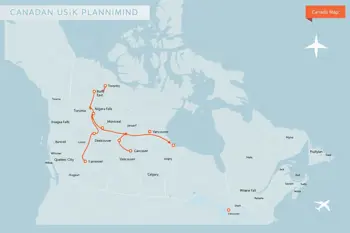
Another two-week plan divides the trip into Vancouver for days 1 to 3, Banff and the Rockies for days 4 to 7, Toronto for days 8 to 11, and Montreal plus Quebec City for days 12 to 14. A road-trip and flight combination covering Toronto, Niagara Falls, Banff, Lake Louise, and Vancouver is described as approximately 4,400 kilometers of driving plus one flight. These distances demonstrate why attempting every major region by car can consume substantial sightseeing time. 8
Twenty-One Days and the Maritime Extension
Three weeks permits a broader sequence from Vancouver through Whistler, Banff, Jasper, Calgary, Toronto, Niagara Falls, Ottawa, Montreal, Quebec City, and Halifax. The twenty-one-day outline assigns three days to Vancouver, one to Whistler, three to Banff, two to the Icefields Parkway and Jasper, one to Calgary, two to Toronto, one to Niagara Falls, one to Ottawa, two to Montreal, two to Quebec City, and three to Halifax with regional day trips. 9
The longer route requires two internal flights when the Maritimes are included: Calgary to Toronto at approximately 3.5 hours and Quebec City to Halifax at approximately 1.5 hours. Halifax can serve as a base for Peggy's Cove, Lunenburg, and the Annapolis Valley. The itinerary can also substitute the VIA Rail Canadian for the western land section, although that changes the balance from active sightseeing and driving to a dedicated rail journey across Canada. 10
Entry, Costs, Seasons, and Practical Risks
Entry requirements depend on nationality and arrival method. U.S. citizens generally need a valid passport, passport card, or another accepted document for land or sea travel, while air travelers generally need a passport. Most U.S. tourists do not need a visitor visa, but travelers of other nationalities may require a visitor visa or electronic travel authorization. Requirements can change, so the Government of Canada and Canada Border Services Agency should be treated as the controlling references before reservations are finalized. 11
Published planning estimates place mid-range travel around CAD 165 to 245 per person per day, while another ten-day estimate gives approximately CAD 3,500 to 5,900 per person for the eastern loop and CAD 4,400 to 7,000 for the western loop, based on two people sharing. Summer brings the most dependable conditions in the Rockies but also higher demand. May and September to October can provide a different balance of weather, daylight, seasonal openings, and accommodation availability. 12
Transport, Park Access, and Final Preparation
Canada's size creates unavoidable transport friction. Crossing from Toronto to Vancouver involves roughly 4,400 kilometers, and travelers must account for flight connections, airport transfers, road conditions, and time-zone changes because Canada has six primary time zones. Rail links are practical in the Toronto to Montreal corridor, while western national park routes are generally more dependent on road transport or organized transfers. Amtrak also provides cross-border rail information for selected U.S. and Canadian connections. 13
Visitors entering Banff National Park by vehicle or using park facilities should verify current Parks Canada pass requirements, reservations, road conditions, and access restrictions. National park conditions can affect lake access, camping, shuttle arrangements, and mountain activities. Travel insurance is relevant because Canada's public healthcare system does not cover tourists, while credit cards are widely accepted and the Canadian dollar is the national currency. Weather, border rules, transportation schedules, and park notices should be checked again immediately before departure. 14
Sources
- Canada Spirit, 10-Day Canada Itinerary
- Voye Global, 7 Days in Canada Itinerary
- Visit Globally, 7-Day Canada Itinerary
- A Couple for the Road, Canada Itinerary
- My Itinerary Trips, 10 Days Canada Itinerary
- Canada Spirit, 14-Day Canada Itinerary
- Canada Spirit, 14-Day Coast-to-Coast Itinerary
- BestRoadTrip, Canada Road Trip
- Canada Spirit, 21-Day Canada Itinerary
- Canada Spirit, 21-Day Coast-to-Coast Trip
- Government of Canada and Canada Border Services Agency, visitor entry requirements
- Machu Picchu, Ultimate Canada Itineraries 2026
- VIA Rail Canada and Amtrak, cross-border and intercity rail information
- Parks Canada and Canada travel planning guidance