
itinerary travel to Mexico: A Reported Planning Framework for First-Time Visitors
For travelers researching an itinerary travel to Mexico, the most consistently recommended first visit combines Mexico City, Oaxaca, and the Yucatán Peninsula rather than concentrating entirely on Cancún’s resort zone. This structure links museums and historic districts, Indigenous and colonial culture, regional food traditions, Maya archaeology, cenotes, and Caribbean beaches while limiting unnecessary backtracking. A 10-day route can work with three principal bases, while 14 days allows more time for Oaxaca and the Yucatán. 123
How to structure the route
Mexico is geographically large, and the regions commonly included in first-time itineraries are distinct. One widely used 10-day framework allocates three days to Mexico City, two to Oaxaca, two to Mérida, one to Chichén Itzá and Valladolid, and two to Tulum or the Riviera Maya. Another plan uses three nights in Mexico City, three in Oaxaca, and seven nights in the Yucatán based in Playa del Carmen. These variations reflect a central planning choice: cultural depth inland or a longer coastal finish. 32
Travelers with seven days generally need to choose between Mexico City plus Oaxaca and Mexico City plus the Riviera Maya. A 10-day trip can connect two major regions with one internal flight, while a 14-day trip can include Mexico City, Oaxaca, Mérida or another Yucatán base, and the Caribbean coast without assigning every day to transit. The route is most coherent when flights arrive in Mexico City and depart from Cancún, creating an open-jaw journey instead of returning to the starting airport. 45
Days 1 to 3: Mexico City
Mexico City is commonly used as the starting point because Benito Juárez International Airport serves the capital and connects with the city’s central districts. Roma Norte and Condesa are frequently identified as practical bases for first-time visitors because they provide access to restaurants, parks, and neighborhood walking routes. Arrival day should remain light, with time for settling in and adjusting to the city’s elevation of approximately 2,240 meters. 214
A three-day outline can divide the city into a historic-center day, a museum and neighborhood day, and a major archaeological excursion. The Historic Center includes the Zócalo and Templo Mayor area. Chapultepec Park and the National Museum of Anthropology require several hours, while Coyoacán can be paired with the Frida Kahlo Museum, which is commonly described as requiring advance online booking because admission periods can fill. Teotihuacan is a separate day trip, reached from Terminal Norte by bus, with the Pyramid of the Sun and Avenue of the Dead as principal sites. 23
Days 4 to 6: Oaxaca
Oaxaca adds a different regional focus, centered on culinary traditions, markets, mezcal, craft production, colonial streets, and Indigenous history. Itineraries commonly assign three nights to Oaxaca City, allowing one arrival evening, one city-focused day, and one excursion day. Santo Domingo, local markets, and a mezcal tasting are recurring elements, while Monte Albán provides the principal archaeological outing near the city. 24
The transfer from Mexico City can be made by domestic flight or bus. One 10-day plan describes an overnight ADO GL bus departing Terminal TAPO at approximately 11 p.m. and arriving in Oaxaca around 5:30 a.m.; flights are presented as an alternative. Because an overnight bus affects the following morning, travelers should treat the arrival day as a reduced-activity period rather than scheduling a demanding excursion immediately. A daytime flight preserves more usable time but adds airport procedures and a separate transport leg. 3
Days 7 to 10: Yucatán and the Caribbean coast
The Yucatán segment can be organized around Mérida, Valladolid, Playa del Carmen, or Tulum. Mérida functions as a cultural and archaeological base, with Uxmal among the principal excursions identified in itinerary research. Valladolid is positioned closer to Chichén Itzá and several cenotes, while Tulum provides access to coastal beaches, the Tulum archaeological site, and nearby water activities. The choice of base changes the balance between colonial-city exploration, ruins, swimming, and beach time. 134
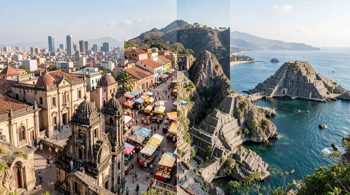
Chichén Itzá is a UNESCO World Heritage property and can be reached from Mérida, Valladolid, or the Riviera Maya, depending on the route. A condensed 10-day schedule might place Chichén Itzá and Valladolid on the same day, then continue toward Tulum. A longer plan can separate the archaeological visit from the transfer and reserve additional time for cenotes or the coast. Tulum Town is described in the research as a less costly lodging alternative to the beach zone, although accommodation choices should be assessed by location, transport access, and current conditions rather than by price alone. 121
Transport, timing, and accommodation logic
ADO buses are repeatedly identified as the main intercity option for routes linking cities in the Yucatán and nearby coastal destinations. Domestic flights are more relevant for longer connections such as Mexico City to Oaxaca or Oaxaca toward Mérida and Cancún. Rental cars are particularly useful for day trips from Valladolid, but they introduce obligations involving insurance, parking, road conditions, and vehicle return logistics. A route with fewer bases can therefore be more efficient than one that lists every notable destination. 123
Accommodation planning follows the same regional divisions. Roma or Condesa are commonly suggested in Mexico City, Oaxaca’s centro supports walking access to cultural sites, and Valladolid is positioned as a practical base for inland Yucatán excursions. In Tulum, the research distinguishes the Town area from the beach zone, where lodging prices are described as substantially higher. Published itinerary estimates place mid-range travel at approximately 90 to 200 U.S. dollars per person per day for a 14-day route, including lodging, food, activities, and transport, although actual totals vary by season and room arrangement. 21
Entry, safety, health, and return requirements
U.S. citizens should carry a valid U.S. passport for entry into Mexico. A passport card is generally limited to qualifying land and sea travel within the Western Hemisphere and should not be treated as a universal substitute for a passport book. U.S. citizens generally do not need a tourist visa for short visits, but Mexican immigration officials determine the authorized stay at entry. Visitor immigration documentation, including the FMM process where applicable, should be checked through official Mexican authorities before departure. 6789
Safety conditions differ significantly by Mexican state, so national-level assumptions are insufficient for a route crossing Mexico City, Oaxaca, and the Yucatán. Travelers should review current government advisories for each destination, use ordinary urban precautions, and confirm local transport arrangements. Health preparation should include being current on routine vaccinations and reviewing Mexico-specific CDC guidance concerning food, water, and other destination risks. On return to the United States, agricultural products, food, plants, and related goods may be restricted or confiscated, making customs and declaration rules part of itinerary planning. 101116
Sources
- A First-Timer's Mexico Itinerary: 10 Days, 0 Resorts, https://www.geekyexplorer.com/mexico-itinerary/
- 14-Day Mexico Itinerary, Discover Mexico, https://discovermexico.info/blog/14-day-mexico-itinerary/
- 10-Day Mexico Itinerary, The Mexico Guides, https://www.themexicoguides.com/itineraries/10-days-mexico/
- Mexico Local Guide: Mexico Itinerary, https://mexicolocalguide.com/mexico-itinerary/
- Rough Guides: Mexico Itineraries, https://www.roughguides.com/mexico/itineraries/
- U.S. Department of State, Mexico Country Information, https://travel.state.gov/content/travel/en/international-travel/International-Travel-Country-Information-Pages/Mexico.html
- U.S. Customs and Border Protection, Western Hemisphere Travel Initiative, https://www.cbp.gov/travel/us-citizens/western-hemisphere-travel-initiative
- Instituto Nacional de Migración, FMM Process, https://www.inm.gob.mx/fmme/publico/en/solicitud.html
- U.S. Embassy and Consulates in Mexico, https://mx.usembassy.gov/u-s-citizen-services/local-resources-of-u-s-citizens/traveling-to-mexico/
- U.S. Department of State, Mexico Travel Advisory, https://travel.state.gov/content/travel/en/traveladvisories/traveladvisories/mexico-travel-advisory.html
- Centers for Disease Control and Prevention, Mexico Traveler Health, https://wwwnc.cdc.gov/travel/destinations/traveler/none/mexico
- UNESCO World Heritage Centre, Chichén-Itzá, https://whc.unesco.org/en/list/483/
- Visit Mexico, https://www.visitmexico.com/en
- Aeropuerto Internacional Benito Juárez Ciudad de México, https://www.aicm.com.mx/
- Mexico City Metro, https://www.metro.cdmx.gob.mx/
- U.S. Department of Agriculture, Traveling from Mexico with Agricultural Products, https://www.aphis.usda.gov/traveling-with-ag-products/another-country/mexico