Military surplus generators for commercial use: An analysis of tactical power integration
The Market and Origin of Military Surplus Power Systems
The global military generator market was valued at $1.3 billion in 2021 and is projected to reach $2 billion by 2031, reflecting a compound annual growth rate of 4.7% throughout the decade 1. Military surplus generators are increasingly utilized by commercial entities that require robust, field-tested power solutions for off-grid operations, agricultural needs, and emergency backup 2, 3. Unlike standard industrial units, these generators are engineered to withstand extreme environmental conditions, making them durable options for remote worksites 2, 6.
It is essential to distinguish between a surplus generator and a traditionally used generator. Surplus units are frequently brand-new items that remained unsold in inventory, were produced in excess of military requirements, or were purchased by government agencies but never deployed 1. Commercial buyers often source these units through specialized auctions such as GovPlanet or Ritchie Bros, where equipment is typically sold in as-is condition 3, 6, 11. Understanding that these assets are decommissioned or excess stock is the first step in assessing their suitability for a specific commercial application 3.
Technical Specifications and Operational Capabilities
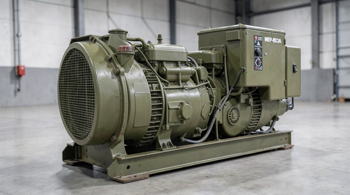
Military generators, particularly those in the MEP series, are valued for their rugged construction and capacity to function in high-demand environments 2, 11. Popular models such as the MEP-802A (5kW) and the MEP-803A (10kW) are frequently identified as suitable candidates for private-sector applications 11. These systems often feature multi-fuel compatibility, allowing them to operate on diesel, JP-8, or kerosene, which provides significant logistical flexibility in remote or resource-limited settings 11.
Commercial integration requires an understanding of non-standard military hardware. Many of these units are equipped with NATO slave connectors and 24-volt electrical systems, necessitating professional modifications to interface with standard 120/240V commercial electrical panels 11. Furthermore, while these units offer high durability, operators should expect higher noise profiles compared to modern commercial silent generators, which may require secondary sound attenuation measures for urban or event-based usage 11.
Regulatory Compliance and Emissions Challenges
One of the most significant friction points for businesses adopting military surplus equipment is regulatory compliance. Many legacy military generator models do not meet modern Tier 4 emissions standards, which are mandated for stationary commercial installations in various jurisdictions 11. States such as California maintain rigorous programs, such as the Portable Diesel Engine Airborne Toxic Control Measure (ATCM), which may restrict the usage of older, high-emission diesel power units 16.
Before purchasing a surplus unit, businesses must evaluate local air quality requirements and the intended location of the generator. Operating a non-compliant unit in a regulated area can lead to significant administrative hurdles or operational prohibitions. It is recommended that commercial operators review local environmental agency guidelines to determine if the specific model under consideration aligns with regional air quality standards for stationary or mobile power generation 16.
Maintenance Realities and Support Infrastructure
The transition from military to commercial maintenance requires a shift in support strategies. Unlike mainstream commercial brands such as Generac or Cummins, military surplus units may lack the intuitive, readily available documentation found with consumer-grade products 11. However, maintenance parts for many older models, such as the MEP series, are often available through specialized aftermarket vendors that focus on the military surplus market 11, 17.
Technical manuals and maintenance guidelines for these generators are frequently maintained by the Army Publishing Directorate or accessed through specialized industry forums, such as Steel Soldiers 13, 14. Operators should be prepared to source parts independently and perform more frequent manual inspections compared to modern smart-monitoring systems. The availability of technical support often relies on third-party experts or community-sourced knowledge rather than manufacturer-provided service contracts 11.
Comparative Analysis of Deployment Scenarios
Military surplus equipment is suited for diverse commercial scenarios, ranging from mobile command centers to temporary field power. Below is a summary of typical considerations for integrating these systems:
| Consideration | Military Surplus Reality |
|---|---|
| Fuel Flexibility | High: Often compatible with diesel, JP-8, and kerosene |
| Durability | Extremely high: Built for field-grade environmental stress |
| Emissions | Variable: Often lacks modern Tier 4 compliance |
| Interconnectivity | Complex: Requires adaptation for standard 120/240V grids |
| Documentation | Technical: Manuals exist but require specialized sourcing |
Commercial users who prioritize mechanical simplicity and long-term durability over low noise and high-tech monitoring often find that military surplus units offer a viable value proposition 4, 11. However, the total cost of ownership must account for the expense of retrofitting, parts procurement, and potential regulatory modifications needed to meet regional site requirements 11.
Risk Mitigation for Commercial Procurement
Businesses looking to acquire military surplus generators must exercise caution regarding the condition of the equipment. Auctions often offer equipment at a significant distance from the buyer, making visual inspection before purchase difficult 6. It is advised to review the specific history provided by the listing agency and account for potential repair needs that may not be disclosed in brief auction summaries 1, 6.
Furthermore, because these systems often serve critical roles, such as powering medical equipment or communications in remote areas, they should undergo thorough testing and certification before being placed into service 2, 11. Engaging with professional technicians who specialize in military-grade power systems can mitigate risks associated with electrical surges or mechanical failures that could disrupt commercial operations 11.
Sources
- Central States Diesel Generators - Benefits of Buying Surplus Military Generators
- Mosquera - Surplus Diesel Generator
- Mosquera - Army Surplus Diesel Generators
- Power Generation Enterprises - Detroit Diesel Generators: Models, Specs & Pricing
- Fischer Panda - Military Diesel Generators
- Mosquera - Army Surplus Military Diesel Generator
- Mosquera - Military 10Kw Diesel Generator
- Mosquera - 10Kw Military Generator
- Mosquera - Us Army 5K Generator
- Mosquera - Drash Military Generator
- General Research Data (LLM Synthesis)
- GovPlanet - Generators
- Steel Soldiers - Generators Forum
- U.S. Army Acquisition Support Center - Tactical Quiet Generator
- Army Publishing Directorate - Technical Manuals
- California Air Resources Board - Portable Diesel Engine ATCM
- Green Mountain Generators - Aftermarket Components