
itinerary travel to Italy: A Practical Planning Framework
Itinerary travel to Italy is most manageable when the route is built around a small number of bases rather than an attempt to cover the entire peninsula. The classic first-visit framework links Rome, Florence, and Venice by high-speed train, while longer trips can add Tuscany, the coast, the Italian Lakes, or southern regions. 1
Choosing the trip length
Seven days generally supports Rome, Florence, and Venice, with approximately two or three nights in each city. Ten days creates room for a coastal or countryside excursion, such as Cinque Terre, the Amalfi Coast, Siena, or another Tuscan destination. Fourteen days allows a less compressed route that can include northern Italy, central Italy, and selected southern areas. Travel planners consistently warn that adding too many cities creates repeated hotel changes and reduces time available for museums, neighborhoods, and meals. 1 2
| Time available | Practical structure | Main limitation |
|---|---|---|
| 7 days | Rome, Florence, Venice | Limited room for day trips |
| 10 days | Three bases plus one or two excursions | Coastal additions can increase transfers |
| 14 days | North, central Italy, and selected southern areas | Longer interregional journeys |
Seven days: the essential city route
A seven-day plan is best treated as an introduction rather than a complete national tour. Three nights in Rome provide time for Ancient Rome and Vatican City, followed by two nights in Florence for Renaissance art and historic streets, then two nights in Venice for canals, palaces, and lagoon culture. One published rail itinerary places Rome to Florence at about 90 minutes and Florence to Venice at roughly two hours and fifteen minutes, making the sequence practical without domestic flights. 5
- Rome: Colosseum, Roman Forum, Palatine Hill, Vatican Museums, and historic-center walks.
- Florence: Uffizi, Duomo, Santa Croce, and Oltrarno.
- Venice: Rialto, San Polo, the Grand Canal, and neighborhood exploration.
The principal risk is treating travel between cities as invisible time. Station transfers, luggage handling, hotel check-in, and orientation consume part of each changeover day. A realistic seven-day schedule therefore assigns major attractions to separate blocks and avoids adding Cinque Terre, the Amalfi Coast, or Lake Como unless one of the three core cities is removed. 8 9
Ten days: adding depth without overloading the route
Ten days is commonly organized as four days in Rome, three in Florence, and three in Venice, although a more balanced version uses three nights in each city and one flexible day. Florence is the most useful base for a Tuscan excursion to Siena, San Gimignano, Pisa, or Chianti. Venice can also support visits to Murano, Burano, or Verona. A route beginning in Rome and ending in Venice avoids unnecessary backtracking when flights permit an open-jaw arrangement. 3 4
| Day range | Base | Suggested emphasis |
|---|---|---|
| 1 to 3 or 4 | Rome | Ancient sites, Vatican City, baroque center |
| 4 or 5 to 6 | Florence | Art, architecture, and Tuscan day trip |
| 7 to 9 | Venice | Historic districts and lagoon islands |
| 10 | Departure | Depart from Venice when possible |
Fourteen days and regional alternatives
Two weeks permit a broader itinerary, but the same principle remains important: each added region introduces transport and accommodation friction. A northern route can combine Venice with Lake Como before continuing to Florence and Rome. A southern route can connect Rome with Naples, Pompeii, and the Amalfi Coast. Travelers returning to Italy may instead prioritize Puglia, Sicily, Sardinia, or smaller regional centers, since Italy’s historical development across independent city-states produced distinct culinary and cultural traditions. 1 2
- Art and history emphasis: Rome, Florence, Venice, and Bologna.
- Coastal emphasis: Rome, Naples, Amalfi Coast, and a shorter northern segment.
- Scenic emphasis: Venice, Lake Como, Tuscany, and selected hill towns.
Regional specialization also changes the transport model. The Rome, Florence, and Venice corridor is suited to rail travel, while rural Tuscany, some hill villages, and parts of Puglia may require organized transport or a carefully planned car segment. Rental vehicles are poorly suited to historic centers because of restricted traffic zones, narrow streets, and limited parking. 6
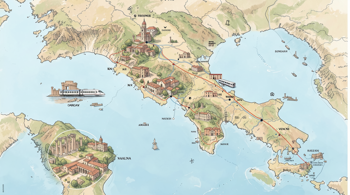
Rail, airports, and local transport
Trenitalia’s Frecciarossa and Italo Treno services connect major cities, with high-speed journeys between Rome, Florence, and Venice taking roughly one and a half to two and a quarter hours depending on the segment and service. Advance booking can produce lower fare categories, while walk-up fares may be substantially higher, so the itinerary should account for fixed departure times. Rome Fiumicino is the principal international gateway for many long-haul arrivals from the United States, and the Leonardo Express connects the airport with Termini in about 32 minutes. 3 7 14
- Use rail for the main north-south city corridor.
- Use regional trains for Cinque Terre, typically approaching the villages through La Spezia.
- Expect walking, vaporetti, buses, or ferries inside destinations where roads are restricted.
- Allow time for airport-to-hotel transfers and station access.
Cinque Terre has highly restricted car traffic in its villages, making regional rail the more practical approach. The Amalfi Coast presents a different constraint: the SITA bus network and private ferries are important options because coastal roads are narrow and parking is limited. These conditions make a route that looks short on a map slower in practice than the rail corridor. 12 13
Reservations, entry rules, and travel friction
Timed reservations are particularly relevant for the Colosseum, Roman Forum, Palatine Hill, Vatican Museums, and Uffizi Gallery. Major museums and archaeological sites can develop long queues, and a missed timed entry can disrupt the rest of a tightly scheduled day. Accommodation planning should also account for the Italian city tax, known as tassa di soggiorno, which varies by city and accommodation category and is commonly collected separately at the property. 10 11 16
United States travelers generally need a passport valid for at least three months beyond the intended departure from the Schengen Area. The European Union’s ETIAS authorization has been described in the supplied research as an upcoming requirement for visa-exempt travelers, with implementation timing subject to official updates. Entry rules should therefore be checked through government sources before departure rather than assumed from older itinerary articles. 8 9
Seasonal planning and realistic pacing
Mid-April through May and late September through October are identified as periods offering a balance of mild weather and more manageable crowds than the busiest summer months. August can bring intense heat, heavy visitor volumes, and Ferragosto-related closures or altered schedules, while July is also associated with peak crowding. Seasonal conditions affect not only comfort but also the availability of timed admissions, ferry operations, and the amount of daylight available for walking-based sightseeing. 6 15
- Reserve major attractions before fixing a densely packed daily schedule.
- Keep at least one flexible period during longer itineraries.
- Group sights geographically to reduce cross-city transport.
- Verify seasonal opening hours, transit timetables, and entry requirements.
The central planning trade-off is breadth versus depth. A seven-day visitor can experience Italy’s most recognizable urban contrasts, while a ten-day visitor can add one meaningful excursion. A fourteen-day visitor gains regional variety, but only if longer transfers are treated as genuine itinerary components rather than as negligible gaps between destinations. 1 6
Sources
- Rough Guides, https://www.roughguides.com/italy/itineraries/
- Wheatless Wanderlust, https://wheatlesswanderlust.com/10-days-italy-itinerary/
- Travel With Hello, https://www.travelwithhello.com/blog/italy-10-day-itinerary
- Global Travel Diary, https://globaltraveldiary.com/10-day-italy-itinerary/
- Tunex Travels, https://www.tunextravels.com/italy-itinerary-for-7-days-rome-florence-venice-by-train/
- Traveleon, https://traveleon.ai/blogs/italy-trip-planner
- Trenitalia, https://www.trenitalia.com
- U.S. Department of State, https://travel.state.gov
- European Union Official Website, https://travel-europe.europa.eu
- Uffizi Galleries, https://www.uffizi.it
- Parco Archeologico del Colosseo, https://colosseo.it
- Parco Nazionale delle Cinque Terre, https://www.parconazionale5terre.it
- SITA Sud Trasporti, https://www.sitasudtrasporti.it
- Aeroporti di Roma, https://www.adr.it
- Lonely Planet, https://www.lonelyplanet.com
- Rick Steves’ Europe, https://www.ricksteves.com