Family-focused offers on the 2026 Toyota C-HR hybrid: Evidence, eligibility, and practical considerations
Family-focused offers on the 2026 Toyota C-HR hybrid require careful qualification because the available research describes two different vehicles and markets. Toyota UK presents the C-HR as a self-charging hybrid and plug-in hybrid crossover, while US launch material identifies the 2026 C-HR as a battery-electric vehicle, so no independently verified nationwide UK family cash incentive for a 2026 hybrid has been established. 1
What the available 2026 information actually covers
Toyota UK’s C-HR model information covers a five-seat crossover with self-charging hybrid and plug-in hybrid powertrains, which is the relevant framework for UK family research. The reviewed material does not identify a separate, nationwide 2026 child-related allowance or family bonus attached specifically to the hybrid C-HR. Any retailer-level terms therefore need to be treated as separate from Toyota UK’s standard model information and checked for the precise vehicle grade, customer conditions, contract length, and geographic scope. 1
A separate Lexington Toyota listing describes a new 2026 C-HR SE AWD and gives an example vehicle price of $39,489, with a finance rate as low as 1.99% APR for 72 months or a lease from $429 per month for 36 months. The listing states that taxes, title, tags, a $385 documentation fee, mileage limits, maintenance responsibilities, and excess-wear charges are not included in the headline figures. It also limits the terms to participating dealers in several US states, demonstrating why those figures cannot be presented as a UK hybrid-family offer. 11
Motability is the clearest family-related route
Among the researched UK programmes, Toyota’s Motability scheme is the most directly family-focused route because eligible customers can exchange a qualifying mobility allowance for a vehicle. The programme may also involve adaptations and replacement-vehicle support, subject to the scheme’s eligibility rules and individual assessment. This is not a child-specific incentive: eligibility is linked to the customer’s qualifying allowance and scheme requirements rather than simply having children or being responsible for family transport. 2
Families considering this route should distinguish vehicle suitability from programme eligibility. The relevant questions include whether the allowance qualifies, whether the selected C-HR grade is available through the scheme, what adaptations are required, and what support is included under the individual arrangement. Because scheme terms and vehicle availability can change, a general description of Motability cannot establish that a particular 2026 C-HR hybrid will be offered in every area or to every eligible applicant. 2
- Eligibility depends on a qualifying mobility allowance and scheme rules.
- Adaptations may be available, but requirements differ between users.
- Replacement-vehicle support is subject to the programme’s conditions.
- Family status alone does not establish eligibility.
Safety features relevant to child passengers
Family evaluation of the C-HR should include child-seat compatibility as well as the headline powertrain. Toyota’s UK specification information identifies ISOFIX child-seat mounting points and Toyota Safety Sense driver-assistance technology. These features are relevant to everyday school, childcare, and family journeys, but their presence does not remove the need to check child-seat fit, rear-door access, seating position, and the operation of driver-assistance systems in the exact vehicle grade under consideration. 3
The current-generation Toyota C-HR has a five-star Euro NCAP safety rating, with separate assessments covering adult occupants, child occupants, vulnerable road users, and safety assistance. A rating is a structured test result rather than a guarantee of identical protection in every crash or seating configuration. Families should therefore interpret the rating alongside correct restraint installation, appropriate child-seat selection, visibility, and the practical ability to reach rear-seat occupants. 4
| Family consideration | Evidence to examine |
|---|---|
| Child restraints | ISOFIX mounting points and actual seat compatibility |
| Active safety | Toyota Safety Sense equipment on the selected grade |
| Crash assessment | Euro NCAP adult, child, vulnerable-road-user, and assistance categories |
Space and everyday family practicality
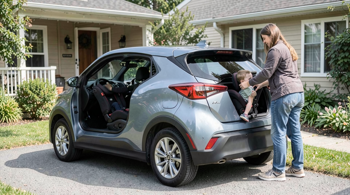
The C-HR’s coupe-style body is a central practical compromise. Independent UK reviews generally describe the hybrid as economical and comfortable for routine driving, but identify weaker rear-seat space, rear visibility, and boot practicality than some conventional family SUVs. The shape can suit households prioritising a compact footprint and distinctive styling, yet families carrying bulky pushchairs, sports equipment, or several large bags should inspect the rear opening and luggage area rather than relying on exterior dimensions alone. 5
Carwow and Parkers also frame the C-HR as a family crossover whose usability depends on the household’s space requirements. The five-seat layout provides ordinary passenger capacity, but the sloping profile can reduce the sense of room for rear passengers and limit loading flexibility. Those limitations matter more when rear-facing child seats, older children, or frequent long journeys are involved. A family-focused assessment should record access, visibility, boot organisation, and seat-folding arrangements during an in-person evaluation. 6 8
Choosing between hybrid and plug-in hybrid use
Toyota UK distinguishes between a self-charging hybrid and a plug-in hybrid C-HR. The self-charging system avoids routine external charging, which can simplify households without dependable home charging access. The plug-in hybrid can suit families whose regular journeys are short and who can charge at home, but its usefulness depends on charging access, journey patterns, annual mileage, and willingness to maintain charging habits. The supplied research does not establish one universal family choice. 1
Autocar’s UK review describes the C-HR hybrid in terms of comfort, efficiency, driving characteristics, and everyday usability, while independent buying information emphasises running costs and ownership context. Families should compare expected fuel use, charging access, servicing requirements, and journey length rather than treating the powertrain label as a complete cost forecast. Maintenance remains an ongoing responsibility, and finance or lease arrangements can add mileage, wear, end-of-contract, or maintenance obligations. 7 8 11
Used-vehicle and contract risks
A lower-cost ownership route may involve Toyota Approved Used vehicles rather than a new 2026 model. Toyota’s Approved Used programme describes inspection, warranty, and support benefits for eligible vehicles, but availability, warranty duration, vehicle history, and pricing depend on the individual car. Honest John’s buying information also highlights the importance of reliability context and practical inspection. A used C-HR can reduce the need to enter a new contract, but age, mileage, condition, and remaining coverage must be assessed separately. 9 10
Advertised finance and lease figures should be read as structured examples, not as the total cost of motoring. The Lexington listing shows how deposits, taxes, registration, documentation charges, annual mileage caps, excess-mileage rates, maintenance, and excess wear can sit outside a monthly figure. The listing also says terms depend on approved credit, participating dealers, stock, and availability. Those conditions create market friction that is especially important for families managing predictable monthly budgets. 11
- Check the exact powertrain, model grade, and market.
- Separate deposit, taxes, fees, and monthly payments.
- Review mileage limits and excess-mileage charges.
- Confirm maintenance, wear, warranty, and end-of-contract responsibilities.
- Verify eligibility directly with an authorised Toyota retailer or the relevant scheme administrator.
Sources
- Toyota UK C-HR model page
- Toyota UK Motability
- Toyota UK C-HR specifications
- Euro NCAP Toyota C-HR result
- What Car? Toyota C-HR review
- Carwow Toyota C-HR review
- Autocar Toyota C-HR review
- Parkers Toyota C-HR review
- Toyota UK Approved Used
- Honest John Toyota C-HR buying guide
- Lexington Toyota 2026 C-HR listing