
Discover Fiji's Traditional Kava Ceremony and Cultural Experiences: A Complete Analytical Guide
Kava ceremonies sit at the center of Fijian cultural identity, functioning not as tourist entertainment but as a living social institution that governs hospitality, diplomacy, and community cohesion. The practice, known locally as sevusevu or yaqona, has been observed across South Pacific islands including Fiji, Tonga, Samoa, and Vanuatu for approximately 3,000 years. 1 Research from the University of Hawaii at Manoa's Traditional Pacific Island Crops archive identifies Vanuatu as the most likely origin point, based on its unmatched genetic diversity of kava cultivars, before the plant spread through deliberate cultivation across maritime trade networks. 2 For anyone seeking to understand what it means to genuinely engage with Fijian culture, the kava ceremony is an essential starting point.
Historical Roots and Cultural Significance of Kava in Fiji
Kava, derived from the root of the Piper methysticum plant, has been central to Fijian ceremonial life for over three millennia. Originally performed as a ritual during audiences with chiefs or when making important community decisions, the ceremony evolved into a cornerstone of social occasions encompassing weddings, funerals, anniversaries, and formal community meetings. 3 A peer-reviewed study on kava's cultural role documented through the National Institutes of Health (PMC9272527) notes that kava use was historically restricted to individuals of high rank and ceremonial occasions, a pattern consistent across the Pacific before broader consumption became normalized. 4
In Fiji specifically, the drink is referred to as yaqona, pronounced 'yanggona,' and also colloquially as 'grog.' It functions as what researchers and cultural observers describe as a form of cultural glue, fostering intergenerational connections and hosting rituals that transcend individual communities. 5 When a formal chiefly kava ceremony, known as yaqona vakaturaga, is conducted, the personnel who prepare and serve the yaqona come from the chiefly clan, reflecting a hierarchy of service built into the ceremony's very structure. 6
The Sevusevu Ceremony: Protocol and Process
The sevusevu ceremony represents the cornerstone of Fijian hospitality, functioning as a formal presentation that acknowledges village authority and requests permission to enter communal spaces. Visitors present dried kava root as a gift to village elders or chiefs, with this gesture symbolizing respect and the desire for peaceful relations. 7 For village homestay participants, such as those documented at Yaqeta Village in Fiji's Yasawa Islands, obtaining kava roots before arrival is a mandatory preparation, as these roots are not typically available at airports or ferry terminals and must be sourced from local markets in towns such as Nadi. 8
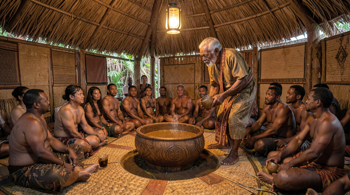
The ceremony follows established protocols that carry deep symbolic weight. Participants sit cross-legged on woven pandanus mats in a circle around a large carved wooden bowl called a tanoa. The drink is served in a coconut shell cup known as a bilo. Protocol requires that recipients clap once before receiving the bilo, consume the drink in a single motion, and then clap three times while saying 'Bula!' after finishing. 9 The order of serving follows social hierarchy, with the village chief and senior men receiving the first cups, a sequence that reflects centuries of established communal structure. 10
Taste, Physical Effects, and the Plant Itself
Kava roots are harvested, dried, powdered, and mixed with water through a straining process traditionally using fibers from the vau tree. The roots, called waka, are considered the most valuable part of the plant and are normally harvested from around three years of age, becoming more valued as they age further. 11 The resulting drink carries a very distinctive character: earthy, somewhat bitter, with a mild numbness felt on the tongue and lips. This sensation originates from compounds called kavalactones, which are attributed with sedative and relaxing effects including potential anxiety relief and improved sleep. 12
Health researchers and cultural practitioners alike note that kava produces a mild, calming effect rather than intoxication in the conventional sense. However, responsible consumption guidelines are consistently emphasized across Pacific health and cultural literature, particularly around the risks of excessive or prolonged intake. Visitors with liver conditions or those taking medications should consult a medical professional before participating, as kavalactones interact with certain drug metabolic pathways. The ceremonial context of moderated, sequential consumption differs substantially from unregulated recreational use, and this distinction matters both culturally and physiologically. 13
Authentic Village Ceremonies vs. Resort-Oriented Experiences
A meaningful distinction exists between fully authentic village kava ceremonies and the lighter-format demonstrations offered at many resorts and cultural facilities. Authentic ceremonies, such as those conducted within iTaukei village communities across the Yasawa and Mamanuca islands, require formal sevusevu preparation and adherence to all hierarchical protocols. Many resorts across the Yasawa Islands, including Nanuya Island Resort, Octopus Resort, Oarsman's Bay Lodge, Mantaray Island Resort, Blue Lagoon Beach Resort, and Barefoot Manta Island Resort, host kava circles several evenings per week in a setting designed to introduce guests to the ritual's key elements. 14
Village-based experiences, including those accessible via Coral Coast Divers on Yanuca Island or through Talanoa Treks in Viti Levu's remote highlands, offer a demonstrably different level of immersion. These settings involve meeting village families, walking through working communities, and participating in ceremonies where the cultural weight is unmediated by resort infrastructure. 15 Travelers who participated in a Nadi-area cultural night tour rated the combined kava, lovo, and meke experience at 4.9 out of 5 across 57 reviewers, reflecting strong satisfaction with structured cultural programming that balances accessibility with genuine local participation. 16
Broader Fijian Cultural Experiences: Meke, Lovo, and Village Life
The kava ceremony rarely stands alone as a cultural touchpoint. It is typically accompanied by or situated within a broader framework of Fijian traditions. The meke is a traditional performance combining dance, song, and oral storytelling that conveys Fijian history, mythology, and community identity. Lovo feasts, involving food cooked in below-ground ovens lined with volcanic or river stones, represent another foundational cultural practice. Ingredients including taro root, fish, chicken, and root vegetables such as dalo and cassava are wrapped and slow-cooked to produce dishes with a distinctive smoky flavor. 17
Additional cultural crafts encountered in village contexts include traditional pottery, weaving from palm fronds and pandanus leaves, and the preparation of kokoda, Fiji's coconut-cured fish dish considered a national culinary emblem. Firewalking ceremonies, historically associated with the Beqa Island community and the Sawau clan, represent another layer of Fijian ritual that cultural travelers may encounter. 18 Village tour formats in areas including Nadi, Denarau, and the Coral Coast typically integrate several of these elements into half-day or evening programs lasting between three and six hours, with group sizes generally capped at around twelve participants for more intimate engagement.
Visitor Etiquette, Eligibility Considerations, and Practical Realities
Respectful engagement with Fijian cultural traditions requires preparation beyond logistical planning. Visitors should dress modestly when entering any village, covering shoulders and knees, and must remove hats and sunglasses as a sign of respect for the community space. Sitting cross-legged on mats rather than standing or using furniture signals cultural awareness. Touching another person's head is considered deeply disrespectful in Fijian custom and should be strictly avoided. 19 Tourism Fiji's guidance consistently emphasizes seeking explicit permission from the village chief or Turaga ni Koro before entering any community, a protocol that the sevusevu ceremony itself formalizes. 20
Practical friction points are worth noting honestly. Village visits in remote archipelagos require advance coordination, boat transfers, and in some cases overnight stays, adding logistical complexity. Not all experience formats accommodate dietary restrictions equally, and vegetarian travelers in particular have reported limited menu options at lovo feasts, though some operators such as Vavavi Fijian Cooking and Cultural Experience explicitly cater to gluten-free, halal, vegan, and vegetarian requirements. 21 Access to remote villages such as those in the Yasawa archipelago involves ferry services like the Yasawa Flyer departing from Port Denarau, with schedules that require planning around tidal and weather conditions. Cyclone seasons and weather advisories, as seen with Tropical Cyclone Vaianu in April 2026, can suspend day-trip and resort-transfer operations, making flexibility an essential part of any cultural travel itinerary in Fiji. 22
Sources
- Beqa Lagoon Resort - Kava Ceremony in Fiji: beqalagoonresort.com/kava-ceremony/
- Kava Krave - Traditional Kava Preparation: Ceremony, Methods and Cultural Respect: kavakrave.com/blogs/news/traditional-kava-preparation-ceremony-guide
- Kosupa Travel - Joining a Traditional Kava Ceremony in a Fijian Village: en.kosupatravel.com/entry/2026/01/25/joining-a-traditional-kava-ceremony-in-a-fijian-village
- Kava Review - Kava History and Ceremony: The 3,000-Year Story: kavareview.com/journal/kava-history-and-ceremony
- Bula Denarau - Kava (Yaqona): The Heart of Fijian Ceremony and Tradition: buladenarau.com/kava/
- Bula Denarau - Chiefly Yaqona Ceremony Overview: buladenarau.com/kava/
- TrekFeed - Fiji Cultural Etiquette Sevusevu Ceremony and Kava Protocols: trekfeed.com/fiji-cultural-etiquette-sevusevu-ceremony-and-kava-protocols
- Kosupa Travel - Fiji Yasawa Homestay Guide Part 2: en.kosupatravel.com/entry/2026/01/25/fiji-yasawa-homestay-guide-part-2
- Kava in Fijian Culture - Laboratory Talk: kava-in-fijian-culture.laboratory-talk.com/kava-in-fijian-culture-historical-role-to-modern-significance/
- MyFijiStay - The Kava Ceremony Is Not a Show: myfijistay.com/the-kava-ceremony-is-not-a-show-how-to-sit-one-out-and-get-it-right
- Bula Denarau - Kava Root Harvesting and Preparation: buladenarau.com/kava/
- Entheology - The Cultural Roots of Kava in Vanuatu and Fiji: entheology.com/kava-kava/the-cultural-roots-of-kava-in-vanuatu-and-fiji/
- True Wind Healing Travel - Dravuni Island Fiji Hike and Kava Ceremony with Locals: truewindhealingtravel.com/dravuni-fiji-kava-ceremony/
- Yasawa Adventures Fiji - Kava Ceremony Activities: yasawafiji.com/activities/kava-ceremony/
- NZ Herald - A Night in the Highlands: An Intrepid Journey Through the Heart of Fiji: nzherald.co.nz/travel/a-night-in-the-highlands
- World-Tourism.org - Nadi Fijian Culture Night Tour with Dinner and Kava Ceremony: world-tourism.org/nadi-fijan-culture-night-tour-with-dinner-kava-ceremony/
- Destination.com - Yasawa's First Dry-Season Lovo Feasts: Village Kava Nights in May: destination.com/guides/fiji-yasawa-islands-may-dry-season-village-lovo-feast-kava-ceremony
- YouTube - Travel by Dart: Inside Fiji's Hidden Traditions, Firewalking, Kava and Tribal Life: youtube.com/watch?v=X-F3vVkX7Bk
- Lonely Planet via General Research - Fiji Etiquette Tips including village dress codes and cultural customs
- Tourism Fiji via General Research - Guide to Fijian Etiquette and Village Permission Protocols: fiji.travel/articles/a-guide-to-fijian-etiquette
- ByFood - Vavavi Fijian Cooking and Cultural Experience: byfood.com/experiences/vavavi-fijian-cooking-and-cultural-experience-33226
- Yasawa Adventures Fiji - Weather and Services Advisory, Tropical Cyclone Vaianu: yasawafiji.com/activities/kava-ceremony/