
New Orleans Mardi Gras Travel Packages 2026: A Factual Planning Report
New Orleans Mardi Gras travel packages 2026 are built around parades, brass bands, elaborate floats, historic krewes, French Quarter street celebrations, and Fat Tuesday on February 17, 2026. Published itineraries range from a February 12 to 15 weekend stay near Bourbon Street to five-day escorted programs, private guided experiences, and longer combinations involving the wider city and regional travel. 1
Festival timing and the 2026 calendar
Mardi Gras is a season rather than a single event. Carnival begins on Twelfth Night in January and continues until midnight on Shrove Tuesday, with the final celebrations concentrated around Fat Tuesday. The official 2026 Mardi Gras date is Tuesday, February 17, making the preceding weekend and final parade days the central period for most travel planning. 2
The timing affects both itinerary design and accommodation choices. A practical planning guide describes early Carnival, the final long weekend, and a broader multi-day stay as distinct travel windows, each offering a different balance between parade intensity, street congestion, and access to restaurants or neighborhoods away from the main routes. Official parade details should be checked as the season approaches because schedules and street arrangements can change. 3
What published packages include
Package structures differ substantially. A weekend group itinerary listed accommodation at Aloft New Orleans Downtown from February 12 to 15, with walking access described as approximately five minutes to Bourbon Street, eight minutes to the Saenger Theatre, twelve minutes to Caesars Superdome, and seventeen minutes to Jackson Square. The stated activities include parades, food, live music, masquerade events, and French Quarter celebrations. 4
Another five-day tour was listed at US$2,990 per person and included New Orleans as both the starting and ending point, English guidance, breakfast-based touring, the French Quarter, Garden District, St. Charles Avenue, the Mississippi River, and a Creole-style dinner aboard a paddle-wheel riverboat. The listing described a partially guided, low-intensity group format for travelers aged eight and older, showing that some packages combine scheduled excursions with independent time. 5
Parades, viewing, and cultural activities
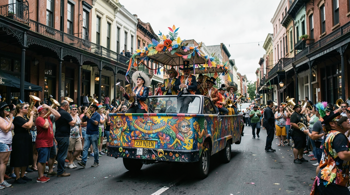
Parade access is a major point of differentiation. The itinerary materials refer to krewes including Bacchus, Endymion, Orpheus, Rex, and Zulu, while other group programs specify grandstand seating for selected parades. Typical cultural components include Mardi Gras World, where visitors can examine float construction, plus King Cake, brass bands, masked riders, marching groups, and signature throws such as beads, decorated shoes, or Zulu coconuts. 1
Private itineraries place greater emphasis on interpretation and food. One five-day experience includes a pre-arrival planning call, French Quarter orientation, a craft cocktail crawl, front-row parade seats, a Garden District tour, a Magazine Street food walk, a Creole cooking class, a James Beard Award-winning restaurant, and a farewell brunch at Brennan’s. Its timing is positioned as the week before Mardi Gras Day rather than the peak day itself. 6
Accommodation and location considerations
Location is a central planning variable because different districts provide different forms of access. French Quarter lodging places travelers close to Bourbon Street, Jackson Square, historic architecture, and nightlife, while Canal Street and Downtown locations can provide proximity to the Quarter without placing every activity directly on Bourbon Street. Published guidance emphasizes that accommodation costs and street access move quickly around the final Carnival days. 3
Some managed programs use a minimum stay spanning several major events, while private balconies and parade-route viewing are treated as premium itinerary features rather than standard inclusions. Travelers should examine whether a quoted package includes the room category, taxes, meals, transfers, viewing access, luggage handling, and event admission. A listed group program, for example, describes accommodation and activities, but its displayed per-person figure is tied to a shared-room basis. 5
Alternative formats: groups, private tours, and cruises
Group travel can reduce planning complexity by combining accommodation, scheduled activities, and local transportation, but it also imposes fixed dates and shared pacing. The published 2026 weekend group listing permits group sizes from one to twenty-five, while the five-day carnival tour lists groups of up to thirty. These formats may suit travelers who prefer organized parade access, but they provide less flexibility than an independently arranged stay. 4
Cruise-based arrangements offer a different structure. A Norwegian Gem itinerary scheduled for February 5 to 12, 2027, not 2026, advertises two days in New Orleans during a wider voyage that also includes Cozumel. The stated cabin figures begin at US$909 for an interior cabin and US$949 for an oceanview cabin, based on double occupancy, with meals, onboard entertainment, and a US$250 per-person deposit described in the published material. This is a future comparison format, not a 2026 package. 7
Costs, conditions, and travel friction
Published prices are not directly comparable because they use different room assumptions, durations, inclusions, and currencies. A five-day shared-room tour is listed from US$2,990 per person, while a United Kingdom city-break provider advertises flights from £1,699. These figures should be treated as examples of package positioning rather than a market average, especially because airfare, room type, taxes, and optional activities may be handled differently. 5 1
Travelers should also account for operational limitations. Streets close for parades, transport routes can be disrupted, viewing positions vary by block, and hotel inventory near parade corridors becomes constrained during peak dates. Package terms may impose deposits, staged payments, cancellation penalties, minimum stays, or shared-room conditions. The principal risk is assuming that an advertised itinerary guarantees every parade, restaurant, room feature, or schedule when event arrangements remain subject to operational changes. 3 8
Evaluation checklist for 2026 planning
A neutral comparison should begin with the trip window, then assess the neighborhood, accommodation basis, parade access, and level of guidance. A traveler focused on the densest street atmosphere may prioritize the final weekend and Fat Tuesday, while a food or culture-focused visitor may prefer the preceding week, when private tours emphasize Garden District architecture, cooking, restaurants, and neighborhood exploration. 3 6
- Confirm whether the itinerary covers February 17, 2026, or an earlier Carnival period. 2
- Check whether parade viewing is street-based, grandstand-based, or balcony-based. 8
- Separate included meals, transfers, taxes, admissions, and luggage services from optional items. 9
- Review room occupancy, minimum-stay rules, deposit deadlines, and cancellation conditions. 9
- Allow for street closures, schedule revisions, crowd density, and limited transport flexibility. 3
Sources
- Freedom Destinations, New Orleans Mardi Gras City Break
- Mardi Gras New Orleans, When Is Mardi Gras?
- Festival Holiday, Mardi Gras New Orleans 2026 Guide
- WeTravel, Mardi Gras 2026
- TourRadar, USA: New Orleans Mardi Gras Carnival
- New Orleans Secrets Tours, Mardi Gras Unlocked
- You Pack I Plan, Sail into Mardi Gras
- Mardi Gras World, parade viewing and float-related information
- US Tours America, Mardi Gras Party itinerary