Military Surplus Forklifts at Government Auctions: Understanding the Risks, Inspection Process, and Market Costs
Key facts
- Government surplus auctions offer equipment from federal, state, and local agencies, often sold in as-is condition without warranties 1 2.
- Median hammer prices for forklifts at government auctions have been tracked near $850, though functional units typically range into the low thousands 3.
- Purchasing from a government auction requires the buyer to manage all transportation and removal logistics, often needing heavy-duty trailers 3 4.
- Used forklifts generally range from $4,000 to $85,000 in the 2026 market depending on capacity, hours, and machine type 5.
Government surplus auctions represent a specialized channel for acquiring material handling equipment formerly used by military branches, federal agencies, or municipal departments. Unlike traditional dealer markets, these auctions operate as disposal platforms where agencies release assets that have reached the end of their scheduled service life rather than those that have ceased to function 3 2. Buyers looking to navigate this marketplace should understand that inventory is rarely centralized, and equipment is typically offered in as-is condition, placing the full burden of assessment and logistical planning on the purchaser 1 6.
Understanding Military and Government Surplus Auctions
Equipment listed as military or government surplus originates from various entities, including the Department of Defense, NASA, and local public works departments 7 2. Platforms such as GovPlanet frequently manage military-specific gear, including heavy-duty vehicles and specialized lifting equipment, while the General Services Administration (GSA) typically handles general federal surplus 6. State and local equipment, such as that from school districts or city maintenance yards, is commonly found on platforms like GovDeals and Public Surplus 3 1.
The auction structure varies by platform, with some sites charging a buyer's premium-a percentage added to the final winning bid-while others, like GSA Auctions, may operate without one 7 6. Because agencies prioritize the clearing of space, buyers must often adhere to strict removal windows, sometimes as short as ten days after the close of the sale 1. Defaulting on payment or failing to remove equipment can result in significant financial penalties, such as a percentage of the final bid or a flat fee 1.
Market Pricing and Comparative Value
When comparing auction results to the broader 2026 industrial market, it is essential to distinguish between the two. Auction prices for forklifts vary widely; while a median price may sit near $850, this figure includes non-running units intended for parts 3. Functional, well-maintained units typically sell for several thousand dollars, yet they remain priced below dealer-refurbished equivalents, which can command $10,000 to $25,000 for standard 5,000 lb models 3 8.
Dealer-market machines often include warranties, recent certifications, and documented maintenance history, justifying the price difference. Auction buyers, conversely, pay for the equipment as-is, meaning they must factor the potential cost of repairs, battery replacements, and tire changes into their total capital commitment 3 9. For high-capacity pneumatic forklifts or specialized rough-terrain rigs, used market prices can reach $40,000 to $55,000 or more, making the auction route attractive to those with internal mechanical capabilities 8.
Inspection and Technical Evaluation
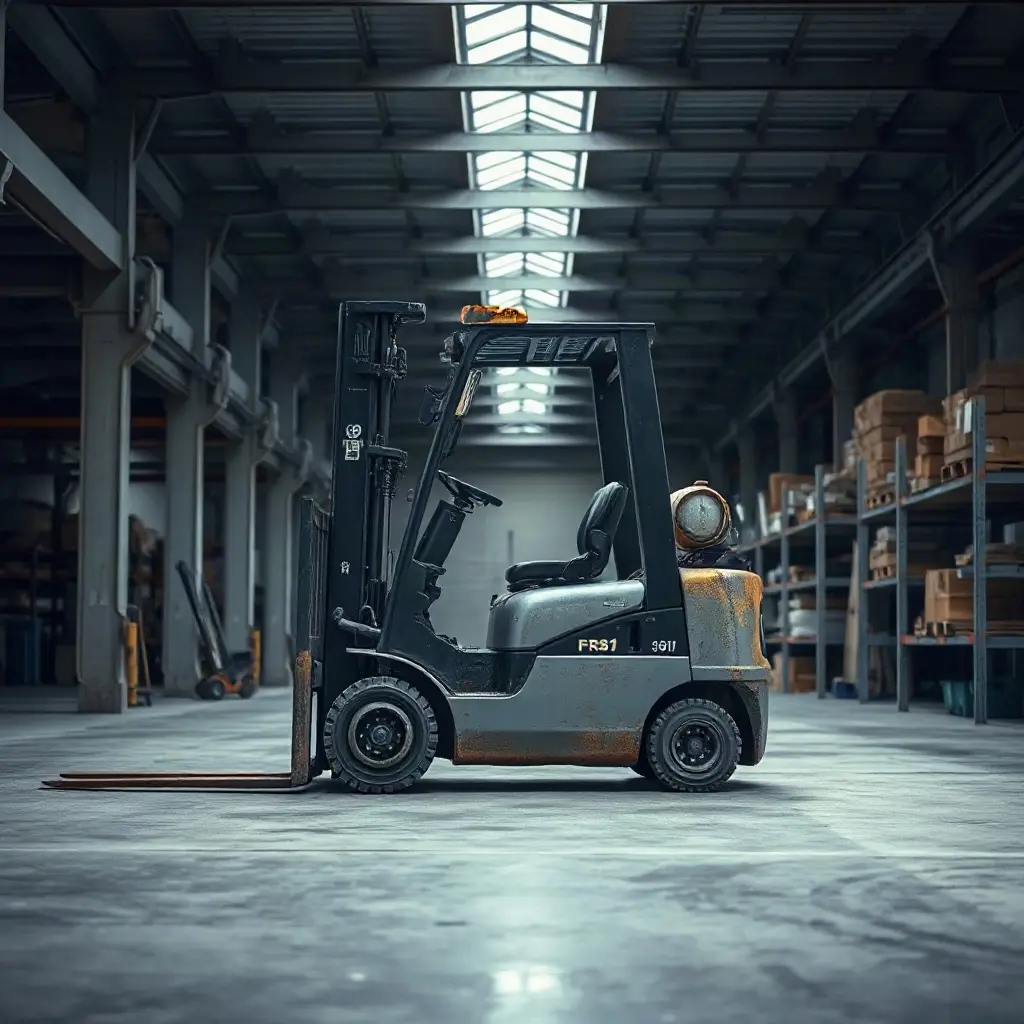
A successful auction purchase hinges on the pre-bid inspection. Because these machines may have been stored for extended periods, buyers should prioritize examining the mast, forks, hydraulic hoses, and cylinders for signs of stress or leaking fluids 8. For electric units, the condition of the battery is the single most critical variable; replacing a large industrial battery can be a significant expense that may negate any initial savings 8 9.
Buyers should also review the hour meter, though it should always be verified against service records and general wear. Safety equipment, including the overhead guard, seatbelts, and operational lights, must be functional to meet standard safety regulations once the machine is placed into service 8. If a site allows for an on-site inspection window, it is advised to bring a qualified technician or, at minimum, a checklist to perform a basic load test to verify the hydraulic system's integrity 3 8.
Logistics and Transportation Risks
Acquiring a forklift at auction involves significant logistical challenges that differ from standard e-commerce deliveries. Most forklifts are not street-legal and require heavy-duty tilt-bed trailers or specialized riggers for transport 3. A standard 5,000 lb capacity forklift can easily weigh over 8,000 lbs, requiring a towing vehicle capable of handling that load safely 3. Buyers are almost always responsible for loading the equipment, meaning they must arrive at the auction site with the proper equipment or a contracted transport professional 3 4.
The lack of formal provenance on some surplus equipment means that service manuals and past maintenance logs might be missing. Without these documents, operators face challenges in diagnosing electrical issues or sourcing compatible replacement parts. Researching manufacturer support for specific models-especially older units-is a recommended step before placing a bid, as parts availability often dictates the long-term utility of the machine 2 8.
Strategic Considerations for Buyers
For fleet managers and warehouse operators, the decision to use government auctions often comes down to balancing lead times and budget against the risk of unknown mechanical issues. In 2026, the industrial market shows a preference for reliable, available equipment over long wait times for new machinery 10. While auctions can provide cost-effective solutions for spare machines or low-intensity tasks, they are best suited for operations that have the technical capacity to service the equipment internally or the budget to absorb unexpected repairs.
Ultimately, bidders should treat auction platforms as one of several options. By monitoring multiple government, federal, and local sites, potential buyers can compare specifications and historical data to gauge whether an item’s hammer price represents a fair value for their specific operational needs. Maintaining a clear budget that includes taxes, buyer premiums, and transport costs is essential for an objective assessment of whether an auction purchase is the most viable path for acquiring industrial material handling equipment 4 6.
Sources
- Public Surplus Auctions: How to Register and Bid - LegalClarity: https://legalclarity.org/public-surplus-auctions-how-to-register-and-bid/
- Government Surplus Auctions (2026): The Complete Guide | GovAuctions.app: https://govauctions.app/guides/complete-guide-government-surplus-auctions
- Forklift Auctions: Government Surplus Forklifts | BidProwl: https://bidprowl.com/forklift-auctions
- How to Buy Government Heavy Equipment at Auction (2026): Prices, Fees and Pickup | GovAuctions.app: https://govauctions.app/guides/how-to-buy-government-heavy-equipment
- Used Forklift Prices in 2026: What Every Class Is Worth | HeavyDutyYard: https://www.heavydutyyard.com/blog/used-forklift-prices
- GSA Auctions vs GovPlanet (2026): Federal Surplus, Two Very Different Lanes | GovAuctions.app: https://govauctions.app/compare/gsa-auctions-vs-govplanet
- GSA Auctions Explained (2026): FAQ, Fees & How to Bid | GovAuctions.app: https://govauctions.app/guides/gsa-auctions-faq
- Used Forklift Buying Guide: Prices, Inspection, Costs: https://practicetestgeeks.com/forklift/used-forklift
- Used Electric Forklifts: Models, Prices & Batteries: https://valueforklifts.com/used-electric-forklifts-models-prices-batteries/
- Texas Buyers Guide for Used Forklift Equipment in 2026: https://sunequipment.com/buying-used-forklifts-in-texas-in-2026-what-fleet-managers-need-to-know/