Military Surplus Bulldozers and Excavators at Government Auctions: A 2026 Buyer’s Guide to Process, Models and Costs
Key facts
- Government auction excavators recorded a median sale price of $6,988, with the middle half ranging from $388 to $14,400.
- Used 20-ton excavators such as the Cat 320 and Komatsu PC200 typically range from $60,000 to $130,000 in 2026.
- A mid-size dozer undercarriage replacement can cost approximately $20,000 to $50,000, depending on brand and machine size.
- Surplus machinery is commonly sold as-is, making inspection, transport planning and repair budgeting essential before bidding.
Military surplus bulldozers and excavators enter public disposal systems after federal agencies no longer require them. Government auctions can include former military construction equipment alongside municipal and federal fleet machinery, but inventory releases are cyclical rather than guaranteed. The important comparison is not simply the winning bid: condition, buyer premiums, hauling, permits, repairs and parts availability determine the equipment’s practical cost.
How government surplus auctions work
Federal surplus property is commonly presented through government auction systems, while specialist industrial auction platforms handle substantial volumes of military and Defense Logistics Agency equipment. General federal surplus can include heavy equipment, vehicles and other property, whereas specialist channels are more closely associated with military trucks and construction machinery. State surplus programs, local auction houses and online public-sector auction platforms provide additional routes for municipal equipment. 1 2 3
Participation normally begins with account registration, acceptance of auction terms and confirmation of payment and collection requirements. Each lot has its own closing time, location, inspection information and removal deadline. Many auctions use timed online bidding, and winning bidders remain responsible for arranging collection. Public access does not mean every lot is suitable for private operation, since transport rules, land-use requirements and operator-safety obligations still apply.
Where bulldozers and excavators appear
Military-origin machinery may be released through specialist government surplus channels, while excavators and dozers from public works departments often appear through broader municipal or state auctions. Government equipment can come from road departments, parks departments, water departments and military construction units. The origin affects the likely configuration: a road agency machine may have familiar commercial attachments, while a military unit may use unusual specifications, tires, controls or support components. 1
Named auction venues commonly discussed in this market include GSA Auctions for general federal property, GovPlanet for military and federal heavy equipment, GovDeals and Public Surplus for many local-government assets, and Purple Wave for state and county equipment. These are different channels, not interchangeable inventories. Seller terms, inspection reports, buyer premiums and removal arrangements can vary by platform and by lot, so the venue name alone does not establish condition or final cost. 1 2 4 3
Models and specifications worth comparing
For excavators, useful comparison points include operating weight, digging depth, hydraulic flow, boom configuration, hours and attachment compatibility. Common commercial reference models include the Cat 320, Komatsu PC200, Hitachi ZX210 and Deere 210G in the approximately 20-ton class. Larger comparisons include the Cat 336, Komatsu PC300, Cat 349 and Komatsu PC490. Mini excavators, including Cat 301 through 308 and Komatsu PC30 through PC80 classes, suit lighter work but have materially different lifting and digging capacity. 5
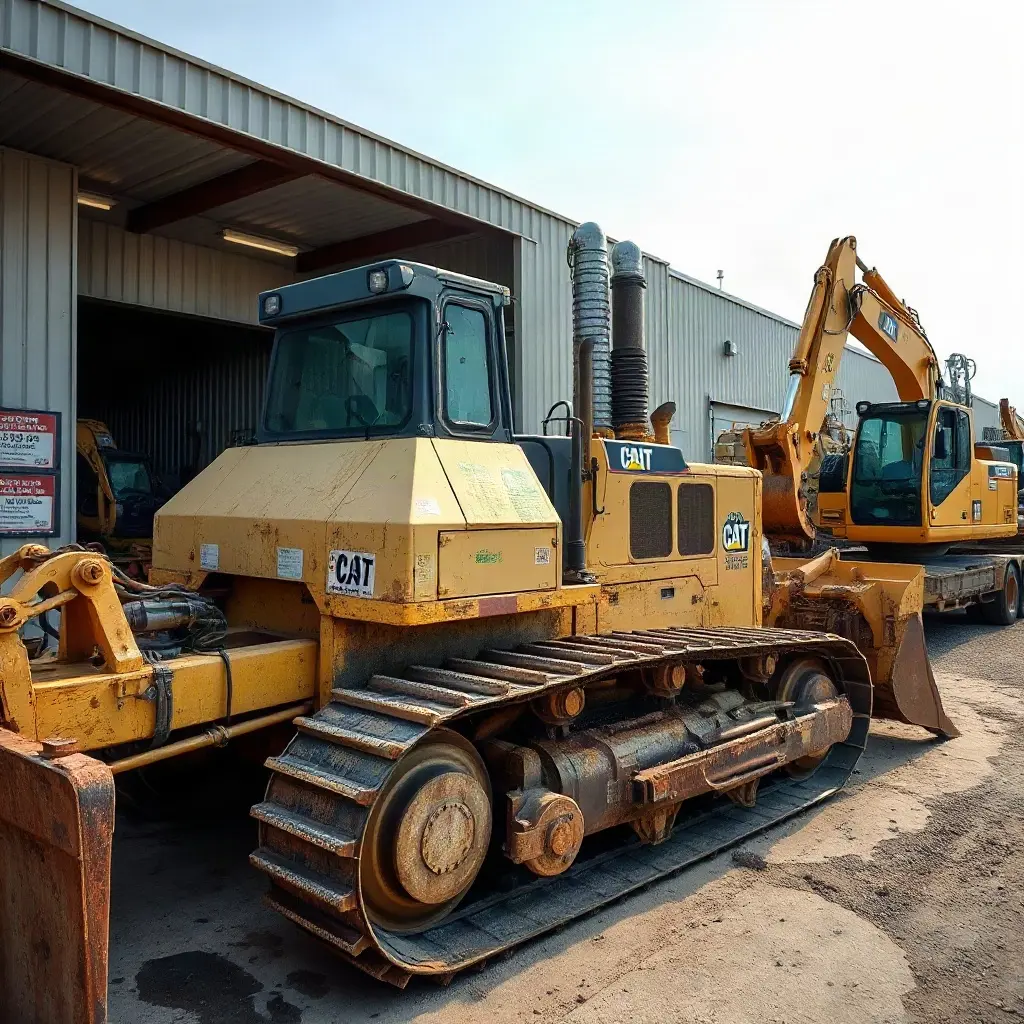
Bulldozers are usually compared by operating weight, blade type, horsepower, track configuration and undercarriage condition. Caterpillar D3, D4, D5, D6 and D7 families are recognizable market benchmarks, with Komatsu and John Deere providing comparable size classes. The undercarriage deserves unusual attention because worn tracks, rollers, idlers and sprockets can change the machine’s value more than age alone. A published 2026 dozer guide estimates that hours account for roughly 70 percent of the age-versus-value relationship. 6
Typical 2026 prices and auction comparisons
Government-auction results can sit well below ordinary commercial-equipment pricing, but the comparison is distorted when surplus machines have high hours, incomplete records or major defects. A 2026 government-auction review reported a median excavator sale price of $6,988, with the middle half of recorded sales ranging from $388 to $14,400. Mini excavators had a reported median of $3,380. These figures describe auction outcomes across varied ages and conditions, not a guaranteed price for a working machine. 1
| Machine or class | Typical 2026 market range | Interpretation |
|---|---|---|
| Government-auction excavator | $388 to $14,400 for the middle half of reported sales | Highly mixed condition and age |
| Mini excavator, commercial used market | $15,000 to $40,000 | Approximately 1.5 to 8 tonnes |
| 20-ton commercial excavator | $60,000 to $130,000 | Cat 320, Komatsu PC200 and comparable models |
| Cat D3, three years old | $72,000 to $88,000 | Small tracked dozer reference range |
| Cat D6N or D6T, three years old | $195,000 to $232,000 | Approximately 26-ton dozer class |
Commercial used-equipment guides place 20-ton excavators at $60,000 to $130,000 and large 50-ton excavators at $100,000 to $290,000 in 2026. Another market report described average used excavator values around $155,000 across all sizes, illustrating how larger, newer machines raise the overall average. These figures are market references, not auction guarantees, and should be adjusted for hours, attachments, emissions tier and service history. 5 7
Fees, transport and other ownership costs
The winning bid is only one component of the acquisition calculation. Some auction platforms apply buyer premiums, with published comparisons describing common ranges of approximately 7.5 to 12.5 percent on certain platforms and category types. Specialist heavy-equipment auctions may use tiered or lot-specific charges. Taxes, title or documentation costs, loading, storage and inspection travel can add further expense. Exact terms must be read for the individual auction because seller rules differ. 1 4 8
Large excavators and bulldozers generally require specialized lowboy or flatbed transport, route planning and, in some cases, oversized-load permits. Collection deadlines create practical pressure when a machine cannot be moved immediately. Transport estimates depend on distance, machine dimensions, weight, loading equipment and state regulations. Repair costs can also exceed the apparent price difference between surplus and commercial machinery, particularly when tracks, hydraulic components, final drives or engine systems require refurbishment.
Inspection risks and maintenance questions
Surplus equipment is commonly sold as-is, meaning the buyer bears responsibility for determining whether the machine starts, moves, digs or pushes correctly. Inspection should cover engine smoke, oil pressure, hydraulic leaks, cylinder scoring, swing-bearing play, travel motors, transmission response, electrical systems, cooling performance and attachment wear. On dozers, track-chain stretch, roller wear, sprocket condition and remaining undercarriage percentage are central valuation checks. 8 6
Maintenance records may be limited, especially where equipment has moved between agencies or has been stored before disposal. Photographs cannot establish hydraulic pressure, engine condition or structural cracks. Where available, an independent inspection report can provide more useful evidence than a short description, but the scope and remedy attached to any inspection program must be checked carefully. A machine with unfamiliar military specifications may also require specialist parts research before it is suitable for regular commercial work.
Eligibility, operating rules and a practical decision framework
Individuals can generally participate in public surplus auctions after completing the relevant registration and agreeing to the platform’s terms. However, registration does not provide operating authorization. Commercial work may require appropriate business compliance, equipment insurance, trained operators and adherence to local workplace-safety rules. Road movement can require registration, lighting, escort arrangements or oversize permits, depending on the machine and route. Government ownership history does not exempt a buyer from ordinary state and local requirements.
A disciplined evaluation separates the bid ceiling from the total project cost. First confirm the machine’s identity, hours, location and inspection terms. Next estimate the buyer premium, taxes, loading, transport, permits, immediate repairs and parts sourcing. Finally compare that total with a documented commercial-equipment price for a similar age, size and condition. Government auctions can provide access to varied equipment, but cyclical inventory, uncertain records and as-is terms make mechanical diligence more important than the auction label itself.
Sources
- How to Buy Government Heavy Equipment at Auction (2026): Prices, Fees and Pickup | GovAuctions.app: https://govauctions.app/guides/how-to-buy-government-heavy-equipment
- GovPlanet FAQ (2026): Buying Heavy Equipment & Military Surplus | GovAuctions.app: https://govauctions.app/guides/govplanet-faq
- GSA Auctions Explained (2026): FAQ, Fees & How to Bid | GovAuctions.app: https://govauctions.app/guides/gsa-auctions-faq
- GSA Auctions vs GovPlanet (2026): Federal Surplus, Two Very Different Lanes | GovAuctions.app: https://govauctions.app/compare/gsa-auctions-vs-govplanet
- Used Excavator Prices by Model (2026 Market Data): https://buyheavymachines.com/used-excavator-prices-by-model-2026/
- What Is My Dozer Worth? 2026 Used Dozer Prices | EquipBook: https://equipbook.ai/blog/used-dozer-prices-2026
- How Cat and Komatsu Are Killing It in the Used Excavator Auction Business (2026): https://www.my-equipment.com/blog/2026/09/how-cat-and-komatsu-are-killing-it-in-the-used-excavator-auction-business-2026/
- 10 Things to Know Before Bidding on Government Auctions (2026 Buyer's Checklist) | GovAuctions.app: https://govauctions.app/guides/10-things-before-bidding-government-auctions