A guide to dental implant pricing and availability: Evidence, regional variation, and treatment planning
This guide to dental implant pricing and availability examines what patients may encounter when comparing private treatment, limited public provision, regional fees, and different implant packages. Published figures vary because some prices cover only surgical placement while others include the implant post, abutment, crown, imaging, and preparatory procedures. 1
What a complete implant price includes
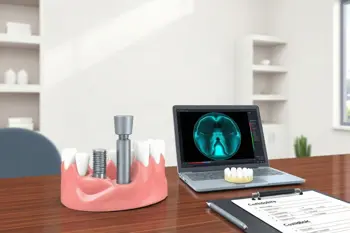
A dental implant is normally a three-part restoration: a post placed in the jawbone, an abutment that connects the post to the restoration, and a crown or bridge. The treatment may also involve consultation, three-dimensional imaging, extraction, grafting, a healing period, temporary teeth, and final restoration. A quoted “implant” price can therefore describe only the surgical post rather than the complete replacement tooth. 5
| Cost category | What it may cover |
|---|---|
| Surgical component | Implant fixture placement |
| Restorative component | Abutment and crown or bridge |
| Preparatory care | Extraction, bone grafting, sinus lifting, or gum treatment |
| Planning and aftercare | Consultation, imaging, follow-up, and maintenance arrangements |
United States pricing evidence
A 2025 survey of 278 dental practices across six major US metropolitan areas reported a nationwide median of $4,000 for a complete dental implant. The same study found a median of $3,400 when treatment was performed by a specialist, compared with $4,800 for a general dentist. Minneapolis recorded the highest metropolitan median at $5,505, while Houston prices had slightly declined from the earlier comparison period. 1
| US reference | Reported figure |
|---|---|
| Complete national median | $4,000 |
| Specialist-performed median | $3,400 |
| General dentist median | $4,800 |
| Minneapolis median | $5,505 |
Other published US estimates show why comparisons require a consistent definition. One national source reports a typical all-in range of $2,005 to $5,255, with a population-weighted average of $3,075, while another describes a single tooth as commonly costing $3,000 to $6,000 in 2026. State-level estimates range from approximately $3,200 in Mississippi to $6,000 in Hawaii, with California at $5,800 and Texas at $4,400 for a general-dentist single-tooth treatment. 2 3 5
Full-arch treatment and additional procedures
Replacing an entire arch involves a different pricing category from replacing one tooth. Published US estimates place full-arch treatment broadly between $18,000 and $35,000 per arch, while another 2026 source reports approximately $20,000 to $50,000 or more per arch. An implant-supported bridge and an All-on-4 restoration also have separate pricing patterns, with one source reporting an average near $5,200 for an implant-supported bridge and $15,176 for an All-on-4 arch. 2 6
- Tooth extraction may be required before implant placement.
- Bone grafting can be needed where the jaw lacks sufficient volume.
- A sinus lift may be considered for some upper-jaw cases.
- Sedation, temporary teeth, laboratory materials, and advanced imaging may be separately itemised.
These additions affect both price and treatment duration. The implant may need to heal for three to six months before the abutment and permanent crown are attached, and staged treatment can extend across four to nine months. A written plan should identify which procedures are definite, which are conditional on imaging or healing, and which components are included in the quoted total. 5 8
Availability in Great Britain
Dental implants are generally provided privately in Great Britain. NHS access is limited and usually relates to clinical necessity, including some cases involving cancer, trauma, congenital conditions, hypodontia, or severe tooth loss where conventional treatment is unsuitable. In England, standard NHS dental charges operate through treatment bands, but implant treatment is not normally included unless it has specific clinical approval. 6 7
| Availability factor | Practical implication |
|---|---|
| NHS eligibility | Usually restricted to defined clinical circumstances |
| Private provision | Assessment and personalised quotation are normally required |
| Clinician access | Depends on suitable expertise and appointment capacity |
| Laboratory capacity | Can affect restoration scheduling and treatment stages |
Private UK prices commonly begin around £2,000 to £3,000 for a single implant, but the complete implant, abutment, and crown may cost more according to location, materials, clinical complexity, and the services included. Full-arch treatment can reach or exceed £10,000 when fixed bridges, grafting, sedation, or additional surgery are included. These are broad category estimates rather than guaranteed quotations. 11 13
Eligibility, risks, and clinical planning
Suitability depends on an examination, imaging, oral health, available jawbone, and the condition of the gums. Active gum disease or inadequate bone may require treatment before placement. The assessment should also consider medical history and whether a removable denture, conventional bridge, or another option is clinically more appropriate. No published price range can determine eligibility because the required procedures differ between patients. 8 15
- Ask whether the quoted figure includes the post, abutment, crown, imaging, and follow-up.
- Confirm whether extraction, grafting, sedation, and temporary teeth are included or conditional.
- Request the proposed implant system and restoration material in writing.
- Clarify what happens if healing is delayed or the restoration requires adjustment.
Regulation, maintenance, and comparison standards
Patients comparing providers should check that the dentist is registered with the General Dental Council. In England, the Care Quality Commission provides information about regulated health and social-care services where its oversight applies. Professional information also emphasises assessment, suitable oral health, and continuing maintenance rather than viewing implant placement as a one-time event. 9 10 15
Long-term costs may include hygiene appointments, examinations, repairs, replacement of crowns or bridges, and management of inflammation around implants. Market friction can arise when one clinic quotes the surgical component and another quotes a complete restoration. The most reliable comparison is therefore between written plans that use the same scope, materials, number of implants, preparatory procedures, aftercare terms, and expected treatment stages. 4 12
Sources
- Dental Economics, “A comparative analysis of dental implant costs across major US markets”
- The Spark Dental, “How Much Do Dental Implants Cost, and What Types Are Available?”
- CostPrism, “Dental Implant Cost by State 2026”
- Vosita, “Dental Implants Cost: What Patients Actually Pay”
- Pearl, “Dental Implant Cost: National Average All-In”
- NHS, “What dental services are available on the NHS?”
- National Institute for Health and Care Excellence, Technology Appraisal 178
- NHS inform, “Dental implants”
- General Dental Council, patient information
- Care Quality Commission
- Bupa Dental Care, “Dental implants”
- PortmanDentex, “Dental implants”
- Dentaly UK, “Dental implants”
- British Association of Oral Surgeons, patient information
- Oral Health Foundation, “Dental implants”