Lower back pain: 4 approaches to relieve daily discomfort | A UK evidence and access guide
Key facts
- Four commonly discussed approaches are active rehabilitation, medicines, targeted procedures and surgery, selected after clinical assessment.
- Private physiotherapy assessments typically range from £45 to £120, with follow-up sessions commonly costing £35 to £85 in 2026 1.
- NHS physiotherapy is funded through NHS services, while typical reported waits are around 6 to 12 weeks, depending on local capacity 2.
- Loss of bladder or bowel control, saddle numbness or increasing difficulty urinating requires urgent hospital assessment 3.
Lower back pain affects the lumbar area between the ribs and the top of the hips, sometimes extending into the buttocks or legs. The phrase “relieve daily discomfort” should be understood as symptom-management language, not a promise of a particular result. Four approaches are compared here as examples of care used in UK services: active rehabilitation, medicines, targeted procedures and surgery. The suitable option depends on the cause, duration, neurological findings, general health and clinical examination. A qualified healthcare professional should assess persistent, severe, recurrent or unexplained symptoms.
1. Active rehabilitation and physiotherapy
Active rehabilitation usually combines advice about movement, individually selected exercises, activity planning and, where appropriate, manual techniques. The aim is to support everyday function and reduce avoidable deconditioning rather than rely on one procedure. NICE guidance covers physical, psychological, pharmacological and surgical options for low back pain and sciatica 4. Hospital information from Leicestershire Partnership NHS Trust also advises modifying activity rather than using complete rest, while noting that many episodes are not linked to a single identifiable structural cause 5.
This approach may be considered for non-specific lower back pain, stiffness, recurrent symptoms or some forms of sciatica after assessment. Physiotherapy does not remove the need to investigate warning signs, progressive weakness or serious illness features. Routine imaging is not generally needed when it would not change management. Newcastle Hospitals describes most lower back problems as non-specific, including strains, minor injuries and nerve irritation, which is why clinical assessment normally precedes decisions about scanning or specialist treatment 3.
| Route | Typical cost or timing | Important limitation |
|---|---|---|
| NHS physiotherapy | No patient charge through NHS services; around 6 to 12 weeks is a reported typical wait | Local referral rules and capacity vary 2 |
| Private physiotherapy assessment | £45 to £120 in 2026 | Fees vary by region, clinician and appointment length 1 |
| Private follow-up | £35 to £85 in 2026 | A course length is not predetermined 1 |
2. Medicines and pharmacist or GP review
Medicines can be used as part of a broader management plan, but the choice depends on the type of pain, other conditions, existing medicines and risk factors. Anti-inflammatory medicines may be considered in some circumstances, while nerve-related symptoms require a different clinical discussion. NICE has updated recommendations on pharmacological management of sciatica, alongside guidance on non-invasive and invasive care 4. A pharmacist, GP or other qualified prescriber should check suitability, dose, interactions and duration.
Potential limitations include stomach irritation or bleeding, kidney and cardiovascular risks with some anti-inflammatory medicines, drowsiness with certain drugs and dependence concerns with some stronger pain medicines. Medication may be unsuitable during pregnancy or alongside particular treatments. It should not be used to delay assessment of worsening weakness, altered bladder or bowel function, fever, unexplained weight loss or severe symptoms after significant injury. Medicines also do not establish the underlying cause of lumbar pain.
3. Targeted injections and specialist pain procedures
Injections and other interventional procedures are generally considered only after a clinical assessment identifies a potentially suitable target, such as nerve irritation or a specific pain generator. Depending on the procedure, an injection may place local anaesthetic, corticosteroid or another medicine near a nerve, joint or epidural space. NICE distinguishes invasive treatments from routine non-invasive care and expects treatment decisions to reflect symptoms, findings and alternatives 4. They are not appropriate for every episode of non-specific back pain.
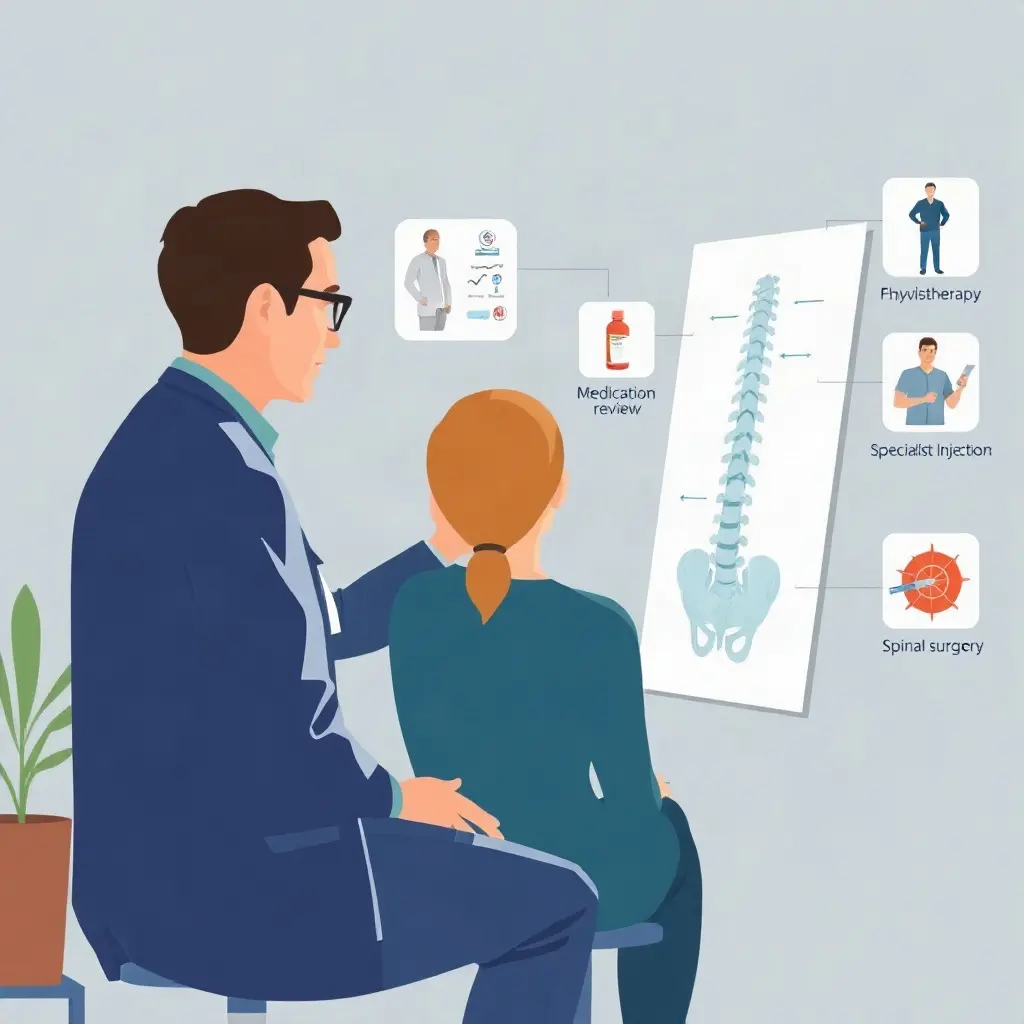
Risks vary with the injection and location, but can include temporary worsening, bleeding, infection, allergic reaction, nerve injury and medication-specific effects. Benefits may be temporary or absent, and repeated procedures require careful review. Private pain-management services illustrate the cost variation: LivingCare lists procedures from £1,100 at Thorpe Park Clinic in Leeds and Canon Medical Arena in Sheffield, although the final price depends on the procedure and consultation pathway 6. This is a published provider figure, not a general UK tariff.
4. Spinal surgery and specialist consultation
Surgery is usually reserved for carefully selected cases, such as particular nerve compression or structural disease where examination and imaging correspond with significant symptoms or neurological problems. It is not a routine first response to ordinary non-specific lower back pain. A spinal consultation normally reviews symptom history, strength, sensation, reflexes, movement and existing scans before discussing alternatives, expected recovery, complications and the possibility that non-surgical care remains more appropriate.
Possible surgical risks include infection, blood clots, anaesthetic complications, nerve damage, persistent symptoms and the need for further treatment. Recovery time and restrictions depend on the operation and general health. Private consultant reviews can add substantial cost before imaging or surgery is considered. NHS specialist referral normally starts through primary care or an appropriate community service, with urgency determined by clinical findings rather than a fixed timetable. A qualified spinal specialist should explain why surgery is being considered and what alternatives exist.
NHS access, private care and named UK services
In England, entry may begin with a GP, a first-contact physiotherapist or a community musculoskeletal service. Some areas allow self-referral to NHS physiotherapy, although routes differ locally. The NHS pathway can include assessment, exercise advice, physiotherapy, medication review and referral to a spinal or pain service when indicated. Newcastle Hospitals provides patient information on back problems, while Leicestershire Partnership NHS Trust publishes guidance on symptoms, activity and self-management 5 3.
Private care may offer a direct physiotherapy appointment or consultant assessment, but it does not automatically mean a different clinical recommendation. Published 2026 private physiotherapy estimates place initial assessments at £45 to £120 and follow-ups at £35 to £85, with London prices commonly higher than northern and Midlands figures 1 2. Named examples of specialist locations include Thorpe Park Clinic in Leeds and Canon Medical Arena in Sheffield, where a provider advertises consultant-led pain assessment and procedures 6. Prices, referral requirements and waiting times should be confirmed directly with the relevant service.
Warning signs, imaging and practical limits
Urgent assessment is required for new loss of bladder or bowel control, numbness around the inner thighs or genitals, altered sensation when wiping, increasing difficulty urinating or severe progressive neurological symptoms. Newcastle Hospitals describes these as warning signs of possible cauda equina syndrome and advises attendance at the nearest accident and emergency department 3. Severe symptoms after major injury, fever or signs of serious illness also need prompt clinical attention rather than routine rehabilitation.
MRI, X-ray or CT is not automatically required for every lower back pain episode. Imaging can show age-related changes that are not responsible for symptoms, and an abnormal scan does not by itself determine treatment. It is generally considered when the result could change management, when symptoms persist despite appropriate care or when specific warning signs are present. Treatment choices should therefore follow a qualified professional’s assessment, with discussion of likely limitations, side effects, alternatives, costs and the practical effect on daily activities.
Sources
- Back Pain Physio Cost UK 2026: Private Rehab vs NHS Route | TreatCompare: https://www.treatcompare.com/articles/back-pain-physio-cost-uk
- Physio Fees by Region and Through Insurance: A UK Breakdown | TreatCompare: https://www.treatcompare.com/articles/private-physiotherapy-cost-uk
- Back problems - Newcastle Hospitals NHS Foundation Trust: https://www.newcastle-hospitals.nhs.uk/services/newcastle-occupational-health-service/information-for-staff/physiotherapy/self-help-leaflets/back-problems/
- Low back pain and sciatica in over 16s: assessment and ... - NICE: https://www.nice.org.uk/guidance/ng59
- Back Pain - Leicestershire Partnership NHS Trust: https://www.leicspart.nhs.uk/msk-physiotherapy-resources-getting-started/spinal/back/
- Lower Back Pain Treatment - The LivingCare Group: https://www.livingcare.co.uk/treatments/lower-back-pain-treatment