A guide to tooth replacement pricing and availability: UK costs, options and access
Tooth replacement pricing and availability vary according to the number of missing teeth, the treatment setting, materials, clinical complexity and local access. This guide compares the main replacement options in the UK, explains what published price ranges usually include, and identifies practical factors that can change eligibility, timing and long-term maintenance.
How UK dental charges are structured
In England, NHS dental treatment is organised into three fixed-price bands rather than a separate charge for every procedure. Band 3 covers complex treatment such as crowns, bridges and dentures, while the applicable charge depends on the course of treatment rather than the number of individual restorations. 1 NHS availability is not uniform, however, because practices determine which services they provide and whether they are accepting patients for particular forms of care. 10
Private dentistry uses practice-set fees, so two consultations for apparently similar tooth loss can produce different estimates. Private pricing reflects clinical planning, laboratory work, materials, imaging, the dentist's experience and regional operating costs. Comparisons are therefore meaningful only when each quotation states whether examinations, scans, temporary teeth, surgery, laboratory fees and follow-up appointments are included. 9
Dental implants: higher initial treatment complexity
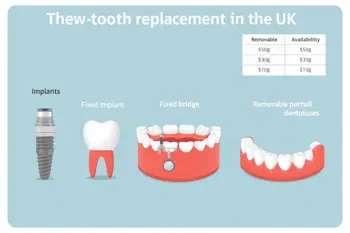
A private dental implant in the UK typically ranges from £2,000 to £3,500 per tooth, depending on surgical complexity and the restoration selected. 2 An implant replaces the tooth root with a post placed in the jaw, followed by an abutment and visible crown. The treatment can require several stages, including assessment, imaging, surgery, healing and fitting of the final restoration.
Eligibility depends on oral and general health, gum stability and sufficient jawbone to support the implant. The Oral Health Foundation notes that inadequate bone density may affect suitability and can lead to procedures such as bone grafting or a sinus lift. 5 These preparatory procedures may add approximately £500 to £1,000 to the overall cost. 5 Smoking, untreated gum disease and inconsistent maintenance can also create clinical risks that should be discussed during assessment.
Bridges as a fixed alternative
A dental bridge replaces a missing tooth or teeth by attaching an artificial tooth to supporting crowns or other structures. Private UK estimates commonly range from £500 to £1,500 per unit, with the material and complexity influencing the final fee. 3 Porcelain and ceramic options may be selected for appearance, while the design depends on the location of the gap, bite forces and condition of the supporting teeth.
Unlike an implant, a conventional bridge does not require implant surgery and is generally completed over a shorter treatment period. Its central limitation is that neighbouring teeth may need preparation to support the restoration. 8 A dentist must therefore assess whether those teeth are structurally sound, whether the gums are healthy and whether the proposed bridge can be cleaned effectively. Future repairs or replacement should also be considered when comparing the initial quotation.
Partial and full dentures
Partial or full dentures are removable appliances that replace several teeth or an entire arch. Private UK prices generally range from £400 to £1,500 per arch, depending on the design, materials and number of teeth being replaced. 4 Partial dentures may use acrylic or metal frameworks, while full dentures rest on the gums and replace all teeth in the upper or lower arch.
Dentures usually avoid implant surgery and can address extensive tooth loss, but they require adaptation, cleaning and periodic review. Fit may change as the shape of the supporting gum and bone changes, and adjustments or replacement may become necessary. 4 Dentures do not reproduce a natural tooth root, so the treatment plan should address stability, chewing, speech, appearance and the patient's ability to remove and maintain the appliance.
Availability, waiting times and regional access
Tooth replacement services are available through NHS and private dental settings across the UK, but access differs by location, provider capacity and treatment type. The Care Quality Commission identifies variation in access to dental services, particularly where practices have limited capacity or where patients require more specialised care. 10 Private clinics generally offer more scheduling flexibility, whereas NHS care depends on whether the required treatment is commissioned and available through the practice.
Digital dentistry has changed how some clinics plan and manufacture restorations. Intraoral scanning and computer-aided design and manufacturing can support more efficient workflows for crowns, bridges and other prostheses, although availability depends on the clinic's equipment and laboratory arrangements. 7 Digital processes do not remove the need for diagnosis, clinical examination or healing time when surgery is involved. Treatment speed should therefore be confirmed as a proposed timeline, not assumed from the technology used.
Comparing the total treatment commitment
Initial price alone does not describe the full financial or clinical commitment. An implant may involve surgery, imaging, bone augmentation and staged appointments; a bridge may involve preparation of supporting teeth; and a denture may require adjustments as fit changes. 8 A written plan should identify the proposed restoration, materials, temporary replacement, expected review schedule, exclusions and circumstances that could create additional charges.
Some private clinics offer staged payment or 0% finance arrangements for major restorative treatment, but the terms, eligibility criteria and total repayment obligations require careful review. 6 NHS and private care also differ in charging structures, appointment access and the scope of treatment available. 9 A clinically suitable option should be judged against oral health, bone condition, durability, maintenance requirements and personal tolerance for removable or surgical treatment, rather than price alone.
Questions that clarify a treatment estimate
A consultation and appropriate imaging are needed before a dentist can confirm suitability. The assessment should establish how many teeth are missing, the condition of neighbouring teeth, gum health, bone volume, bite forces and whether infection or extraction is present. 5 These factors explain why published ranges are useful for orientation but cannot function as a personalised quote.
Patients can ask whether the estimate includes consultation, radiographs or three-dimensional scans, extractions, grafting, temporary teeth, laboratory charges, the final crown or denture, adjustments and aftercare. They can also ask who will provide each stage, how long healing may take and what maintenance is expected. Comparing complete treatment plans rather than isolated headline fees gives a clearer view of availability, risk and likely long-term obligations.
Sources
- NHS, Understanding NHS dental charges
- Bupa, Dental implant costs
- Private Health UK, Dental bridge costs
- Denplan, Dentures
- Oral Health Foundation, Dental implants
- Dental Finance, Patient finance information
- British Dental Association, Dentistry and you
- Which?, Dental treatments explained
- MoneyHelper, NHS versus private healthcare costs
- Care Quality Commission, Dental services