Unclaimed Gold Jewelry at Police Auctions in Ontario: A Consumer Guide to Process, Pricing and Risk
Key facts
- Ontario police-related auctions may include jewellery, but each item depends on an authority’s disposal process and auction terms.1
- A February 2026 Toronto guide placed the melt value of 14-karat gold at approximately CAD $72 to $75 per gram.2
- Police-related auction purchases can involve HST, collection deadlines and sales made without testing or guarantees.34
- Gold value depends on karat, weight, gemstones, workmanship, condition and buyer demand rather than weight alone.
Unclaimed gold jewelry at police auctions in Ontario is not a single permanent marketplace or guaranteed source of inventory. Jewelry may appear through a police service’s own auction system or an authorized auction provider, but the authority, item history, description and sale conditions require separate verification. Ontario examples show that police auction systems can change: Timmins Police Service announced a dedicated online platform for items including jewellery, tools, electronics and bicycles in 2026.1
What “unclaimed” means in Ontario
“Unclaimed” is an administrative description, not an independent guarantee of ownership history, gold content or value. Property may have been found, seized, recovered or held for another reason, and the legal route for disposal can differ according to that reason. Ontario reporting on Peterborough explains that the Community Safety and Policing Act permits certain qualifying property to be sold, with a police service board able to direct proceeds toward a public-interest purpose.5
That process does not mean every item held by a police service can immediately be offered to the public. A legitimate notice should identify the responsible police service or authorized operator, the auction terms, payment requirements, collection arrangements and any available description. A listing that uses police imagery but does not connect back to an official police website or clearly identified auction provider deserves additional scrutiny.
Where Ontario police auctions are found
Ontario has no single province-wide auction catalogue for all police property. A 2026 overview reported that Police Auctions Canada handled property associated with York, Waterloo and Hamilton police services, while individual services may use their own websites or other authorized providers.3 The Timmins announcement also illustrates a separate municipal approach, with auction access placed through the service’s website rather than a social-media page.1
The safest starting point is the police service’s official website, usually under headings such as online auctions, unclaimed property, public notices or recovered property. The operator name should match the official notice, and the terms should be read before registration. Search results, social-media advertisements and third-party directories can identify possibilities, but they should not substitute for confirmation from the relevant public authority.
How bidding and collection generally work
Online police-related auctions commonly require account registration, acceptance of sale terms and bidding during a stated closing period. Timmins Police Service said its planned 2026 auction would post items for a defined period and could reject registrations where there was an apparent intention not to pay.1 The practical requirements therefore include accurate contact details, a valid payment method and the ability to meet the stated collection rules.
The winning bid is only one part of the final cost. HST, buyer charges, handling, delivery or travel may apply, depending on the operator. One 2026 overview reported that Police Auctions Canada charged no buyer’s premium, added HST and gave successful bidders seven days to pay and collect, but those terms should not be assumed to apply elsewhere.3 Government auction guidance also describes sales as “as is, where is,” with collection arranged by the purchaser.6
Gold jewelry types and valuation factors
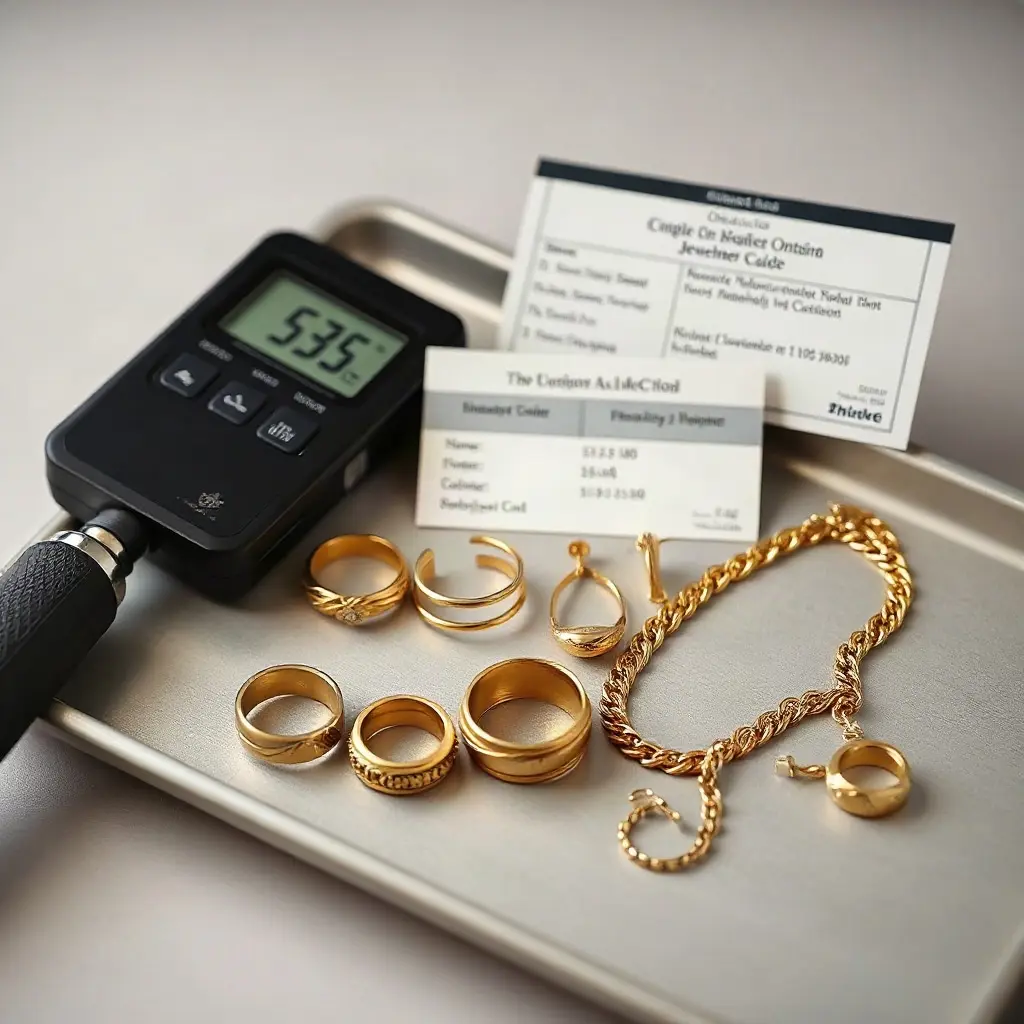
Potential jewelry categories include rings, chains, bracelets, earrings, pendants and watches containing gold components. The first comparison is karat or fineness. A 14K mark indicates that approximately 58.5% of the metal is gold, while 10K represents approximately 41.7%, according to a Canadian 2026 gold valuation guide.7 Marks can help, but they do not establish total weight, condition or authenticity by themselves.
Gold value is commonly separated into metal value and jewelry value. A Toronto guide reported a February 2026 gold price near CAD $3,850 per troy ounce and estimated approximately CAD $72 to $75 in melt value for one gram of 14K gold.2 A five-gram 14K ring was used in that guide as an example with melt value close to CAD $360, before any buyer’s margin, gemstones, repairs or design considerations.2
Inspection, authenticity and condition
Before bidding, the useful specifications are the karat mark, fineness, gross weight, dimensions, gemstone details and photographs of clasps, settings and damage. The description should distinguish solid gold from plated, filled or merely gold-coloured construction. Hollow chains, missing stones, stretched links, worn prongs and altered sizing can materially change the practical value even when the hallmark appears credible.
Inspection rights vary, and some public auctions provide limited information or no testing. A professional jeweller or qualified appraiser can examine metal purity, gemstones, repairs and structural condition when the item is important or the description is incomplete. The cost of that assessment should be included in the maximum total budget. A hallmark is useful evidence, but an independent examination is stronger than relying on a photograph or short description.
Risks, remedies and a sensible bidding limit
Police-related auction jewelry may have limited provenance, no return right and no guarantee that an item will meet a buyer’s assumptions. The Winnipeg Police Service’s published auction information provides a clear example of the risk language used for unclaimed goods: items are sold as is, without testing or guarantees, and sales are final.4 Ontario terms may differ, but similar wording should be treated as a material condition rather than fine print.
A disciplined comparison starts with verified gold content multiplied by a realistic market reference, then adjusts for gemstones, design, condition, taxes, charges and collection costs. It also accounts for the possibility that the item is difficult to resell or needs repair. If the provenance, purity, weight or return position is unclear, the appropriate response is to reduce the maximum bid or decline the transaction, rather than assume the police connection creates special value.
Sources
- Timmins Police announce new online auction platform | The Daily Press: https://www.timminspress.com/news/timmins-police-announce-new-online-auction-platform
- What Is My Gold Jewelry Worth? Toronto 2026 Prices | GoldAgo: https://www.goldago.com/blog/what-is-my-gold-jewelry-worth-toronto/
- Police Auctions in Canada by Province (2026): Where Seized and Unclaimed Property Is Sold | GovAuctions.app: https://govauctions.app/ca/guides/police-auctions-canada-by-province
- Winnipeg Police Service Unclaimed Goods Auction | City of Winnipeg: https://www.winnipeg.ca/police/community/news-releases/2026-10-07-winnipeg-police-service-unclaimed-goods-auction
- How Police Auction Money Finds Its Way Back Into the Community — PtboCanada: https://www.ptbocanada.com/journal/how-police-auction-money-finds-its-way-back-into-the-community
- Canadian Government Surplus Auctions Explained (2026): How They Work | GovAuctions.app: https://govauctions.app/ca/guides/canadian-government-surplus-auctions-explained
- How to Sell Gold Jewelry for Cash in Canada (2026 Guide): https://goldstockcanada.com/blog/how-to-sell-gold-jewelry-for-cash-in-canada-and-get-the-best-price-in-2026