Inspecting ex-government chassis cab trucks: tips for potential buyers in 2026 | UK condition, legality and alternatives
Key facts
- Ex-government fleet history can improve maintenance visibility, but it does not guarantee sound mechanical condition or careful loading.
- A 3.5-tonne commercial vehicle includes the vehicle, fuel, driver, passengers and cargo within its gross vehicle weight limit.
- Published 2026 reference prices put the Ford Transit from £43,085 excluding VAT and the Mercedes-Benz Sprinter from £49,190 excluding VAT.
- Operating a goods vehicle above 3.5 tonnes for business generally involves operator licensing and tachograph requirements.
Inspecting an ex-government chassis cab truck in 2026 requires more than checking its paintwork or starting the engine. The cab and frame, the separately fitted body, the maintenance trail, legal weights, emissions status and likely repair costs all affect whether a former public-sector vehicle suits its intended work.
What ex-government history can and cannot tell a buyer
Public-sector vehicles may have served councils, utilities, emergency services, defence departments or other operational fleets. A structured fleet can produce service records, inspection notes and predictable replacement patterns, which make the vehicle’s past easier to investigate. However, government ownership is not a quality certificate. Use may have involved short journeys, prolonged idling, towing, heavy equipment, repeated cold starts or work on salted roads.
The phrase “ex-government” also covers very different disposal routes. A maintained municipal dropside and a specialist operational truck may have completely different wear patterns. A vehicle biography should therefore include the department or fleet type, recorded mileage, dates of maintenance, body changes, accident entries and the reason for disposal. Auction guidance also advises comparing mileage with service records, annual testing, plating, tyres, brakes, emissions information and the V5C document 1.
Frame, cab and body inspection
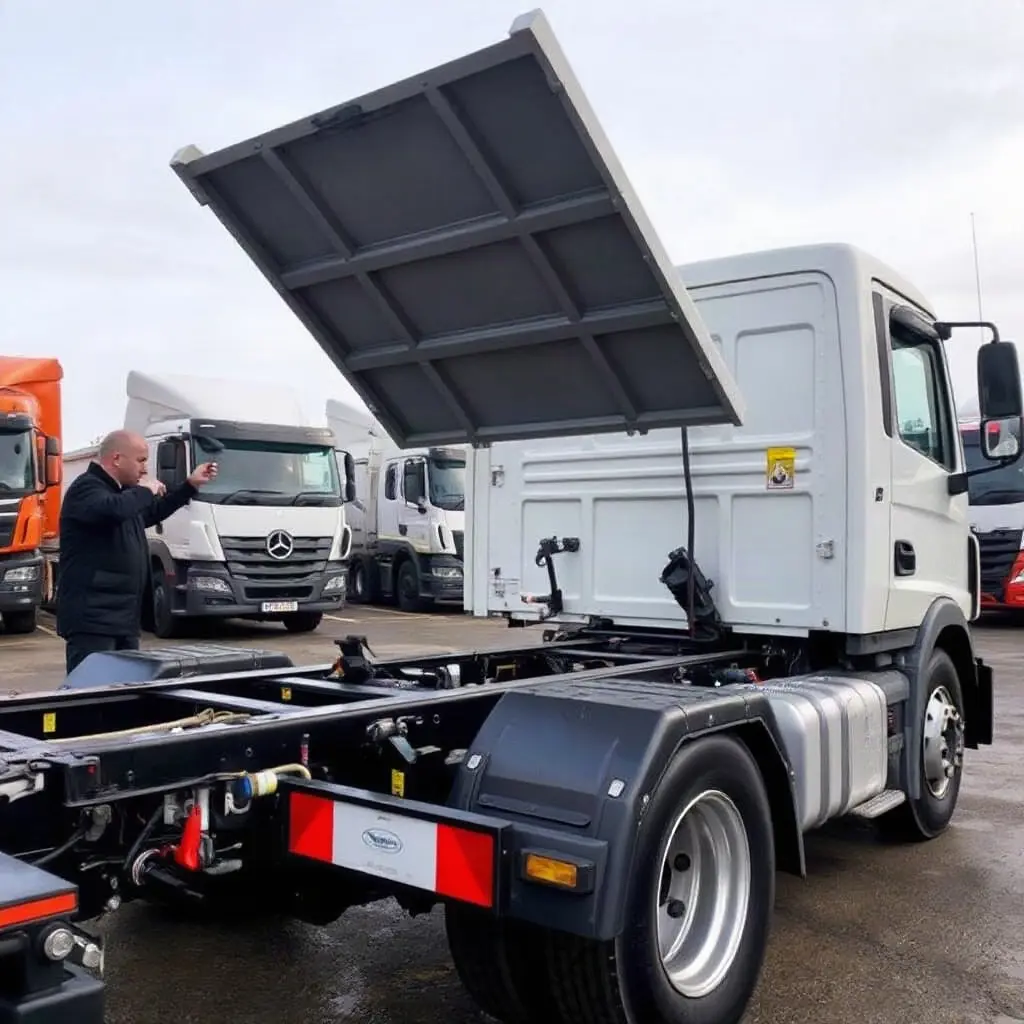
Start underneath, using a torch and, ideally, a qualified commercial-vehicle inspector. Examine chassis rails, cross-members, suspension hangers, spring seats, steering mounts and body mounting points for deep corrosion, cracks, distortion, fresh underseal or badly repaired welds. Surface rust on an outer panel is mainly cosmetic, while corrosion around structural members can affect safety and roadworthiness. Check that the chassis identification marking is legible and matches the paperwork.
Inspect the cab for uneven panel gaps, water ingress, damaged floor sections, worn seat bases and evidence of equipment removal. On the rear body, examine the floor, sideboards, hinges, locks, ramps, hydraulic components, subframe, lights and electrical plugs separately from the cab and chassis. A body conversion may be older, heavier or less valuable than the base vehicle. Confirm that body mounting is secure and that added tools, tanks or storage do not create an axle overload.
Engine, gearbox, brakes and suspension
Before starting, look for oil or coolant leaks, damaged hoses, neglected wiring and excessive soot around the exhaust system. A cold start is more informative than an engine already warmed by the seller. Listen for unusual rattles, observe smoke, check warning lights and allow enough time for the engine to reach normal temperature. A short drive cannot rule out injector, turbocharger, clutch, automatic gearbox, emissions-system or cooling-system problems, so a diagnostic scan and specialist inspection are appropriate for expensive commercial vehicles.
During the road test, assess clutch take-up, gear selection, steering play, braking stability, suspension noise and drivetrain vibration. Check brake discs, drums, pipes and air systems where fitted, together with tyre age, tread, sidewall damage and matching axle specifications. Repeated heavy loading may leave sagging springs, uneven tyre wear, worn kingpins or stressed wheel bearings. Idling history can be difficult to prove visually, but service intervals, engine-hours records and maintenance notes may reveal intensive stationary operation.
Records, identity and roadworthiness
Request the V5C, identification numbers, disposal paperwork, service invoices, inspection sheets, repair orders and details of every body or electrical modification. Compare the recorded mileage across documents rather than relying on one dashboard reading. The MOT history can show recurring advisories, corrosion, brake defects, tyre problems and mileage patterns, but it does not replace a mechanical examination. Recorded damage, outstanding recalls and discrepancies in keeper or body details should be resolved before any commitment.
Check whether the truck is already registered for UK roads and whether its taxation, MOT status and emissions classification suit the intended area of operation. Some military vehicles have not previously been registered for UK roads and may require first registration, an MOT and possibly an inspection before lawful road use 2. Clean-air-zone rules vary by location, so the exact registration number, Euro standard and route should be checked against official local requirements rather than inferred from appearance or model year.
Weights, payload and licence implications
A chassis cab’s permitted gross vehicle weight is not the same as its usable payload. Payload is reduced by the body, fuel, driver, passengers, tools, water tanks and conversion equipment. The completed vehicle must remain within its gross limit and each axle limit, with sensible weight distribution. A truck that appears large may have little practical capacity after a heavy tipper, recovery body or utility fit-out is installed.
For context, a 3.5-tonne van means a maximum combined weight of 3,500kg, including the vehicle, driver, fuel and cargo; published guidance places typical payloads across this class at roughly 700kg to 1,600kg, depending on specification 3. Above that threshold, licence category, operator licensing, tachograph use, driver-hours rules and heavier-vehicle compliance can apply. Confirm the plated weights, train weight, towing limit and intended body specification with the manufacturer or an authorised commercial-vehicle specialist.
Comparing newer chassis-cab alternatives
Ford Transit, Mercedes-Benz Sprinter, Iveco Daily and Isuzu N-Series models represent different approaches to the same work. A Transit offers a broad choice of wheelbases, body styles and powertrains, while a Sprinter is available in rear-wheel-drive configurations and several weight classes. The Iveco Daily is commonly considered where a truck-like chassis and higher weight ratings matter, while Isuzu N-Series vehicles are oriented toward compact distribution and utility work. Exact payload, axle, towing and safety equipment depend on the derivative.
Published 2026 reference figures provide useful new-vehicle context rather than values for used ex-government trucks. The Ford Transit is listed from £43,085 excluding VAT, while a Mercedes-Benz Sprinter starts at £49,190 excluding VAT in a basic rear-wheel-drive configuration 4 5. A newer vehicle may bring clearer specifications, newer safety systems and lower initial repair risk, but depreciation, taxation, servicing, tyres, commercial insurance and downtime still need to be modelled against the older truck’s condition.
| Comparison point | Ex-government chassis cab | Newer commercial alternative |
|---|---|---|
| History | May have detailed fleet records, but use intensity can vary | Known specification and warranty framework |
| Payload | Must be weighed after body and equipment are assessed | Factory data is clearer, but options alter kerb weight |
| Costs | Lower purchase reference may be offset by repairs and downtime | Higher acquisition cost with more predictable early maintenance |
When to proceed and when to walk away
An independent inspection is particularly important when the truck has structural corrosion, specialist hydraulics, an unusual body, incomplete records or a long period off the road. Budget for an initial service, fluids, filters, tyres, brakes, batteries, remedial welding and body repairs where condition suggests they may be required. Commercial insurance pricing depends on vehicle weight, use, driver history, location, security and body type, so it should be established before assessing total ownership cost.
Serious warning signs include mismatched identification numbers, unexplained mileage changes, unresolved structural corrosion, axle weights that do not suit the planned body, persistent warning lights, contaminated fluids, unstable braking, unsafe wiring and missing legal documents. A truck can be mechanically repairable yet unsuitable for a particular licence, clean-air route, payload or towing requirement. Walking away is rational when the cost and compliance uncertainty cannot be measured with confidence.
Sources
- Buying HGVs and Trucks at Auction in the UK — Universal Auction Group: https://www.universalauctionsgroup.com/articles/buying-hgvs-and-trucks-at-auction-in-the-uk
- How to Buy Ex-MoD & Ex-Government Vehicles in the UK (2026) | GovAuctions.app: https://govauctions.app/uk/guides/how-to-buy-ex-mod-government-vehicles-uk
- What is a 3.5 Tonne Van? Licences, Payload & Which to Buy: https://www.diesels.co.uk/3-5-tonne-van/
- Best large panel vans 2026 | Auto Express: https://www.autoexpress.co.uk/best/large-panel-vans
- Buy Mercedes-Benz Sprinter Price, PPC or HP | Top Gear: https://www.topgear.com/car-reviews/mercedes-benz/sprinter/buying