NHS urgent care access: Identifying local services and when to use them: A Guide to Navigating UK Healthcare Pathways
Key facts
- NHS 111 provides 24/7 assessment and can direct patients to the most appropriate local care service 1 2.
- Urgent Treatment Centres (UTCs) treat non-life-threatening illnesses and injuries, often operating from 8am to 8pm, seven days a week 3 4.
- Emergency Departments (A&E) are reserved for life-threatening conditions such as severe chest pain, major trauma, or loss of consciousness 3 1.
- Primary care services, including GP practices and pharmacies, remain the appropriate first point of contact for routine health issues and repeat prescriptions 3.
Navigating the National Health Service (NHS) for urgent medical attention requires an understanding of the distinct tiers of care available. When a health concern arises that is not an emergency but requires prompt medical attention, patients have several pathways available beyond the traditional Emergency Department. The system is structured to ensure that individuals receive the right level of care at the right time, helping to maintain the capacity of emergency services for those in critical, life-threatening situations 1 5.
Understanding the Tiers of Urgent and Emergency Care
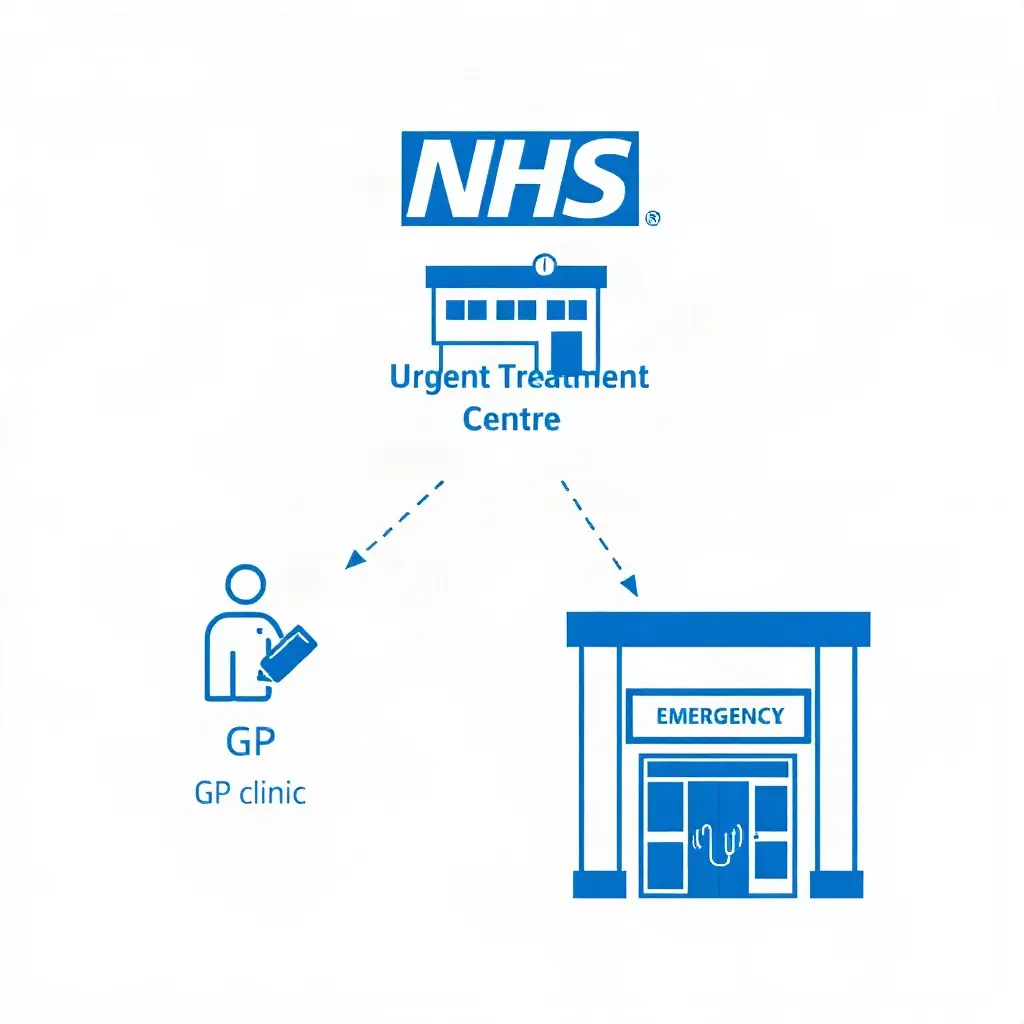
The NHS categorises medical care based on the severity and nature of the condition. Primary care, delivered by General Practitioner (GP) practices and pharmacies, is the foundation of the health service, managing long-term conditions and minor, non-urgent illnesses 3. For issues that fall between routine primary care and life-threatening emergencies, Urgent Treatment Centres (UTCs) and Minor Injuries Units (MIUs) serve as essential bridge facilities. These units are staffed by experienced clinicians and are equipped to diagnose and treat a wide range of common ailments 3.
Emergency Departments, commonly referred to as A&E, exist specifically to handle serious or life-threatening medical crises 1. Attendance at an A&E department does not guarantee a shorter waiting time for minor issues; patients are assessed by triage nurses upon arrival, and those with the most critical conditions are prioritized regardless of their arrival time 2. Because up to one in five patients attending A&E could potentially be treated by alternative services, understanding these service boundaries is vital for both patient outcomes and systemic efficiency 5.
When to Use Urgent Treatment Centres vs. A&E
Urgent Treatment Centres are appropriate for conditions that require same-day attention but do not pose an immediate threat to life 3. These facilities typically treat patients aged two years and older for issues including suspected fractures, minor burns, cuts, skin infections, and sudden illnesses that cannot wait for a routine GP appointment 3 4. Many UTCs operate with extended hours, frequently offering walk-in services or booked appointments between 8am and 8pm 4.
Conversely, the Emergency Department must be reserved for acute crises. Clinical guidelines specify that individuals should seek emergency care for symptoms such as persistent, severe chest pain, difficulty breathing, signs of a stroke (such as facial drooping or slurred speech), uncontrolled heavy bleeding, loss of consciousness, or major trauma 1 5 2. If a condition is ambiguous, calling 999 or visiting an A&E department immediately is the standard protocol for suspected life-threatening situations 3 6.
The Role of NHS 111 in Navigating Services
NHS 111 acts as the primary navigational tool for individuals unsure of which service they require. Accessible 24/7 via telephone or the NHS 111 online portal, this service provides symptom assessment conducted by trained advisors and clinicians 7 1. Beyond providing medical advice, NHS 111 can book arrival times at specific Urgent Treatment Centres or Emergency Departments and arrange urgent out-of-hours GP appointments if the assessment deems it necessary 1 2.
The shift toward digital triage has expanded, with an increasing number of residents utilizing the NHS 111 online service as an alternative to telephone calls 7. This service is designed to direct individuals to the most appropriate healthcare setting based on local capacity, ensuring that patients receive timely care while reducing unnecessary footfall in crowded emergency departments 1.
Identifying Local Services
Locating the nearest facility depends on the patient's specific geographic location and the availability of local Integrated Care Board (ICB) resources. Local health authority websites provide service finders that list nearby hospitals with A&E departments and the locations of local Urgent Treatment Centres 1 2. Information regarding specific hospital trusts, such as the Norfolk and Norwich University Hospital or Basildon University Hospital, is maintained on official NHS platforms to help residents understand their local network of care 1 2.
It is important to note that while services share a national identity, the specific configuration of urgent care sites can evolve, with recent investments targeting the expansion of UTC capacity and the addition of new assessment units 8 9. Residents are encouraged to verify the opening times and service scope of their nearest units through official NHS digital resources before traveling 1.
Preparation and Clinical Consultation
When preparing to seek urgent medical assistance, patients should have relevant information ready to assist triage staff, including current medications, known allergies, and a clear summary of symptoms, including when they began 3. For those caring for children, specialized resources like childhood illness applications are sometimes provided by local health services to assist in managing minor ailments at home while guiding parents on when professional intervention is required 5.
A qualified healthcare professional should always be the final authority on an individual’s medical care. While public health information provides general guidance on where to go, specific health concerns must be evaluated by a medical practitioner to ensure proper diagnosis and safety 10.
Sources
- Urgent and emergency care - Norfolk & Suffolk ICB: https://www.norfolkandsuffolk.icb.nhs.uk/health/care-support/emergency-care/
- Urgent and emergency care in south west Essex - NHS Essex Integrated Care Board: https://www.essex.icb.nhs.uk/area/south-west-essex/urgent-care-south-west-essex-nhs-111-ae-and-emergency-help/
- Urgent Treatment and Minor Injury Units - NHS Essex Integrated Care Board: https://www.essex.icb.nhs.uk/health/support/urgent-treatment-and-minor-injury-units/
- Please think which service you need this Winter – Royal Primary Care: https://www.royalprimarycare.nhs.uk/please-think-which-service-you-need-this-winter/
- Should I go to A&E - do you really need to come in to hospital?: https://www.mse.nhs.uk/should-i-go-to-ae
- How to manage some common Injuries and Illnesses - NHSGGC: https://www.nhsggc.scot/your-health/right-care-right-place/how-to-manage-some-common-conditions/
- Urgent and emergency care - Care Quality Commission: https://www.cqc.org.uk/publications/major-report/state-care/2025-2026/secondary/uec
- £140 million boost to urgent care to ease winter pressures on NHS - GOV.UK: https://www.gov.uk/government/news/140-million-boost-to-urgent-care-to-ease-winter-pressures-on-nhs
- NHS England — South East » Expansion of Urgent Treatment Centres and Same Day Emergency Care across the South East to improve access and ease pressure on A&E: https://www.england.nhs.uk/south-east/2026/04/13/expansion-of-urgent-treatment-centres-and-same-day-emergency-care-across-the-south-east-to-improve-access-and-ease-pressure-on-ae/
- NHS key statistics: England: https://researchbriefings.files.parliament.uk/documents/CBP-7281/CBP-7281.pdf