Used tipper vans from government fleet auctions: UK buying process, costs and inspection risks
Key facts
- UK councils generally dispose of retired tippers through commercial auction houses rather than a single public auction website. 1
- Government fleet auction buyers commonly need to budget for a buyer’s premium, VAT and collection or transport costs. 1 2
- Used light commercial vehicle values averaged £8,569 in January 2026 across one major UK auction market. 3
- Ex-fleet assessment should compare mileage with service records, MOT history, finance checks and write-off records. 2
Used tipper vans from government fleet auctions are usually retired council, public-works or other institutional vehicles sold through commercial auction houses. The process is not a single national programme: disposal routes, bidder eligibility, inspection arrangements and fees vary between the public body, auctioneer and individual lot.
How UK government fleet auctions work
There is no single official UK government auction website for surplus vehicles. Councils commonly appoint commercial auctioneers or vehicle remarketing companies, with retired tippers, vans, gritters, sweepers, refuse vehicles and related machinery appearing under the auctioneer’s name rather than the council’s own website. 1 Police, defence and local-government disposals can therefore follow separate systems and contractual arrangements.
Most sales require online registration, identity checks and acceptance of auction terms before bidding. Some auctions are open to the general public, while others are aimed at registered professional traders or restrict particular lots. Timed online auctions normally publish photographs, descriptions, closing times and collection rules, but the catalogue remains a starting point rather than a mechanical inspection report. 2
What types of tipper vans appear
Public-sector fleets use several sizes of tipper. The lightest are typically 3.5-tonne chassis-cab vehicles used by parks, highways and grounds teams. Larger rigid tippers and dumpers may be used for road maintenance, construction materials, snow clearance or waste operations. Gross vehicle weight affects payload, taxation, licensing requirements and the type of work for which the vehicle is suitable.
Common market comparisons include Ford Transit tipper derivatives, Mercedes-Benz Sprinter chassis cabs, Iveco Daily models and Renault Master conversions. The useful comparison is not only the badge or cab trim, but also gross vehicle weight, payload, wheelbase, drive layout, cab seating, body dimensions and Euro emissions standard. Double-cab bodies can provide additional seats, while single-cab versions usually prioritise load-bed length and working payload.
| Comparison point | Why it matters |
|---|---|
| Gross vehicle weight | Determines operating limits, licensing implications and usable payload. |
| Engine and drive layout | Influences towing, gradients, fuel use and traction on building sites. |
| Cab seating | Single-cab and double-cab bodies suit different crew requirements. |
| Tipper body | Steel, alloy, body length and side height affect durability and carrying use. |
Typical costs beyond the hammer price
The final cost is not necessarily the winning bid. Auction terms may add a buyer’s premium, and many commercial vehicles are sold subject to VAT. A 2026 UK guide covering ex-council vehicles states that buyer’s premium and VAT commonly apply, with collection generally required within a few working days. 1 Another commercial-vehicle auction guide also identifies registration, buyer’s premium, VAT and transport or drive-away costs as core parts of the calculation. 2
Transport can be necessary when a van is non-running, lacks a valid MOT, has damaged bodywork or is not road legal. Additional ownership costs include road tax, servicing, tyres, hydraulic repairs, body refurbishment and compliance work. Auction charges differ by provider and lot, so the published conditions should be read before any bid is considered. A market reference point, rather than a tipper-specific valuation, is that used light commercial vehicles averaged £8,569 in January 2026 in one UK auction market. 3
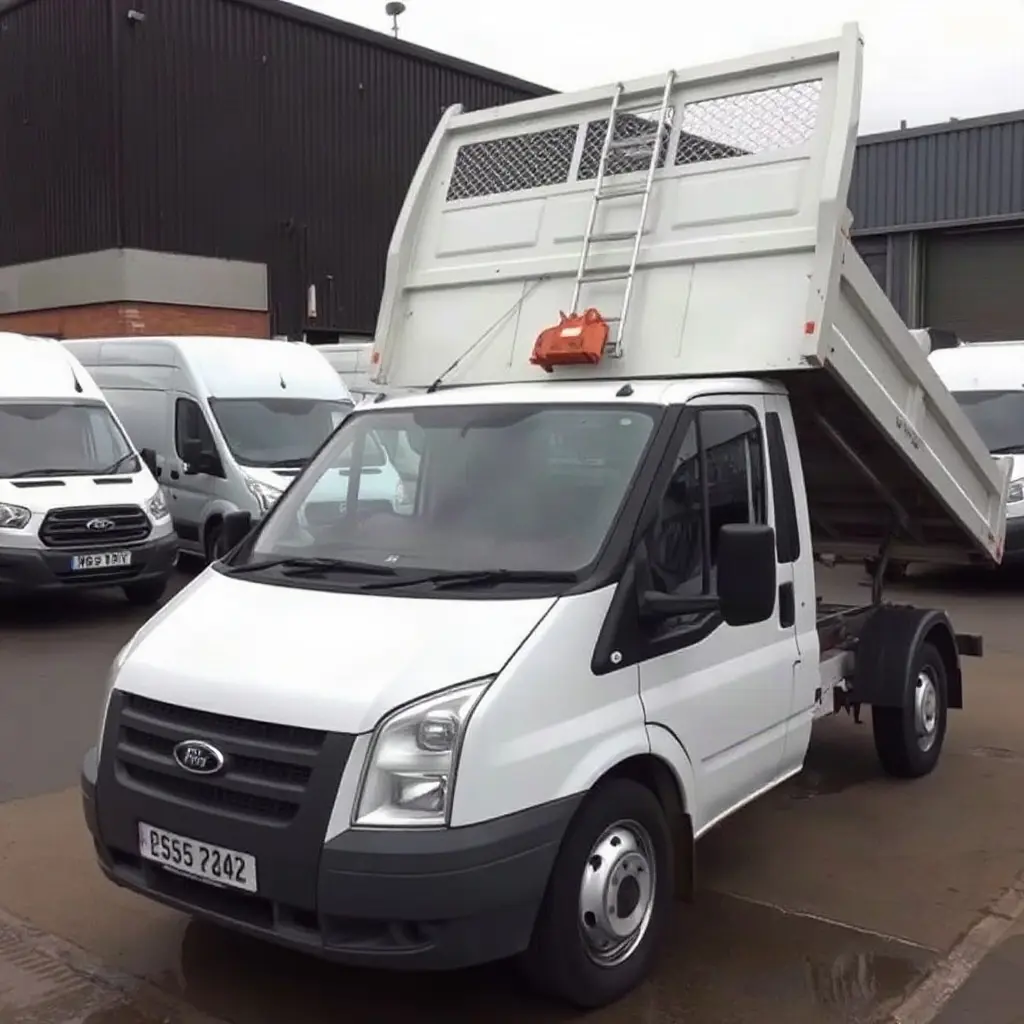
Inspection checklist for a used tipper
The hydraulic system deserves separate attention from the engine and cab. Inspect the hydraulic ram, pump, hoses, control valves, reservoir, subframe and mounting points for leaks, corrosion, distortion or fresh paint that could conceal repairs. Operate the body through a complete tipping cycle where the auction rules permit it, checking for jerky movement, unusual noise, slow lifting and failure to hold position.
Examine the chassis rails, crossmembers, body floor, hinges, tailgate, locking mechanisms and welds. Repeated loading and tipping can create fatigue around the subframe and mounting points, even when the cab appears presentable. Check tyre condition, brake performance, steering play, suspension, warning lights, clutch operation and evidence of accident repair. A mechanical inspection after purchase remains prudent because auction descriptions cannot replace a workshop assessment.
Documents, history and public-sector maintenance
Before bidding, the registration number should be checked against the V5C details, stated mileage, MOT history and service documentation. Auction guidance recommends comparing mileage with service records and MOT advisories, while also carrying out finance and write-off checks. 2 The vehicle’s classification, keeper history, tax position and recorded defects should match the catalogue description as closely as possible.
Public-sector vehicles may have structured, mileage-based maintenance schedules and a stronger paperwork trail than some privately operated commercial vehicles. That does not mean every ex-fleet tipper has been lightly used. Council vehicles can spend long periods on short routes, repeated starts, construction sites, winter gritting or heavily loaded work. Service records are therefore more informative than the government-fleet label alone, particularly when hydraulic servicing and body repairs are documented.
Bidding, collection and legal protection
A disciplined bidding process starts with a maximum total cost rather than a maximum hammer bid. That figure should include the buyer’s premium, VAT where applicable, transport, immediate servicing, tyres, hydraulic work and any inspection or registration expense. Timed auctions can encourage rapid bidding near the closing period, so the vehicle’s condition and total ownership cost should remain more important than competing bids.
Auction purchases normally provide fewer practical protections than buying from a registered commercial dealer, especially where vehicles are sold as described, for repair or without a warranty. The buyer must understand exclusions, collection deadlines and responsibility for loading. Public-sector provenance may help establish a maintenance trail, but it does not guarantee roadworthiness, legal compliance or mechanical reliability. A written record of the catalogue, photographs and inspection findings can help identify discrepancies after collection.
How to compare alternatives before bidding
A tipper is appropriate when loose materials must be unloaded quickly, but a dropside body with removable sides can offer greater flexibility for pallets and equipment. A panel van protects enclosed cargo, while a larger rigid tipper can carry more material but brings higher running, licensing and maintenance demands. The correct alternative depends on payload, site access, crew size, towing needs and the proportion of work performed off-road.
Market conditions also affect the comparison. UK used LCV values averaged £8,727 in March 2026 in another auction-market report, while vans under 70,000 miles and in stronger condition attracted the greatest professional-buyer interest in that market. 4 Those figures describe broad used-van activity rather than a guaranteed tipper valuation. Condition, body specification, payload rating, emissions standard and hydraulic serviceability can move a tipper’s value substantially in either direction.
Sources
- Ex-Council Vans, Mowers and Machinery Auctions in the UK (2026): Where They Sell and What to Check | GovAuctions.app: https://govauctions.app/uk/guides/ex-council-vans-and-machinery-uk
- Buying Commercial Vehicles and Ex-Fleet Vans at Auction: WhatTrade Buyers Need to Know — Universal Auction Group: https://www.universalauctionsgroup.com/articles/buying-commercial-vehicles-andex-fleet-vans-at-auction-whattrade-buyers-need-to-know
- Used van market sees values rise as buyers steer clear of buying new | Motor Trader: https://www.motortrader.com/motor-trader-news/automotive-news/used-van-market-sees-values-rise-as-buyers-steer-clear-of-buying-new-11-02-2026
- Used van demand strong at BCA and Manheim | Fleet remarketing: https://www.fleetnews.co.uk/news/used-van-demand-remains-strong-at-bca-and-manheim